Use the Leading Coefficient Test to determine the end behavior of the graph of the polynomial function.
Ch. 3 - Polynomial and Rational Functions

4장, 문제 19
Use the Leading Coefficient Test to determine the end behavior of the graph of the polynomial function.
검증된 단계별 안내1
Identify the degree of the polynomial function \(f(x) = 5x^3 + 7x^2 - x + 9\). The degree is the highest power of \(x\), which is 3 in this case.
Determine the leading coefficient, which is the coefficient of the term with the highest degree. Here, the leading coefficient is 5.
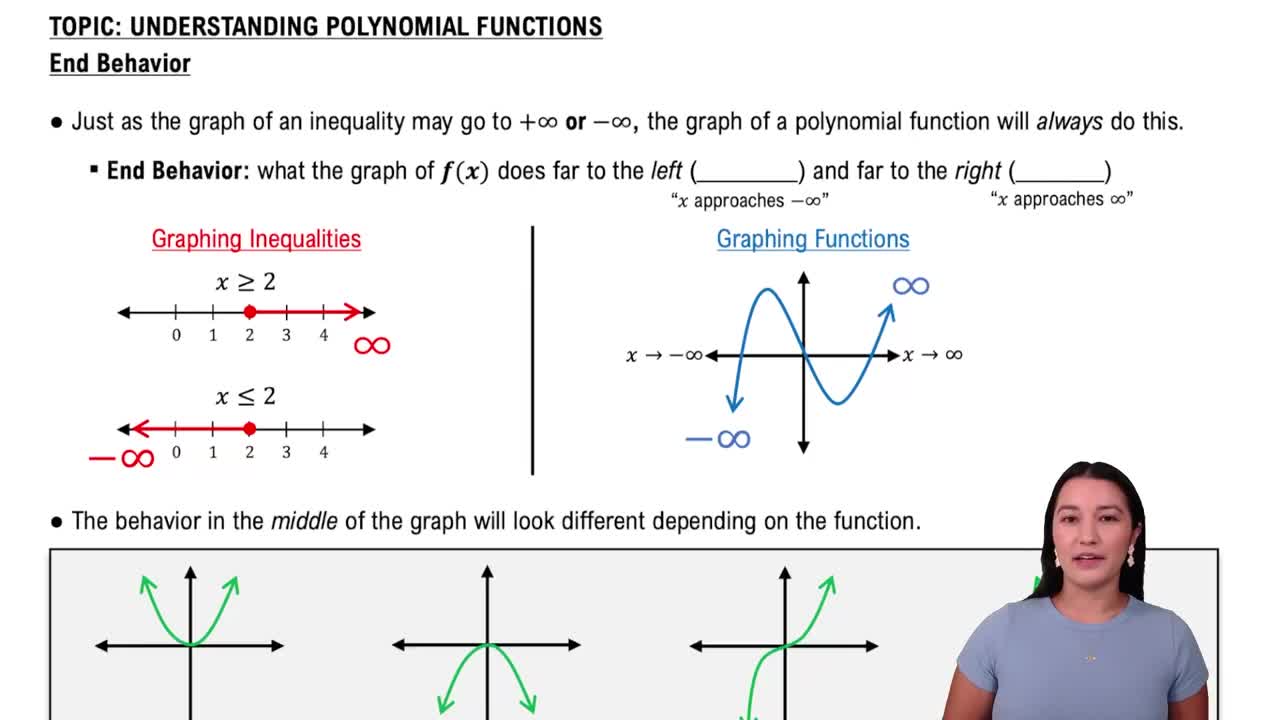
Recall the Leading Coefficient Test rules for end behavior: For an odd degree polynomial, if the leading coefficient is positive, as \(x \to \infty\), \(f(x) \to \infty\) and as \(x \to -\infty\), \(f(x) \to -\infty\).
Apply the test to this polynomial: Since the degree is 3 (odd) and the leading coefficient is 5 (positive), the graph will rise to the right and fall to the left.
Summarize the end behavior: As \(x\) approaches positive infinity, \(f(x)\) approaches positive infinity; as \(x\) approaches negative infinity, \(f(x)\) approaches negative infinity.

비슷한 문제에 대한 검증된 영상 답변:
이 영상 해법은 위 문제에 도움이 된다고 튜터들이 추천한 것입니다.
영상 길이:
1m도움이 되었나요?
주요 개념
질문에 올바르게 답하기 위해 반드시 이해해야 하는 핵심 개념들은 다음과 같습니다.
Polynomial Functions
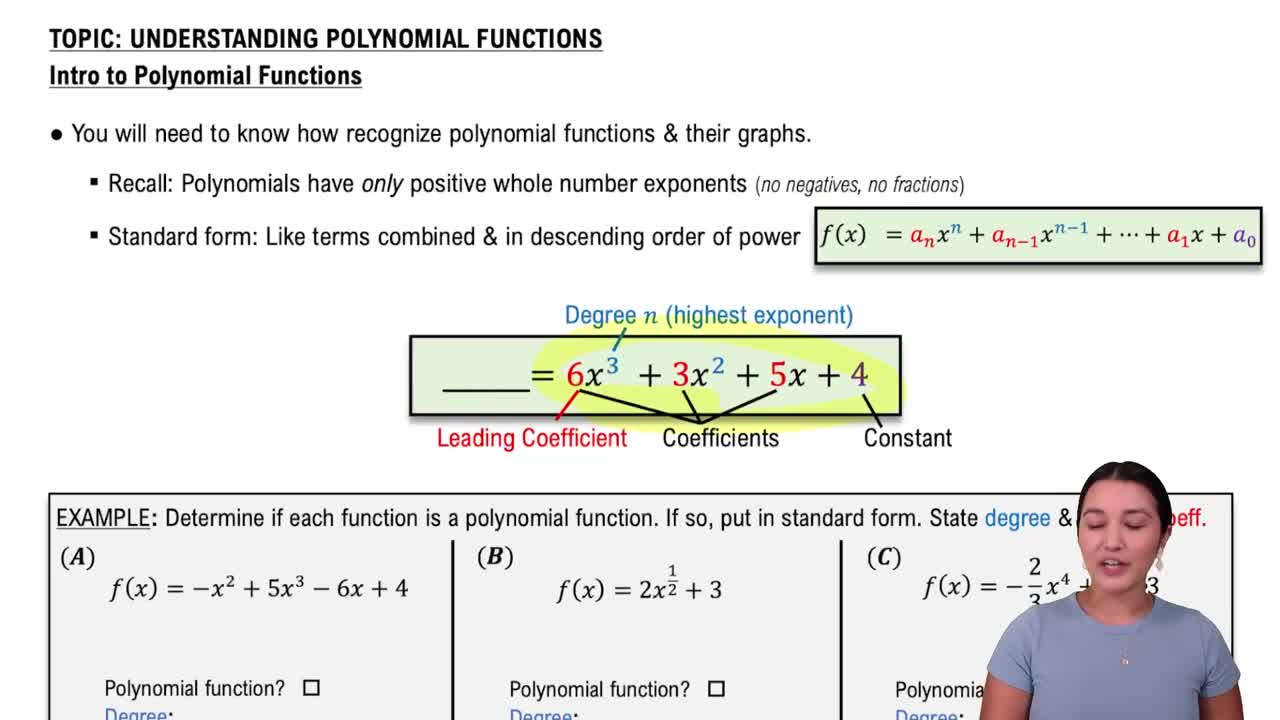
A polynomial function is an expression consisting of variables raised to whole-number exponents and coefficients, combined using addition, subtraction, and multiplication. Understanding the general form and degree of a polynomial helps in analyzing its graph and behavior.
추천 영상:
Introduction to Polynomial Functions
Leading Coefficient Test
The Leading Coefficient Test uses the degree and leading coefficient of a polynomial to determine the end behavior of its graph. Specifically, it predicts how the function behaves as x approaches positive or negative infinity based on whether the degree is even or odd and the sign of the leading coefficient.
추천 영상:
End Behavior of Polynomial Functions
End Behavior of Functions
End behavior describes how the values of a function behave as the input x becomes very large or very small. For polynomials, this is determined by the highest-degree term, which dominates the function's growth or decline at the extremes of the x-axis.
추천 영상:
End Behavior of Polynomial Functions
관련 실천
교과서 질문
660
views
교과서 질문
Use the graph of the rational function in the figure shown to complete each statement in Exercises 15–20.
As _____
619
views
교과서 질문
Divide using synthetic division. (3x2+7x−20)÷(x+5)
563
views
교과서 질문
Solve each polynomial inequality in Exercises 1–42 and graph the solution set on a real number line. Express each solution set in interval notation.
639
views
교과서 질문
In Exercises 17–24, a) List all possible rational roots. b) List all possible rational roots. c) Use the quotient from part (b) to find the remaining roots and solve the equation. x3−10x−12=0
863
views
교과서 질문
Use the vertex and intercepts to sketch the graph of each quadratic function. Give the equation of the parabola's axis of symmetry. Use the graph to determine the function's domain and range. f(x)=(x−1)2+2
838
views