Ch. 3 - Polynomial and Rational Functions
Blitzer - College Algebra 8th Edition
Blitzer8th EditionCollege AlgebraISBN: 9780136970514당신이 사용하는 게 아니라요?교과서 변경
4장, 문제 24

In Exercises 19–24, use the Leading Coefficient Test to determine the end behavior of the graph of the polynomial function. f(x)=11x46x2+x+3f(x)=−11x^4−6x^2+x+3

검증된 단계별 안내
1
Identify the leading term of the polynomial function. The leading term is the term with the highest power of x, which in this case is 11x4.
Determine the degree of the polynomial, which is the exponent of the leading term. Here, the degree is 4, an even number.
Look at the leading coefficient, which is the coefficient of the leading term. In this function, the leading coefficient is -11, a negative number.
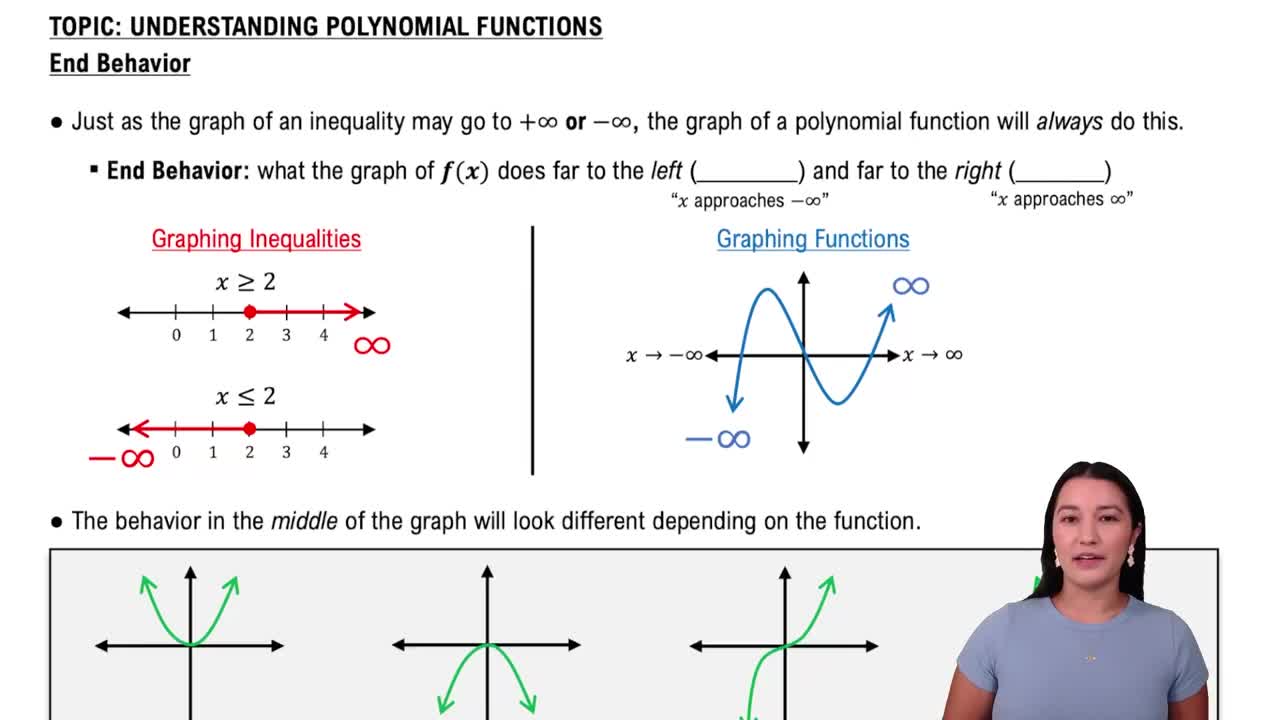
Apply the Leading Coefficient Test: For an even degree polynomial, if the leading coefficient is negative, the end behavior of the graph is that both ends go down as x approaches positive and negative infinity.
Summarize the end behavior: As x, f(x), and as x, f(x).

비슷한 문제에 대한 검증된 영상 답변:

이 영상 해법은 위 문제에 도움이 된다고 튜터들이 추천한 것입니다.
영상 길이:
3m
도움이 되었나요?

주요 개념

질문에 올바르게 답하기 위해 반드시 이해해야 하는 핵심 개념들은 다음과 같습니다.

Leading Coefficient Test

The Leading Coefficient Test uses the degree and leading coefficient of a polynomial to determine its end behavior. For large positive or negative x-values, the sign and degree dictate whether the graph rises or falls on each end. This test simplifies predicting the graph's behavior without plotting points.
추천 영상:
06:08
End Behavior of Polynomial Functions

Degree of a Polynomial

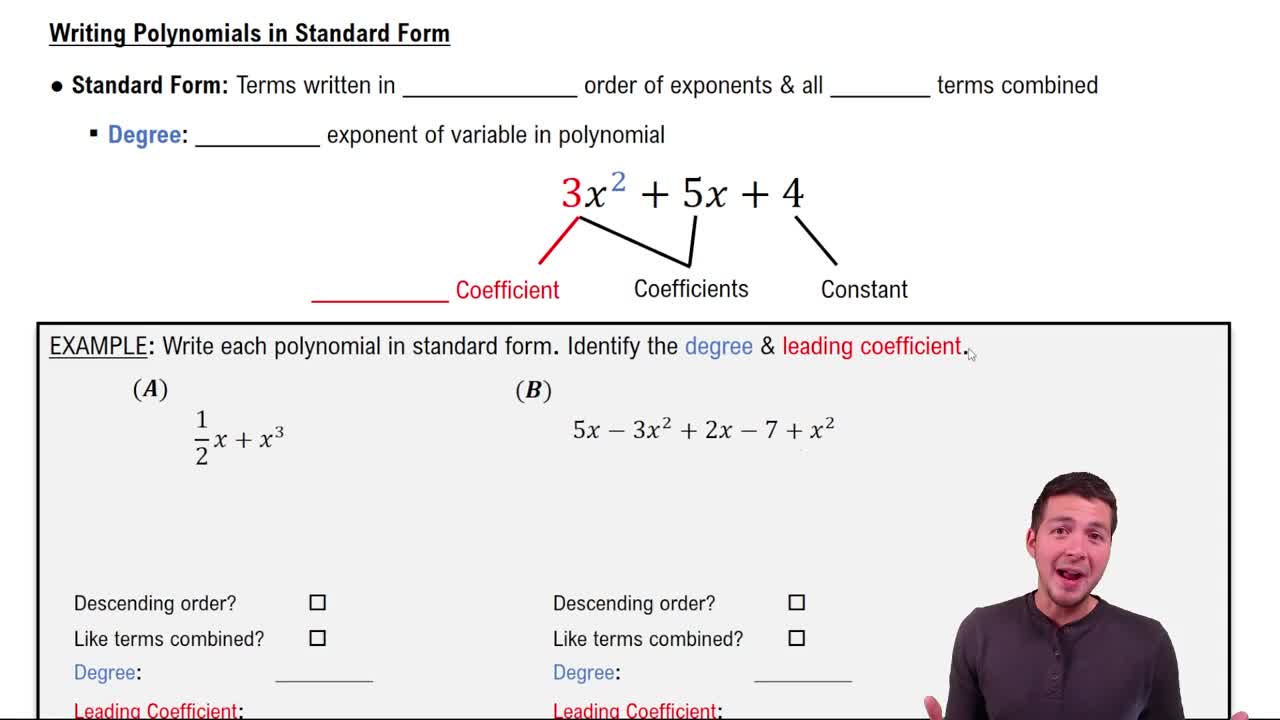
The degree of a polynomial is the highest power of the variable in the expression. It indicates the general shape and number of turning points of the graph. Even-degree polynomials have similar end behaviors on both sides, while odd-degree polynomials have opposite end behaviors.
추천 영상:
05:16
Standard Form of Polynomials

Leading Coefficient

The leading coefficient is the coefficient of the term with the highest degree in a polynomial. Its sign (positive or negative) affects the direction of the graph's ends. A positive leading coefficient causes the graph to rise on the right end, while a negative one causes it to fall.
추천 영상:
06:08
End Behavior of Polynomial Functions