Solve each polynomial inequality in Exercises 1–42 and graph the solution set on a real number line. Express each solution set in interval notation. (2−x)2(x−7/2)<0
Ch. 3 - Polynomial and Rational Functions

4장, 문제 33
Find the vertical asymptotes, if any, and the values of x corresponding to holes, if any, of the graph of each rational function. h(x)=(x+7)/(x2+4x−21)
검증된 단계별 안내1
Start by identifying the denominator of the rational function, which is \(x^{2} + 4x - 21\).
Factor the denominator to find its roots. To factor \(x^{2} + 4x - 21\), look for two numbers that multiply to \(-21\) and add to \(4\).
Write the denominator as a product of two binomials based on the factors found: \(x^{2} + 4x - 21 = (x + a)(x + b)\), where \(a\) and \(b\) are the numbers from the previous step.
Set each factor equal to zero to find the values of \(x\) that make the denominator zero: \(x + a = 0\) and \(x + b = 0\). These values are potential vertical asymptotes or holes.
Check if any of these \(x\)-values also make the numerator zero. If a value makes both numerator and denominator zero, it corresponds to a hole; if it only makes the denominator zero, it corresponds to a vertical asymptote.

비슷한 문제에 대한 검증된 영상 답변:
이 영상 해법은 위 문제에 도움이 된다고 튜터들이 추천한 것입니다.
영상 길이:
2m주요 개념
질문에 올바르게 답하기 위해 반드시 이해해야 하는 핵심 개념들은 다음과 같습니다.
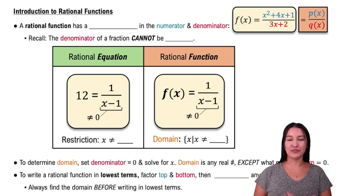
Rational Functions
A rational function is a ratio of two polynomials, expressed as f(x) = P(x)/Q(x). Understanding the behavior of rational functions involves analyzing their numerators and denominators, especially where the denominator equals zero, which affects the domain and graph.
추천 영상:
Intro to Rational Functions
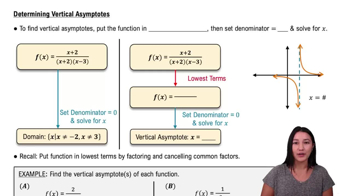
Vertical Asymptotes
Vertical asymptotes occur at values of x where the denominator of a rational function is zero but the numerator is not zero, causing the function to approach infinity or negative infinity. Identifying these points helps describe the function's behavior near undefined values.
추천 영상:
Determining Vertical Asymptotes
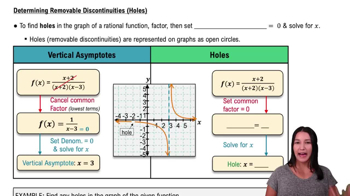
Holes in the Graph
Holes occur when a factor cancels out from both numerator and denominator, resulting in a removable discontinuity. At these x-values, the function is undefined, but the limit exists, indicating a 'hole' rather than an asymptote on the graph.
추천 영상:
Determining Removable Discontinuities (Holes)
관련 실천
교과서 질문
757
views
교과서 질문
Use synthetic division and the Remainder Theorem to find the indicated function value. f(x)=2x3−11x2+7x−5;f(4)
514
views
교과서 질문
Use the Intermediate Value Theorem to show that each polynomial has a real zero between the given integers. f(x)=x3−x−1; between 1 and 2
941
views
교과서 질문
Given f(x) = 2x^3 - 7x^2 + 9x - 3, use the Remainder Theorem to find f(- 13).
1134
views
교과서 질문
Solve each polynomial inequality in Exercises 1–42 and graph the solution set on a real number line. Express each solution set in interval notation. x(4−x)(x−6)≤0
496
views
교과서 질문
In Exercises 17–38, use the vertex and intercepts to sketch the graph of each quadratic function. Give the equation of the parabola's axis of symmetry. Use the graph to determine the function's domain and range. f(x)=x2+6x+3
608
views