Find the vertical asymptotes, if any, and the values of x corresponding to holes, if any, of the graph of each rational function. r(x)=x/(x2+4)
Ch. 3 - Polynomial and Rational Functions

4장, 문제 26
In Exercises 25–26, graph each polynomial function.
검증된 단계별 안내1
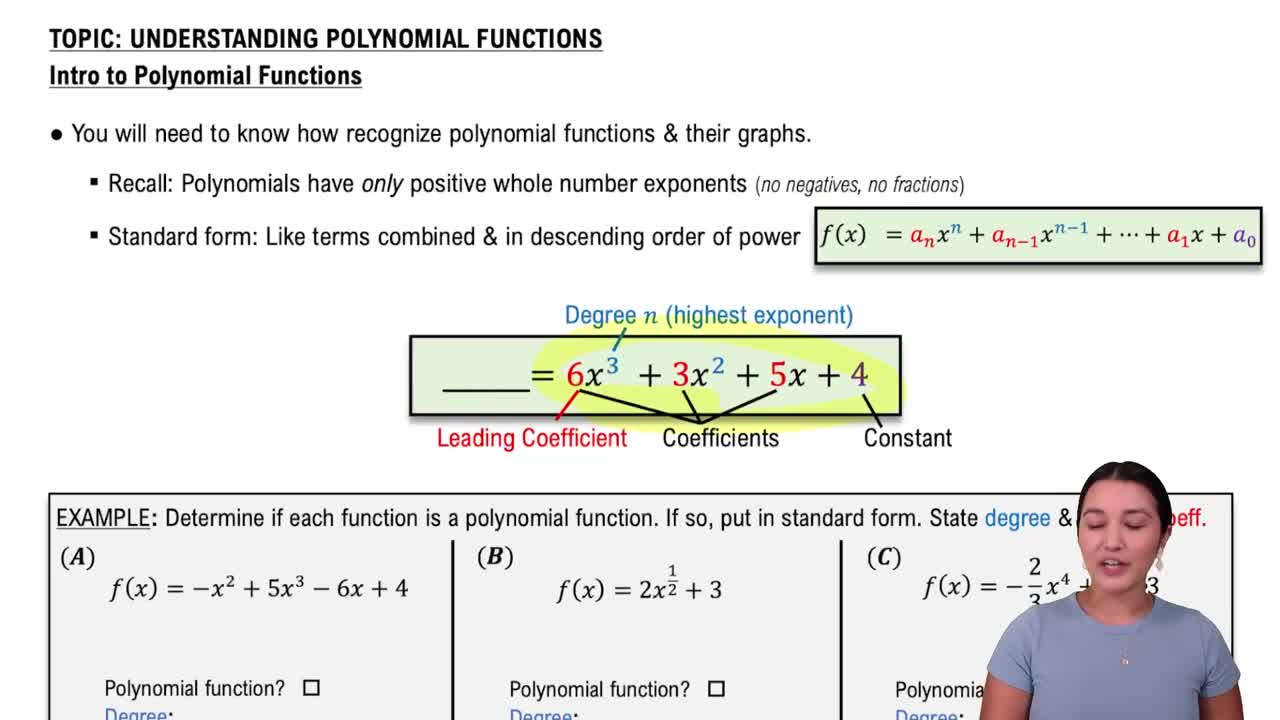
Identify the degree and leading term of the polynomial function \(f(x) = -x^3 (x + 4)^2 (x - 1)\). To do this, expand the powers and multiply the highest degree terms: the degree is the sum of the exponents, and the leading coefficient comes from multiplying the leading coefficients of each factor.
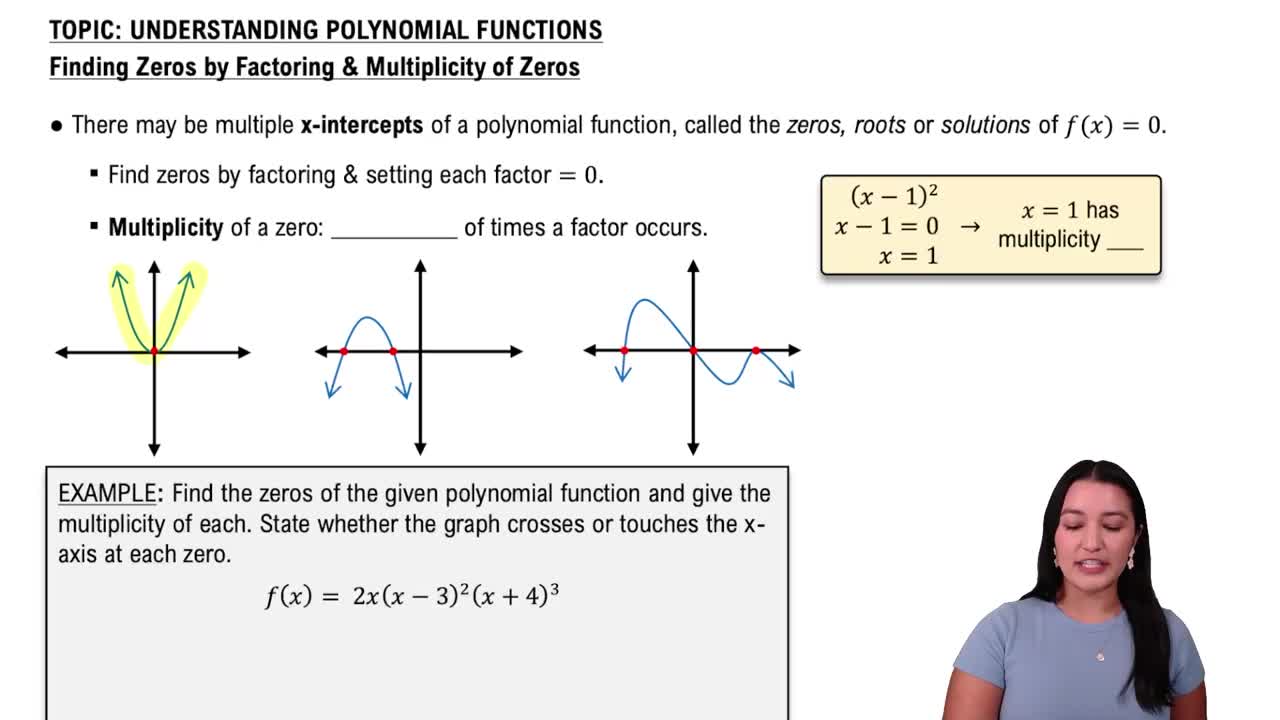
Determine the zeros (roots) of the function by setting each factor equal to zero: solve \(x^3 = 0\), \((x + 4)^2 = 0\), and \((x - 1) = 0\). These zeros are the x-values where the graph will cross or touch the x-axis.
Analyze the multiplicity of each zero: a zero with an odd multiplicity (like 3 or 1) means the graph crosses the x-axis at that zero, while a zero with an even multiplicity (like 2) means the graph touches the x-axis and turns around at that zero.
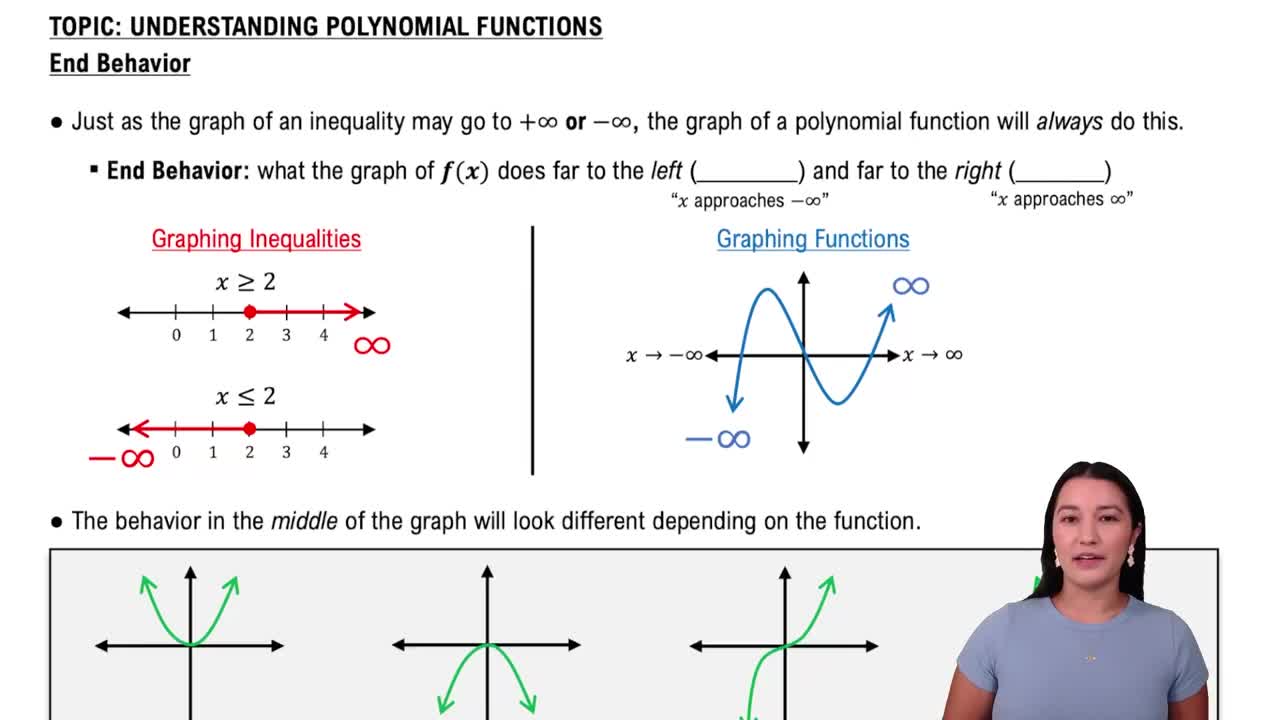
Determine the end behavior of the polynomial by looking at the leading term's degree and sign. Since the degree is odd and the leading coefficient is negative, the graph will fall to the right and rise to the left (or vice versa, depending on the sign).
Plot the zeros on the x-axis, use the multiplicity to sketch the behavior at each zero, and use the end behavior to guide the shape of the graph as \(x\) approaches positive and negative infinity. Connect these points smoothly to complete the graph.

비슷한 문제에 대한 검증된 영상 답변:
이 영상 해법은 위 문제에 도움이 된다고 튜터들이 추천한 것입니다.
영상 길이:
5m도움이 되었나요?
주요 개념
질문에 올바르게 답하기 위해 반드시 이해해야 하는 핵심 개념들은 다음과 같습니다.
Polynomial Function and Degree
A polynomial function is an expression consisting of variables raised to whole-number exponents and their coefficients. The degree of the polynomial is the highest exponent sum in any term, which determines the general shape and end behavior of the graph.
추천 영상:
Introduction to Polynomial Functions
Zeros and Their Multiplicities
Zeros of a polynomial are the values of x that make the function equal to zero. The multiplicity of a zero indicates how many times that root is repeated, affecting whether the graph crosses or touches the x-axis at that point.
추천 영상:
Finding Zeros & Their Multiplicity
End Behavior of Polynomial Functions
End behavior describes how the graph behaves as x approaches positive or negative infinity. It depends on the leading term's degree and coefficient, indicating whether the graph rises or falls on each end.
추천 영상:
End Behavior of Polynomial Functions
관련 실천
교과서 질문
601
views
교과서 질문
Find an nth-degree polynomial function with real coefficients satisfying the given conditions. If you are using a graphing utility, use it to graph the function and verify the real zeros and the given function value. n=3; -5 and 4+3i are zeros; f(2) = 91
2266
views
1
rank
교과서 질문
In Exercises 25–26, graph each polynomial function.
990
views
교과서 질문
Find the zeros for each polynomial function and give the multiplicity for each zero. State whether the graph crosses the x-axis, or touches the x-axis and turns around, at each zero. f(x)=3(x+5)(x+2)2
1238
views
교과서 질문
Divide using long division.
727
views
교과서 질문
Solve each polynomial inequality in Exercises 1–42 and graph the solution set on a real number line. Express each solution set in interval notation. x2≤2x+2
546
views