Ch. 3 - Polynomial and Rational Functions
Blitzer - College Algebra 8th Edition
Blitzer8th EditionCollege AlgebraISBN: 9780136970514당신이 사용하는 게 아니라요?교과서 변경
4장, 문제 37

Use Descartes's Rule of Signs to determine the possible number of positive and negative real zeros for each given function. f(x)=2x4−5x3−x2−6x+4

검증된 단계별 안내
1
Write down the given polynomial function: \(f(x) = 2x^{4} - 5x^{3} - x^{2} - 6x + 4\).
To find the possible number of positive real zeros, count the number of sign changes in the coefficients of \(f(x)\). The coefficients are: \(2, -5, -1, -6, 4\).
Identify the sign changes between consecutive coefficients: from \(2\) to \(-5\) (change), \(-5\) to \(-1\) (no change), \(-1\) to \(-6\) (no change), \(-6\) to \(4\) (change). So, there are 2 sign changes.
According to Descartes's Rule of Signs, the number of positive real zeros is either equal to the number of sign changes or less than that by an even number. So, possible positive zeros are 2 or 0.
To find the possible number of negative real zeros, evaluate \(f(-x)\) and count the sign changes in its coefficients. Replace \(x\) by \(-x\) in \(f(x)\) and simplify to get \(f(-x)\), then count the sign changes in the coefficients of \(f(-x)\).

비슷한 문제에 대한 검증된 영상 답변:

이 영상 해법은 위 문제에 도움이 된다고 튜터들이 추천한 것입니다.
영상 길이:
3m
도움이 되었나요?

주요 개념

질문에 올바르게 답하기 위해 반드시 이해해야 하는 핵심 개념들은 다음과 같습니다.

Descartes's Rule of Signs

Descartes's Rule of Signs is a method used to determine the possible number of positive and negative real zeros of a polynomial function by counting the sign changes in the coefficients of f(x) and f(-x). The number of positive real zeros is equal to the number of sign changes in f(x) or less than that by an even number. Similarly, the number of negative real zeros is found by applying the rule to f(-x).
추천 영상:
6:54
Cramer's Rule - 2 Equations with 2 Unknowns

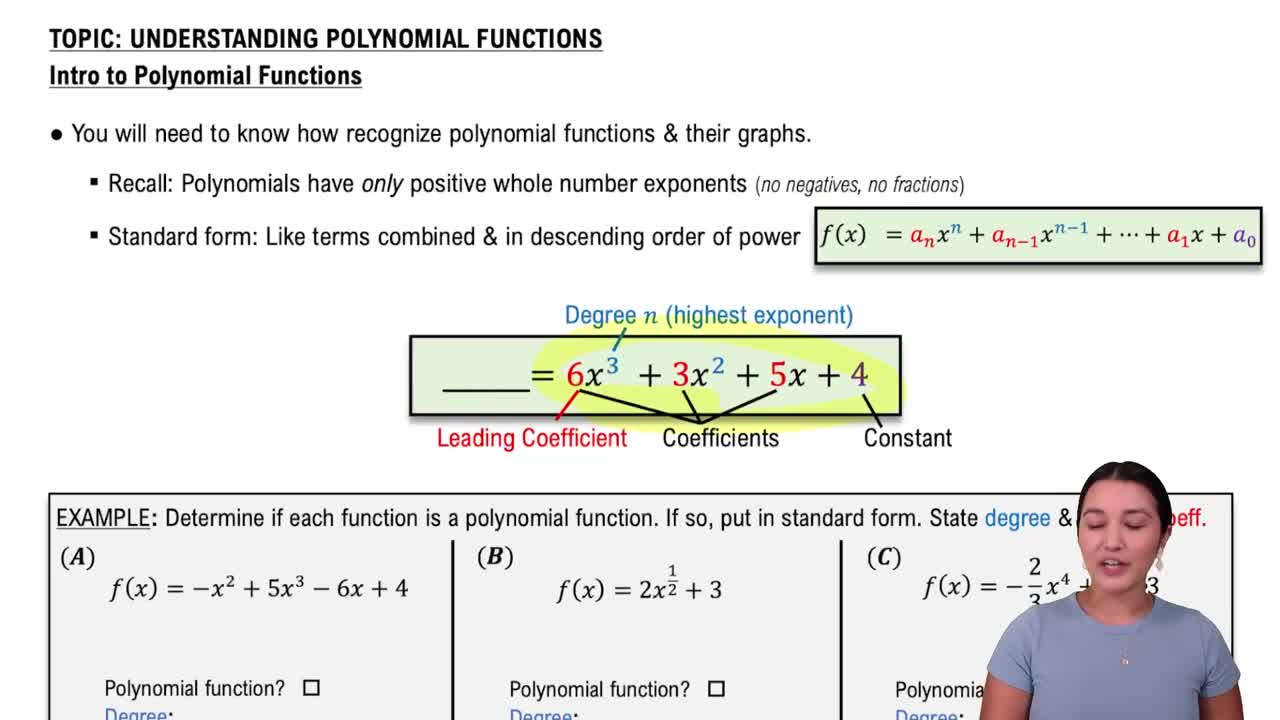
Polynomial Functions and Their Coefficients

A polynomial function is an expression consisting of variables raised to whole-number exponents and coefficients. Understanding the arrangement and signs of coefficients is essential for applying Descartes's Rule of Signs, as the rule depends on counting sign changes between consecutive terms. For example, in f(x) = 2x^4 - 5x^3 - x^2 - 6x + 4, the coefficients are 2, -5, -1, -6, and 4.
추천 영상:
06:04
Introduction to Polynomial Functions

Evaluating f(-x) to Find Negative Zeros

To determine the possible number of negative real zeros, substitute -x into the polynomial to get f(-x). This changes the signs of terms with odd powers of x. Then, count the sign changes in the coefficients of f(-x) to apply Descartes's Rule of Signs for negative zeros. This step is crucial because it transforms the problem of finding negative zeros into a similar sign-change counting process.
추천 영상:
6:37
Zero and Negative Rules