
교과서 질문
Use the Intermediate Value Theorem to show that each polynomial has a real zero between the given integers. f(x)=3x3−8x2+x+2; between 2 and 3
894
views

 검증된 단계별 안내
 02:58
02:58
 6:54
6:54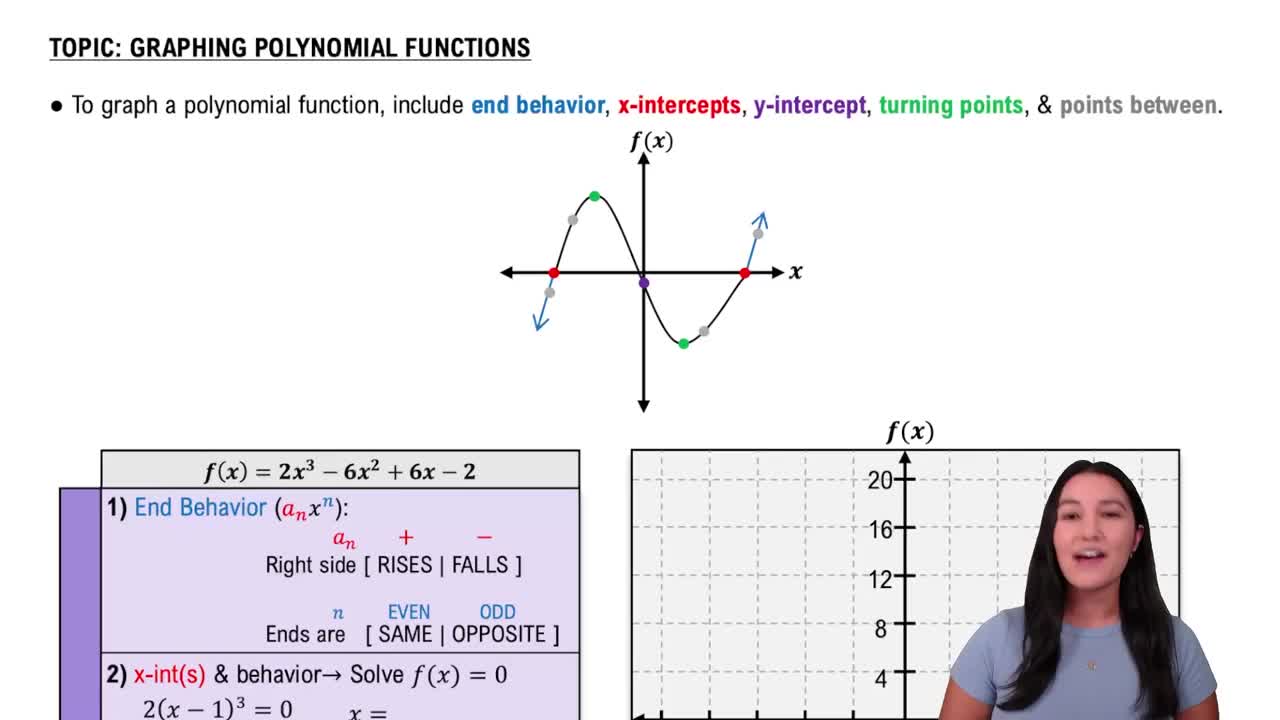 05:25
05:25Use the Intermediate Value Theorem to show that each polynomial has a real zero between the given integers. f(x)=3x3−8x2+x+2; between 2 and 3
For Exercises 40–46, (a) List all possible rational roots or rational zeros. (b) Use Descartes's Rule of Signs to determine the possible number of positive and negative real roots or real zeros. (c) Use synthetic division to test the possible rational roots or zeros and find an actual root or zero. (d) Use the quotient from part (c) to find all the remaining roots or zeros.
Use synthetic division and the Remainder Theorem to find the indicated function value. f(x)=6x4+10x3+5x2+x+1; f(−2/3)
Use synthetic division and the Remainder Theorem to find the indicated function value. f(x)=2x4−5x3−x2+3x+2; f(−1/2)
Use Descartes' Rule of Signs to explain why has no real roots.
An equation of a quadratic function is given. a) Determine, without graphing, whether the function has a minimum value or a maximum value. b) Find the minimum or maximum value and determine where it occurs. c) Identify the function's domain and its range. f(x)=3x2−12x−1