Write a polynomial that represents the length of each rectangle. Transcription: The area of the rectangle is 0.5x3 - 0.3x2 + 0.22x + 0.06 square units and its width is x + 0.2 units
Ch. 3 - Polynomial and Rational Functions

4장, 문제 55
Use transformations of f(x)=1/x or f(x)=1/x2 to graph each rational function. h(x)=1/(x−3)2+1
검증된 단계별 안내1
Identify the base function given, which is \(f(x) = \frac{1}{x^2}\). This is the starting point for the transformations.
Recognize the horizontal shift in the function \(h(x) = \frac{1}{(x-3)^2} + 1\). The term \((x-3)\) inside the denominator indicates a shift to the right by 3 units.
Understand the vertical shift: the \(+1\) outside the fraction means the entire graph of \(\frac{1}{(x-3)^2}\) is shifted upward by 1 unit.
Combine the transformations: start with the graph of \(f(x) = \frac{1}{x^2}\), shift it right by 3 units to get \(\frac{1}{(x-3)^2}\), then shift it up by 1 unit to get \(h(x) = \frac{1}{(x-3)^2} + 1\).
Analyze the asymptotes: the vertical asymptote moves from \(x=0\) to \(x=3\) due to the horizontal shift, and the horizontal asymptote moves from \(y=0\) to \(y=1\) due to the vertical shift.

비슷한 문제에 대한 검증된 영상 답변:
이 영상 해법은 위 문제에 도움이 된다고 튜터들이 추천한 것입니다.
영상 길이:
2m주요 개념
질문에 올바르게 답하기 위해 반드시 이해해야 하는 핵심 개념들은 다음과 같습니다.
Parent Rational Functions
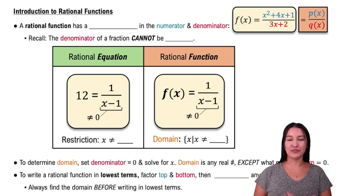
Parent rational functions like f(x) = 1/x and f(x) = 1/x² serve as the basic models for more complex rational functions. Understanding their graphs, including asymptotes and general shape, is essential before applying transformations. For example, f(x) = 1/x has vertical and horizontal asymptotes at x=0 and y=0, respectively.
추천 영상:
Intro to Rational Functions
Transformations of Functions
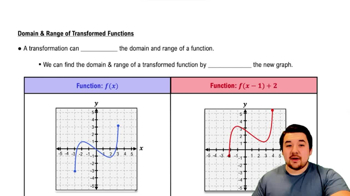
Transformations include shifts, stretches, compressions, and reflections applied to the parent function's graph. Horizontal shifts move the graph left or right, vertical shifts move it up or down, and changes inside the function's formula affect these shifts. For h(x) = 1/(x−3)² + 1, the graph shifts right by 3 units and up by 1 unit.
추천 영상:
Domain & Range of Transformed Functions
Asymptotes of Rational Functions
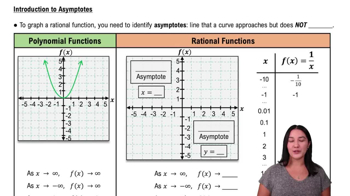
Asymptotes are lines that the graph approaches but never touches. Vertical asymptotes occur where the denominator is zero, indicating undefined points, while horizontal asymptotes describe end behavior as x approaches infinity. For h(x) = 1/(x−3)² + 1, the vertical asymptote is x=3 and the horizontal asymptote is y=1.
추천 영상:
Introduction to Asymptotes
관련 실천
교과서 질문
1198
views
교과서 질문
Follow the seven steps to graph each rational function. f(x)=4x/(x−2)
596
views
교과서 질문
Solve each rational inequality in Exercises 43–60 and graph the solution set on a real number line. Express each solution set in interval notation. (x + 1)/(x + 3) < 2
520
views
교과서 질문
Exercises 53–60 show incomplete graphs of given polynomial functions. a) Find all the zeros of each function. b) Without using a graphing utility, draw a complete graph of the function. f(x)=4x3−8x2−3x+9
469
views
교과서 질문
Write an equation in vertex form of the parabola that has the same shape as the graph of f(x) = 3x2 or g(x) = -3x2, but with the given maximum or minimum. Minimum = 0 at x = 11
1194
views
교과서 질문
Use transformations of f(x) = (1/x) or f(x) = (1/x2) to graph each rational function. g(x) = 1/(x + 2)2 - 1
1039
views