Ch. 3 - Polynomial and Rational Functions
Blitzer - College Algebra 8th Edition
Blitzer8th EditionCollege AlgebraISBN: 9780136970514당신이 사용하는 게 아니라요?교과서 변경
4장, 문제 69

Follow the seven steps to graph each rational function. f(x)=2x2/(x2+4)

검증된 단계별 안내
1
Identify the domain of the function by finding all values of \(x\) for which the denominator is not zero. For \(f(x) = \frac{2x^{2}}{x^{2} + 4}\), set the denominator equal to zero: \(x^{2} + 4 = 0\) and solve for \(x\).
Find the intercepts: To find the \(y\)-intercept, evaluate \(f(0)\). To find the \(x\)-intercepts, set the numerator equal to zero and solve for \(x\).
Determine any vertical asymptotes by analyzing where the denominator is zero and the numerator is not zero. Since the denominator is \(x^{2} + 4\), check if it has real roots.
Find the horizontal asymptote by comparing the degrees of the numerator and denominator polynomials. Since both numerator and denominator are degree 2, divide the leading coefficients to find the horizontal asymptote.
Analyze the behavior of the function near the asymptotes and at large values of \(x\) to understand the end behavior, then sketch the graph using all the information gathered.

비슷한 문제에 대한 검증된 영상 답변:

이 영상 해법은 위 문제에 도움이 된다고 튜터들이 추천한 것입니다.
영상 길이:
16m
도움이 되었나요?

주요 개념

질문에 올바르게 답하기 위해 반드시 이해해야 하는 핵심 개념들은 다음과 같습니다.

Rational Functions

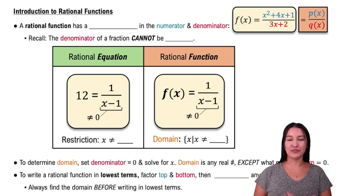
A rational function is a ratio of two polynomials, expressed as f(x) = P(x)/Q(x). Understanding the domain, where the denominator Q(x) ≠ 0, is essential to avoid undefined values and to analyze the function's behavior.
추천 영상:
6:04
Intro to Rational Functions

Graphing Steps for Rational Functions

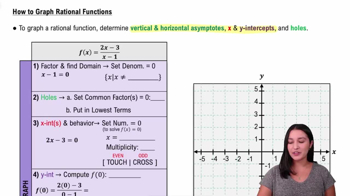
Graphing rational functions involves seven key steps: finding the domain, intercepts, asymptotes (vertical, horizontal, or oblique), analyzing end behavior, plotting points, and sketching the curve. These steps help visualize the function accurately.
추천 영상:
8:19
How to Graph Rational Functions

Asymptotes and End Behavior

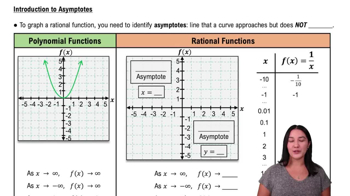
Asymptotes are lines that the graph approaches but never touches. Vertical asymptotes occur where the denominator is zero, and horizontal or oblique asymptotes describe the function's behavior as x approaches infinity or negative infinity.
추천 영상:
6:24
Introduction to Asymptotes