Use long division to rewrite the equation for g in the form quotient + remainder/divisor. Then use this form of the function's equation and transformations of f(x) = 1/x to graph g. g(x) = (2x+7)/(x+3)
Ch. 3 - Polynomial and Rational Functions

4장, 문제 93
In Exercises 89–94, the equation for f is given by the simplified expression that results after performing the indicated operation. Write the equation for f and then graph the function. (1 − 3/(x+2)) / (1 + 1/(x−2))
검증된 단계별 안내1
Start by rewriting the given expression clearly: . This helps visualize the numerator and denominator separately.
Find a common denominator for the numerator: rewrite as . Simplify the numerator inside the fraction.
Similarly, find a common denominator for the denominator: rewrite as . Simplify the numerator inside this fraction.
Now, the entire expression is a complex fraction: . To simplify, multiply the numerator by the reciprocal of the denominator.
Perform the multiplication: multiply the numerators together and the denominators together, then simplify the resulting expression by combining like terms and factoring if possible. This will give the simplified expression for .

비슷한 문제에 대한 검증된 영상 답변:
이 영상 해법은 위 문제에 도움이 된다고 튜터들이 추천한 것입니다.
영상 길이:
14m도움이 되었나요?
주요 개념
질문에 올바르게 답하기 위해 반드시 이해해야 하는 핵심 개념들은 다음과 같습니다.
Simplifying Complex Rational Expressions
This involves rewriting expressions that contain fractions within fractions into a simpler, single rational expression. The process typically includes finding common denominators, combining terms, and simplifying numerators and denominators separately to make the expression easier to work with.
추천 영상:
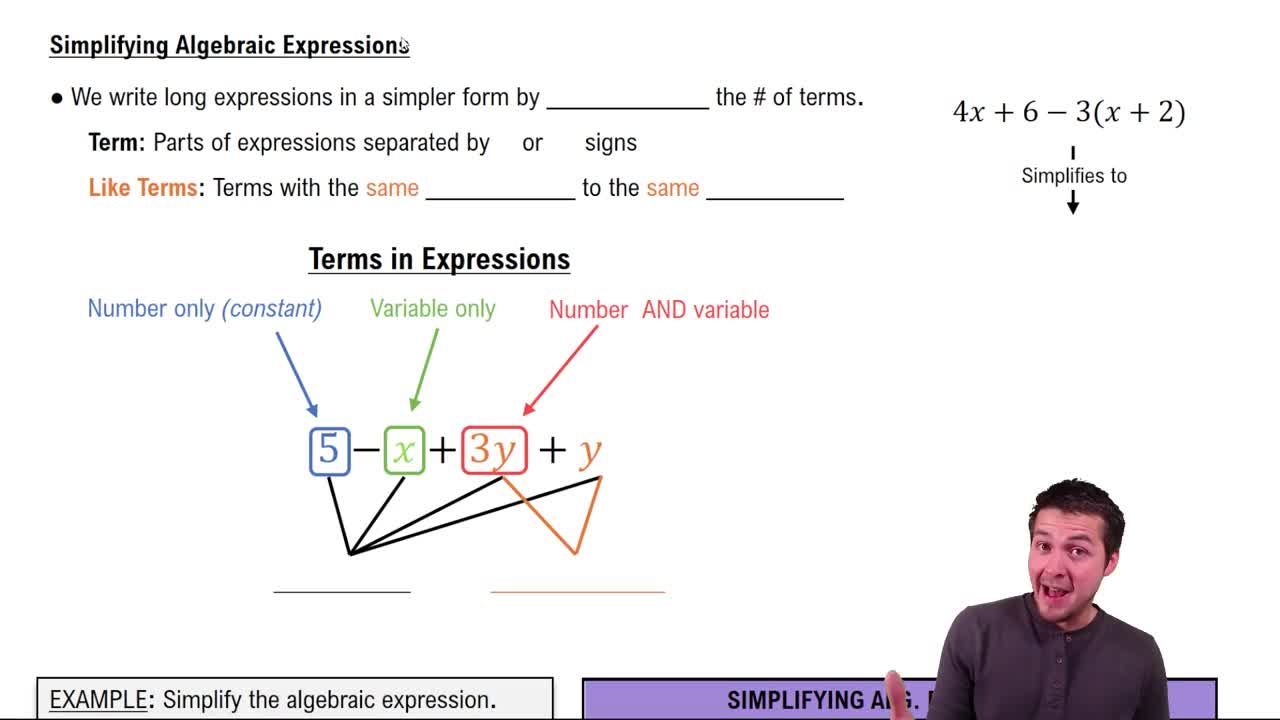
Simplifying Algebraic Expressions
Domain of a Function
The domain is the set of all input values (x-values) for which the function is defined. When simplifying rational expressions, it is important to identify values that make any denominator zero, as these values are excluded from the domain to avoid undefined expressions.
추천 영상:
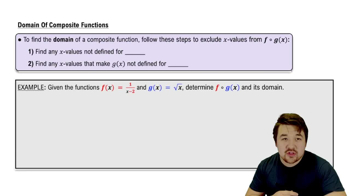
Domain Restrictions of Composed Functions
Graphing Rational Functions
Graphing involves plotting the function on a coordinate plane, considering key features such as intercepts, asymptotes, and behavior near undefined points. Understanding how to interpret the simplified function helps in sketching its graph accurately.
추천 영상:
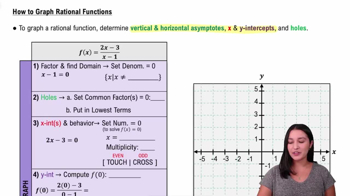
How to Graph Rational Functions
관련 실천
교과서 질문
1110
views
교과서 질문
Solve each inequality in Exercises 86–91 using a graphing utility. (x - 4)/(x - 1) ≤ 0
495
views
교과서 질문
Use long division to rewrite the equation for g in the form quotient + remainder/divisor. Then use this form of the function's equation and transformations of f(x) = 1/x to graph g. g(x)=(3x−7)/(x−2)
638
views
교과서 질문
In Exercises 97–98, write the equation of each parabola in vertex form. Vertex: (-3,-4) The graph passes through the point (1,4).
1135
views
교과서 질문
Solve each inequality in Exercises 86–91 using a graphing utility. 1/(x + 1) ≤ 2/(x + 4)
527
views
교과서 질문
In Exercises 89–94, the equation for f is given by the simplified expression that results after performing the indicated operation. Write the equation for f and then graph the function. x/(2x+6) − 9/(x2−9)
833
views