Exercises 107–109 will help you prepare for the material covered in the next section. Factor: x3+3x2−x−3
Ch. 3 - Polynomial and Rational Functions

4장, 문제 105
Solve: .
검증된 단계별 안내1
Start by examining the polynomial equation and consider possible rational roots using the Rational Root Theorem, which suggests testing factors of the constant term over factors of the leading coefficient.
List the possible rational roots by taking factors of the constant term 4 (±1, ±2, ±4) and dividing by factors of the leading coefficient 1 (±1), so possible roots are ±1, ±2, ±4.
Test each possible root by substituting into the polynomial or using synthetic division to check if it yields zero, indicating a root.
Once a root is found, use synthetic division or polynomial division to divide the original polynomial by the corresponding factor , where is the root found, to reduce the polynomial to a cubic or quadratic.
Solve the reduced polynomial (cubic or quadratic) by factoring further, using the quadratic formula, or other methods to find the remaining roots.

비슷한 문제에 대한 검증된 영상 답변:
이 영상 해법은 위 문제에 도움이 된다고 튜터들이 추천한 것입니다.
영상 길이:
6m도움이 되었나요?
주요 개념
질문에 올바르게 답하기 위해 반드시 이해해야 하는 핵심 개념들은 다음과 같습니다.
Polynomial Equations
A polynomial equation involves expressions with variables raised to whole-number exponents and coefficients. Solving such equations means finding all values of the variable that make the equation true. Understanding the degree of the polynomial helps determine the number of possible roots.
추천 영상:
가이드 코스
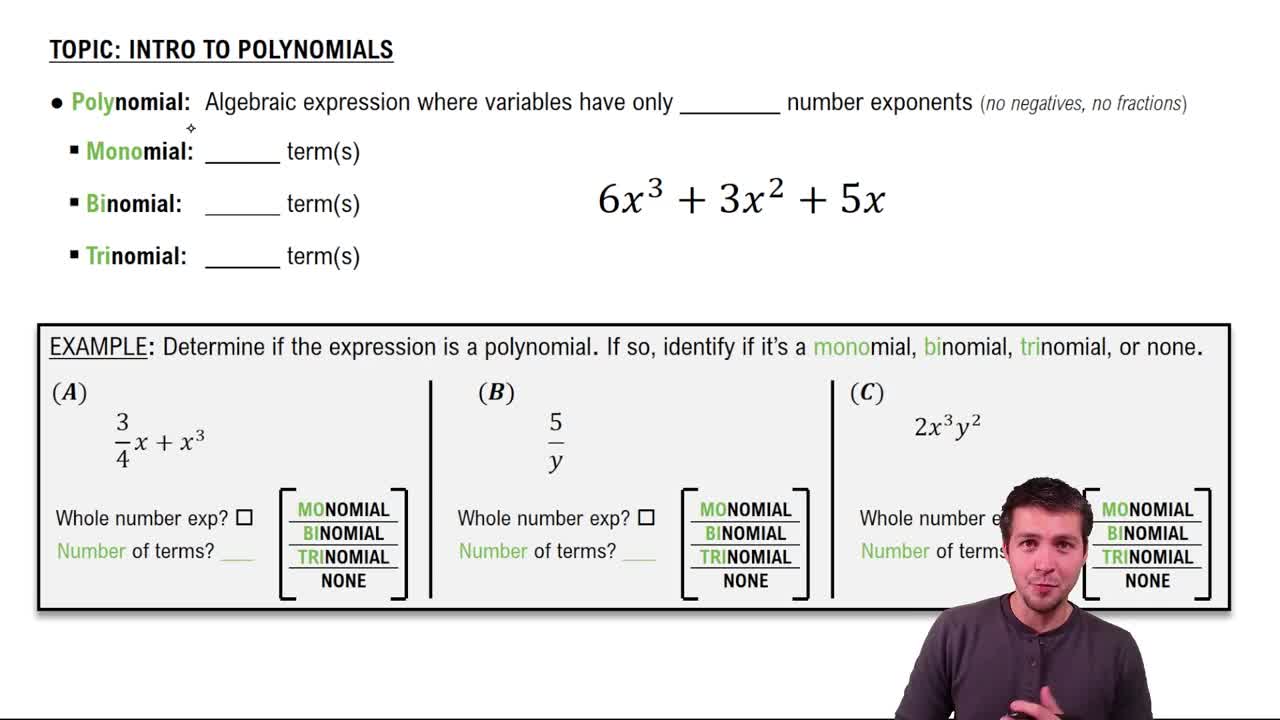
Introduction to Polynomials
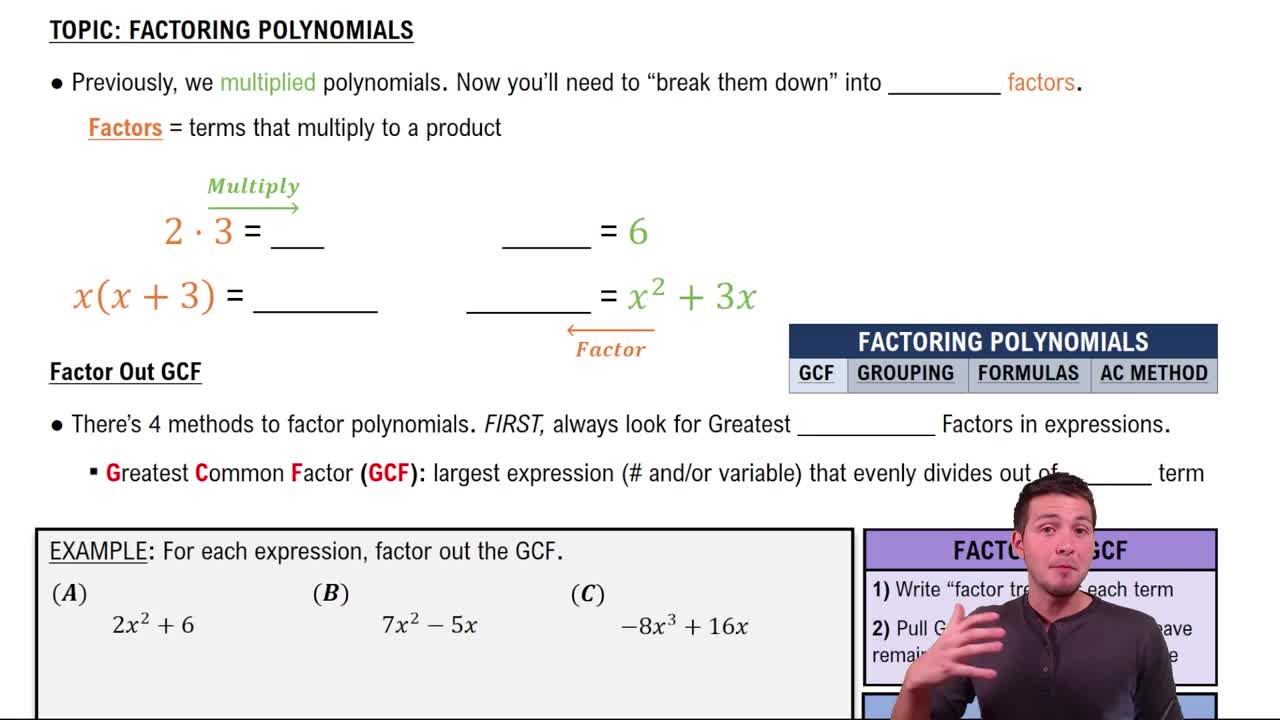
Factoring Polynomials
Factoring is the process of rewriting a polynomial as a product of simpler polynomials. This technique simplifies solving equations by setting each factor equal to zero. Recognizing patterns like grouping or special products can aid in factoring higher-degree polynomials.
추천 영상:
가이드 코스
Introduction to Factoring Polynomials
Rational Root Theorem and Synthetic Division
The Rational Root Theorem helps identify possible rational roots of a polynomial by considering factors of the constant and leading coefficients. Synthetic division is a streamlined method to test these roots and divide polynomials, making it easier to factor and solve the equation.
추천 영상:
가이드 코스
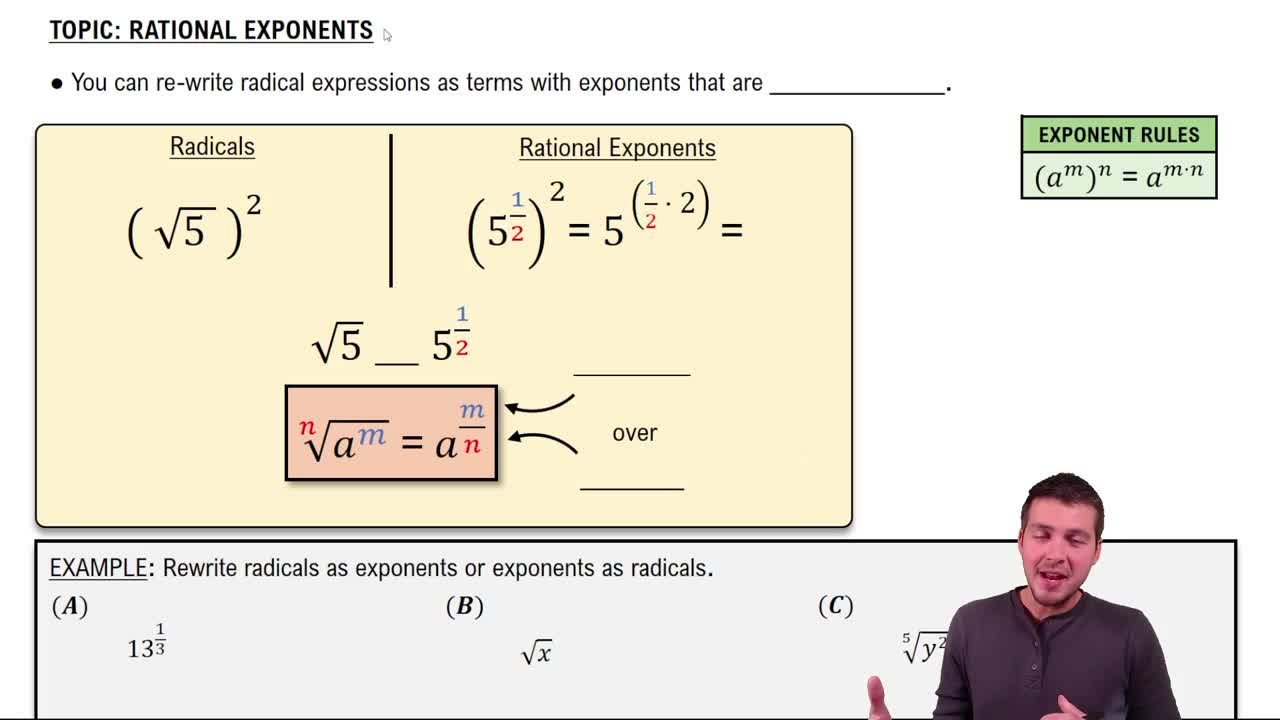
Rational Exponents
관련 실천
교과서 질문
871
views
교과서 질문
Write an equation in point-slope form and slope-intercept form of the line passing through (-10,3) and (-2,-5).
944
views
교과서 질문
In Exercises 97–98, write the equation of each parabola in vertex form. Vertex: (-3,-1) The graph passes through the point (-2,-3).
1613
views
교과서 질문
Exercises 107–109 will help you prepare for the material covered in the next section. Determine whether f(x)=x4−2x2+1 is even, odd, or neither. Describe the symmetry, if any, for the graph of f.
851
views
교과서 질문
Find the average rate of change of f(x)=√x from x1=4 to x2=9.
847
views
교과서 질문
Use long division to rewrite the equation for g in the form quotient + remainder/divisor. Then use this form of the function's equation and transformations of f(x) = 1/x to graph g. g(x)=(3x−7)/(x−2)
638
views