Use the Rational Zero Theorem to list all possible rational zeros for each given function.
Ch. 3 - Polynomial and Rational Functions

4장, 문제 35
Use the vertex and intercepts to sketch the graph of each quadratic function. Give the equation of the parabola's axis of symmetry. Use the graph to determine the function's domain and range. f(x)=2x2+4x−3
검증된 단계별 안내1
Identify the quadratic function given: \(f(x) = 2x^{2} + 4x - 3\).
Find the vertex of the parabola using the formula for the x-coordinate of the vertex: \(x = -\frac{b}{2a}\), where \(a = 2\) and \(b = 4\).
Calculate the y-coordinate of the vertex by substituting the x-value found into the function: \(f(x) = 2x^{2} + 4x - 3\).
Determine the axis of symmetry, which is the vertical line passing through the vertex, given by the equation \(x = -\frac{b}{2a}\).
Find the x-intercepts by solving the quadratic equation \(2x^{2} + 4x - 3 = 0\) using the quadratic formula: \(x = \frac{-b \pm \sqrt{b^{2} - 4ac}}{2a}\), and find the y-intercept by evaluating \(f(0)\).

비슷한 문제에 대한 검증된 영상 답변:
이 영상 해법은 위 문제에 도움이 된다고 튜터들이 추천한 것입니다.
영상 길이:
2m도움이 되었나요?
주요 개념
질문에 올바르게 답하기 위해 반드시 이해해야 하는 핵심 개념들은 다음과 같습니다.
Vertex of a Quadratic Function
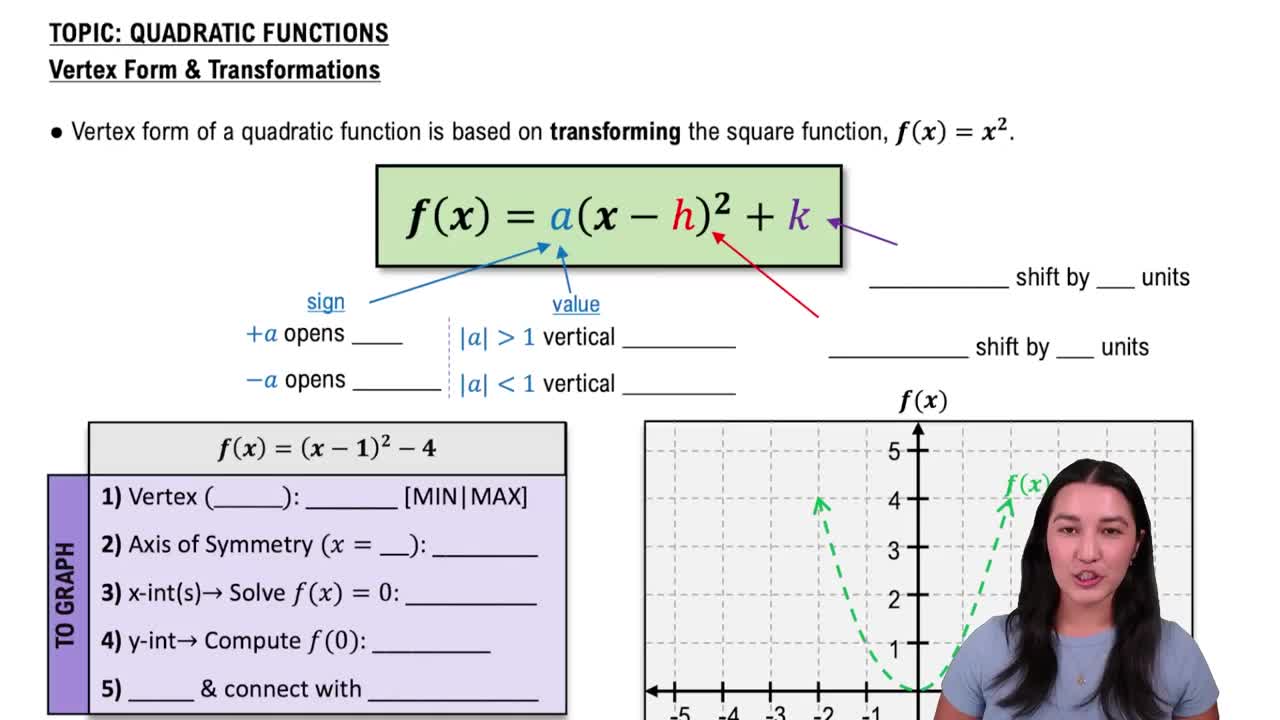
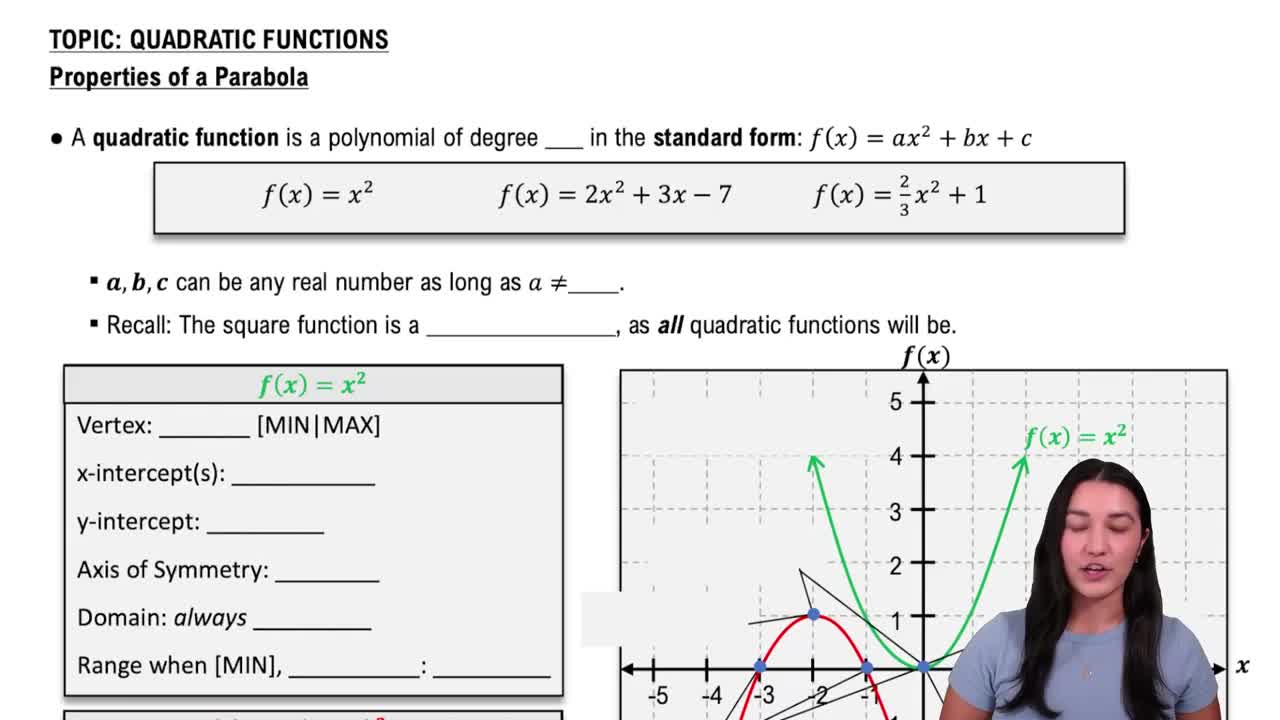
The vertex of a quadratic function is the highest or lowest point on its graph, a parabola. It can be found using the formula x = -b/(2a) for a function in standard form f(x) = ax² + bx + c. The vertex helps determine the parabola's maximum or minimum value and is essential for sketching the graph accurately.
추천 영상:
Vertex Form
Axis of Symmetry
The axis of symmetry is a vertical line that passes through the vertex of the parabola, dividing it into two mirror-image halves. Its equation is x = -b/(2a). Knowing the axis of symmetry helps in graphing the parabola and understanding the symmetry of the function's values.
추천 영상:
Properties of Parabolas
Domain and Range of Quadratic Functions
The domain of any quadratic function is all real numbers since x can take any value. The range depends on the vertex: if the parabola opens upward (a > 0), the range is all values greater than or equal to the vertex's y-coordinate; if it opens downward (a < 0), the range is all values less than or equal to the vertex's y-coordinate.
추천 영상:
Domain & Range of Transformed Functions
관련 실천
교과서 질문
1049
views
교과서 질문
Solve each polynomial inequality in Exercises 1–42 and graph the solution set on a real number line. Express each solution set in interval notation. (1−x)2(x−5/2)<0
380
views
교과서 질문
Use Descartes's Rule of Signs to determine the possible number of positive and negative real zeros for each given function. f(x)=5x3−3x2+3x−1
464
views
교과서 질문
Solve each polynomial inequality in Exercises 1–42 and graph the solution set on a real number line. Express each solution set in interval notation.
521
views
교과서 질문
Use the Intermediate Value Theorem to show that each polynomial has a real zero between the given integers.f(x)=2x4−4x2+1; between -1 and 0
616
views
교과서 질문
Use synthetic division and the Remainder Theorem to find the indicated function value. f(x)=3x3−7x2−2x+5;f(−3)
451
views