Ch. 4 - Exponential and Logarithmic Functions
Blitzer - College Algebra 8th Edition
Blitzer8th EditionCollege AlgebraISBN: 9780136970514당신이 사용하는 게 아니라요?교과서 변경
5장, 문제 37

Use properties of logarithms to expand each logarithmic expression as much as possible. Where possible, evaluate logarithmic expressions without using a calculator. ln(x3x2+1(x+1)4)\(\ln\) \(\left\)( \(\frac{x^3 \sqrt{x^2 + 1}\)}{(x + 1)^4} \(\right\))

검증된 단계별 안내
1
Start by writing the given logarithmic expression clearly: \(\ln\left( \frac{x^{3} \sqrt{x^{2} + 1}}{(x + 1)^{4}} \right)\).
Use the logarithm property for quotients: \(\ln\left( \frac{A}{B} \right) = \ln(A) - \ln(B)\), to separate the expression into two logarithms: \(\ln\left(x^{3} \sqrt{x^{2} + 1}\right) - \ln\left((x + 1)^{4}\right)\).
Next, apply the logarithm property for products: \(\ln(AB) = \ln(A) + \ln(B)\), to expand \(\ln\left(x^{3} \sqrt{x^{2} + 1}\right)\) into \(\ln(x^{3}) + \ln\left(\sqrt{x^{2} + 1}\right)\).
Rewrite the square root as an exponent: \(\sqrt{x^{2} + 1} = (x^{2} + 1)^{1/2}\), and use the power rule for logarithms: \(\ln\left(A^{r}\right) = r \ln(A)\), to express \(\ln\left(\sqrt{x^{2} + 1}\right)\) as \(\frac{1}{2} \ln(x^{2} + 1)\).
Similarly, apply the power rule to \(\ln(x^{3})\) and \(\ln\left((x + 1)^{4}\right)\) to get \(3 \ln(x)\) and \(4 \ln(x + 1)\) respectively. Combine all parts to write the fully expanded expression.

비슷한 문제에 대한 검증된 영상 답변:

이 영상 해법은 위 문제에 도움이 된다고 튜터들이 추천한 것입니다.
영상 길이:
3m
도움이 되었나요?

주요 개념

질문에 올바르게 답하기 위해 반드시 이해해야 하는 핵심 개념들은 다음과 같습니다.

Properties of Logarithms

Properties of logarithms include the product, quotient, and power rules, which allow the expansion or simplification of logarithmic expressions. For example, ln(ab) = ln(a) + ln(b), ln(a/b) = ln(a) - ln(b), and ln(a^n) = n ln(a). These rules help break down complex expressions into simpler sums and differences of logarithms.
추천 영상:
5:36
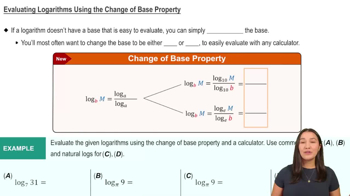
Change of Base Property

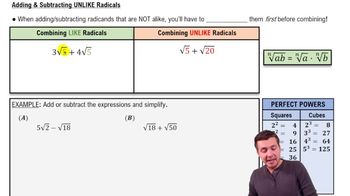
Simplifying Radicals and Exponents

Simplifying expressions involving radicals and exponents is essential before applying logarithmic properties. For instance, the square root √(x² + 1) can be left as is, but recognizing powers like x³ or (x + 1)^4 helps in applying the power rule of logarithms effectively.
추천 영상:
5:48
Adding & Subtracting Unlike Radicals by Simplifying

Domain Considerations for Logarithmic Functions

The domain of a logarithmic function requires the argument to be positive. When expanding ln[(x³(√(x² + 1)))/(x + 1)⁴], it is important to consider values of x that keep the entire expression inside the logarithm positive to ensure the expression is defined.
추천 영상:
5:26
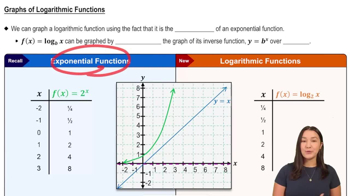
Graphs of Logarithmic Functions