Ch. 4 - Exponential and Logarithmic Functions
Blitzer - College Algebra 8th Edition
Blitzer8th EditionCollege AlgebraISBN: 9780136970514당신이 사용하는 게 아니라요?교과서 변경
5장, 문제 109

In Exercises 109–112, find the domain of each logarithmic function. f(x) = ln (x² - x − 2)

검증된 단계별 안내
1
Recall that the domain of a logarithmic function f(x) = ln(g(x)) requires the argument g(x) to be greater than zero, so we need to find where x² - x - 2 > 0.
Set up the inequality: x²-x-2>0.
Factor the quadratic expression: x²-x-2 = (x-2)(x+1).
Determine the critical points by setting each factor equal to zero: x-2=0 gives x=2, and x+1=0 gives x=-1.
Test intervals determined by the critical points (-∞, -1), (-1, 2), and (2, ∞) to find where the product is positive, which will give the domain of the function.

비슷한 문제에 대한 검증된 영상 답변:

이 영상 해법은 위 문제에 도움이 된다고 튜터들이 추천한 것입니다.
영상 길이:
3m
도움이 되었나요?

주요 개념

질문에 올바르게 답하기 위해 반드시 이해해야 하는 핵심 개념들은 다음과 같습니다.

Domain of a Function

The domain of a function is the set of all input values (x-values) for which the function is defined. For logarithmic functions, the argument inside the logarithm must be positive, so determining the domain involves finding all x-values that make the expression inside the log greater than zero.
추천 영상:
3:51
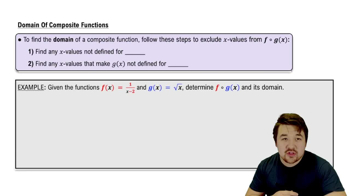
Domain Restrictions of Composed Functions

Properties of Logarithmic Functions

Logarithmic functions, such as the natural logarithm ln(x), are only defined for positive arguments. This means the expression inside the logarithm, here (x² - x - 2), must be greater than zero. Understanding this property is essential to correctly find the domain.
추천 영상:
5:26
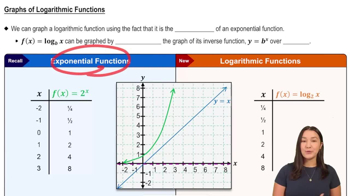
Graphs of Logarithmic Functions

Solving Quadratic Inequalities

To find where the quadratic expression (x² - x - 2) is positive, you solve the inequality x² - x - 2 > 0. This involves factoring the quadratic, finding its roots, and testing intervals to determine where the expression is positive, which helps identify the domain of the logarithmic function.
추천 영상:
04:03
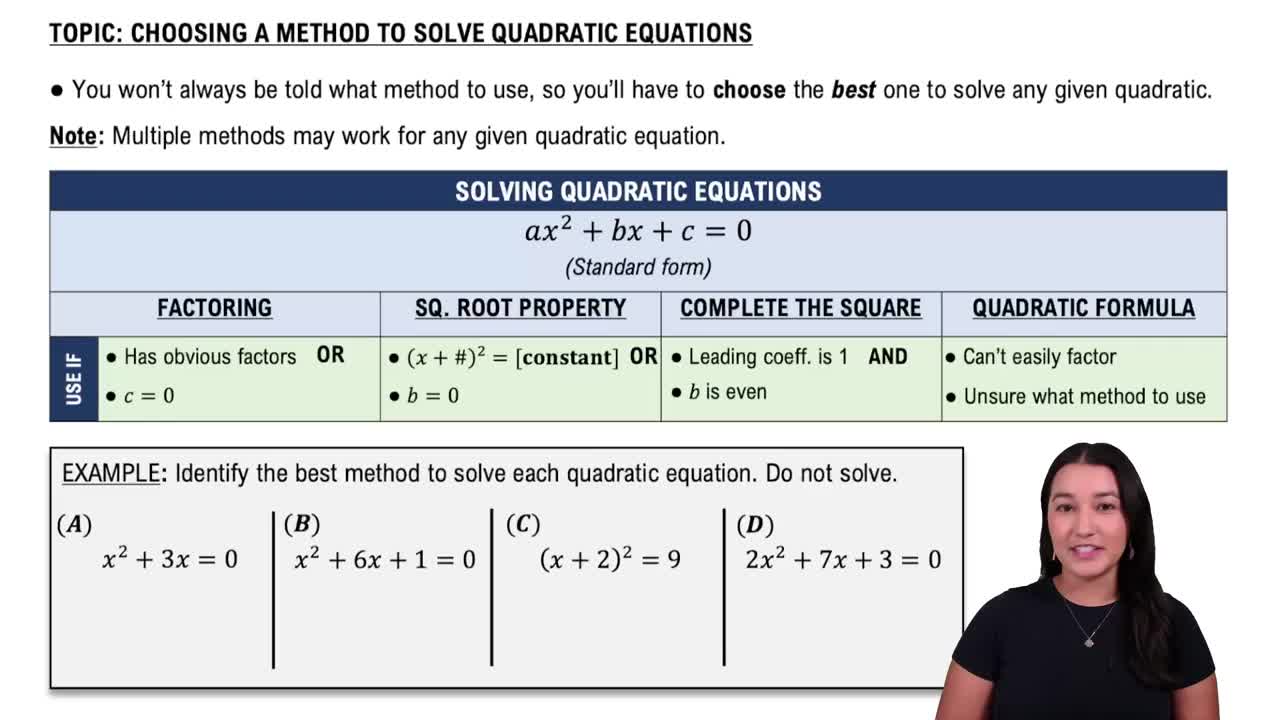
Choosing a Method to Solve Quadratics