Begin by graphing f(x) = 2x. Then use transformations of this graph to graph the given function. Be sure to graph and give equations of the asymptotes. Use the graphs to determine each function's domain and range. If applicable, use a graphing utility to confirm your hand-drawn graphs. h(x) = 2x+1 – 1
Ch. 4 - Exponential and Logarithmic Functions

5장, 문제 27
Begin by graphing f(x) = 2x. Then use transformations of this graph to graph the given function. Be sure to graph and give equations of the asymptotes. Use the graphs to determine each function's domain and range. If applicable, use a graphing utility to confirm your hand-drawn graphs. g(x) = 2x – 1
검증된 단계별 안내1
Start by understanding the base function: \(f(x) = 2^{x}\). This is an exponential function with base 2, which has a graph that passes through the point \((0,1)\) and increases rapidly as \(x\) increases. The horizontal asymptote of this graph is the line \(y = 0\).
Next, analyze the given function \(g(x) = 2^{x} - 1\). Notice that this is a vertical shift of the base function \(f(x)\) downward by 1 unit because of the \(-1\) outside the exponential.
To graph \(g(x)\), take the graph of \(f(x) = 2^{x}\) and shift every point down by 1 unit. For example, the point \((0,1)\) on \(f(x)\) moves to \((0, 0)\) on \(g(x)\).
Determine the new horizontal asymptote for \(g(x)\). Since the original asymptote was \(y = 0\), shifting down by 1 moves the asymptote to \(y = -1\). This means the graph will approach but never cross the line \(y = -1\).
Finally, use the graph to identify the domain and range of \(g(x)\). The domain of an exponential function is all real numbers, so \((-\infty, \infty)\). The range is all values greater than the horizontal asymptote, so for \(g(x)\) it is \((-1, \infty)\).

비슷한 문제에 대한 검증된 영상 답변:
이 영상 해법은 위 문제에 도움이 된다고 튜터들이 추천한 것입니다.
영상 길이:
4m도움이 되었나요?
주요 개념
질문에 올바르게 답하기 위해 반드시 이해해야 하는 핵심 개념들은 다음과 같습니다.
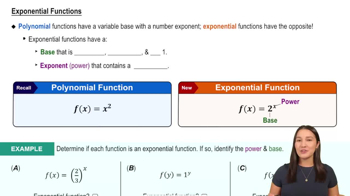
Exponential Functions
An exponential function has the form f(x) = a^x, where the base a is a positive constant not equal to 1. These functions grow or decay rapidly and have unique properties such as always being positive and having a horizontal asymptote. Understanding the basic graph of f(x) = 2^x is essential for applying transformations.
추천 영상:
Exponential Functions
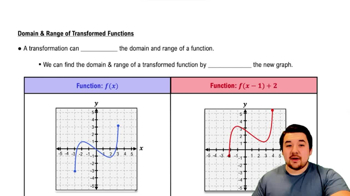
Transformations of Functions
Transformations involve shifting, stretching, compressing, or reflecting the graph of a function. For g(x) = 2^x - 1, subtracting 1 shifts the graph of 2^x downward by 1 unit. Recognizing how these changes affect the graph and asymptotes helps in sketching the new function accurately.
추천 영상:
Domain & Range of Transformed Functions
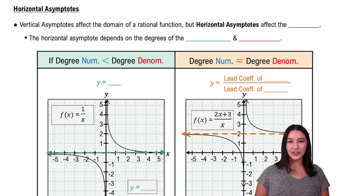
Domain, Range, and Asymptotes
The domain of exponential functions is all real numbers, while the range depends on vertical shifts. The horizontal asymptote is a line the graph approaches but never touches; for f(x) = 2^x, it is y = 0. After transformations, the asymptote shifts accordingly, affecting the range and graph behavior.
추천 영상:
Determining Horizontal Asymptotes
관련 실천
교과서 질문
841
views
교과서 질문
Use properties of logarithms to expand each logarithmic expression as much as possible. Where possible, evaluate logarithmic expressions without using a calculator. log √(100x)
1473
views
교과서 질문
Evaluate each expression without using a calculator. log2 (1/8)
816
views
교과서 질문
Solve each exponential equation in Exercises 23–48. Express the solution set in terms of natural logarithms or common logarithms. Then use a calculator to obtain a decimal approximation, correct to two decimal places, for the solution. 5x=17
704
views
교과서 질문
Use properties of logarithms to expand each logarithmic expression as much as possible. Where possible, evaluate logarithmic expressions without using a calculator. logb ((x2y)/z2)
1186
views
교과서 질문
Evaluate each expression without using a calculator. log7 √7
826
views
