Ch. 4 - Exponential and Logarithmic Functions
Blitzer - College Algebra 8th Edition
Blitzer8th EditionCollege AlgebraISBN: 9780136970514당신이 사용하는 게 아니라요?교과서 변경
5장, 문제 57

In Exercises 53-58, begin by graphing f(x) = log₂ x. Then use transformations of this graph to graph the given function. What is the vertical asymptote? Use the graphs to determine each function's domain and range. g(x) = (1/2)log₂ x

검증된 단계별 안내
1
Start by understanding the base function: \(f(x) = \log_{2} x\). This function has a vertical asymptote at \(x = 0\), a domain of \((0, \infty)\), and a range of \((-\infty, \infty)\).
Next, analyze the given function \(g(x) = \frac{1}{2} \log_{2} x\). Notice that this is a vertical scaling of the original function \(f(x)\) by a factor of \(\frac{1}{2}\).
To graph \(g(x)\), take the graph of \(f(x)\) and compress it vertically by multiplying all \(y\)-values by \(\frac{1}{2}\). This transformation does not affect the \(x\)-values or the vertical asymptote.
Since the vertical asymptote of \(f(x)\) is at \(x = 0\), and the transformation does not shift it horizontally, the vertical asymptote of \(g(x)\) remains at \(x = 0\).
Determine the domain and range of \(g(x)\). The domain remains \((0, \infty)\) because the logarithm is undefined for \(x \leq 0\). The range is all real numbers \((-\infty, \infty)\) because vertical scaling by \(\frac{1}{2}\) does not restrict the output values.

비슷한 문제에 대한 검증된 영상 답변:

이 영상 해법은 위 문제에 도움이 된다고 튜터들이 추천한 것입니다.
영상 길이:
3m
도움이 되었나요?

주요 개념

질문에 올바르게 답하기 위해 반드시 이해해야 하는 핵심 개념들은 다음과 같습니다.

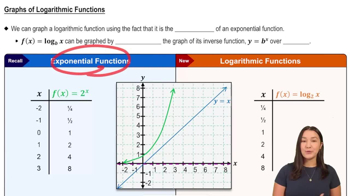
Logarithmic Functions and Their Graphs

A logarithmic function, such as f(x) = log₂ x, is the inverse of an exponential function with base 2. Its graph passes through (1,0) and increases slowly, defined only for x > 0. Understanding its shape and key points is essential for graphing and analyzing transformations.
추천 영상:
5:26
Graphs of Logarithmic Functions

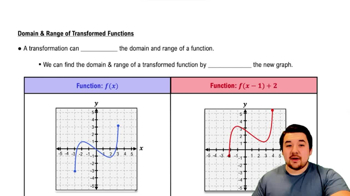
Transformations of Functions

Transformations include vertical stretches/compressions, reflections, and shifts applied to a base graph. For g(x) = (1/2)log₂ x, the factor 1/2 compresses the graph vertically, affecting the steepness but not the domain or vertical asymptote. Recognizing these changes helps in sketching the new graph accurately.
추천 영상:
4:22
Domain & Range of Transformed Functions

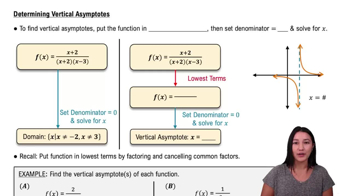
Vertical Asymptotes, Domain, and Range of Logarithmic Functions

Logarithmic functions have a vertical asymptote where the argument equals zero, here at x = 0. The domain is all positive real numbers (x > 0), and the range is all real numbers. Identifying the asymptote and these sets is crucial for understanding the function's behavior and graph.
추천 영상:
3:12
Determining Vertical Asymptotes