Ch. 4 - Exponential and Logarithmic Functions
Blitzer - College Algebra 8th Edition
Blitzer8th EditionCollege AlgebraISBN: 9780136970514당신이 사용하는 게 아니라요?교과서 변경
5장, 문제 64

In Exercises 64–73, solve each exponential equation. Where necessary, express the solution set in terms of natural or common logarithms and use a calculator to obtain a decimal approximation, correct to two decimal places, for the solution. 2^(4x-2) = 64

검증된 단계별 안내
1
Rewrite the equation in exponential form: \(2^{4x-2} = 64\). Recognize that 64 can be expressed as a power of 2, specifically \(64 = 2^6\). This gives \(2^{4x-2} = 2^6\).
Since the bases are the same, set the exponents equal to each other: \(4x - 2 = 6\).
Solve for \(x\) by isolating it. First, add 2 to both sides of the equation: \(4x = 8\).
Divide both sides of the equation by 4 to solve for \(x\): \(x = \frac{8}{4}\).
Simplify the fraction to find \(x\). If needed, verify the solution by substituting \(x\) back into the original equation.

비슷한 문제에 대한 검증된 영상 답변:

이 영상 해법은 위 문제에 도움이 된다고 튜터들이 추천한 것입니다.
영상 길이:
1m
도움이 되었나요?

주요 개념

질문에 올바르게 답하기 위해 반드시 이해해야 하는 핵심 개념들은 다음과 같습니다.

Exponential Equations

Exponential equations are mathematical expressions in which a variable appears in the exponent. To solve these equations, one often needs to rewrite them in a form that allows for easier manipulation, such as expressing both sides with the same base or using logarithms. Understanding the properties of exponents is crucial for simplifying and solving these types of equations.
추천 영상:
5:47
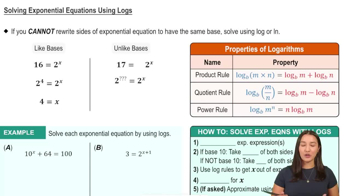
Solving Exponential Equations Using Logs

Logarithms

Logarithms are the inverse operations of exponentiation, allowing us to solve for the exponent in an exponential equation. The logarithm of a number is the exponent to which a base must be raised to produce that number. Familiarity with natural logarithms (base e) and common logarithms (base 10) is essential, especially when expressing solutions in logarithmic form.
추천 영상:
7:30
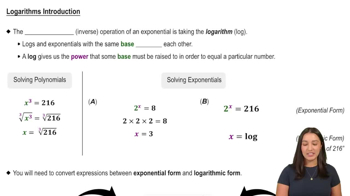
Logarithms Introduction

Calculator Use for Approximations

Using a calculator to obtain decimal approximations is often necessary when dealing with logarithmic solutions or complex exponential equations. Understanding how to input logarithmic functions and interpret the results is vital for accurately finding and rounding solutions to the required decimal places, ensuring precision in mathematical communication.
추천 영상:
5:47
Solving Exponential Equations Using Logs
관련 실천
교과서 질문

Give the equation of each exponential function whose graph is shown.

944
views
교과서 질문

The figure shows the graph of f(x) = ln x. In Exercises 65–74, use transformations of this graph to graph each function. Graph and give equations of the asymptotes. Use the graphs to determine each function's domain and range. g(x) = ln (x+2)

826
views
교과서 질문

Use properties of logarithms to condense each logarithmic expression. Write the expression as a single logarithm whose coefficient is 1. Where possible, evaluate logarithmic expressions without using a calculator. 12(log5x+log5y)2log5(x+1)\(\frac{1}{2}\) \(\left\)( \(\log\)_5 x + \(\log\)_5 y \(\right\)) - 2 \(\log\)_5 (x + 1)

970
views
교과서 질문

The figure shows the graph of f(x) = log x. In Exercises 59–64, use transformations of this graph to graph each function. Graph and give equations of the asymptotes. Use the graphs to determine each function's domain and range.

g(x) = 1-log x

1364
views
교과서 질문

Solve each logarithmic equation in Exercises 49–92. Be sure to reject any value of xx that is not in the domain of the original logarithmic expressions. Give the exact answer. Then, where necessary, use a calculator to obtain a decimal approximation, correct to two decimal places, for the solution. lnx+3=1\(\ln\]\sqrt{x+3}\)=1

938
views
교과서 질문

Use properties of logarithms to condense each logarithmic expression. Write the expression as a single logarithm whose coefficient is 1. Where possible, evaluate logarithmic expressions without using a calculator. (1/2)(log x + log y)

794
views