Ch. 4 - Exponential and Logarithmic Functions
Blitzer - College Algebra 8th Edition
Blitzer8th EditionCollege AlgebraISBN: 9780136970514당신이 사용하는 게 아니라요?교과서 변경
5장, 문제 95

In Exercises 89–102, determine whether each equation is true or false. Where possible, show work to support your conclusion. If the statement is false, make the necessary change(s) to produce a true statement. ln(5x) + ln 1 = ln(5x)

검증된 단계별 안내
1
Recall the logarithmic property that states: ln(a) + ln(b) = ln(a b). This means the sum of two natural logarithms is the natural logarithm of the product of their arguments.
Apply this property to the left side of the equation: ln(5x) + ln(1) = ln(5x 1) = ln(5x).
Recognize that ln(1) = 0 because the natural logarithm of 1 is always zero.
Since the left side simplifies to ln(5x), and the right side is also ln(5x), the equation is true as written.
Therefore, no changes are necessary to make the statement true.

비슷한 문제에 대한 검증된 영상 답변:

이 영상 해법은 위 문제에 도움이 된다고 튜터들이 추천한 것입니다.
영상 길이:
1m
도움이 되었나요?

주요 개념

질문에 올바르게 답하기 위해 반드시 이해해야 하는 핵심 개념들은 다음과 같습니다.

Properties of Logarithms

Logarithms have specific properties that simplify expressions, such as the product rule: ln(a) + ln(b) = ln(ab). Understanding these rules helps in combining or breaking down logarithmic expressions correctly.
추천 영상:
5:36
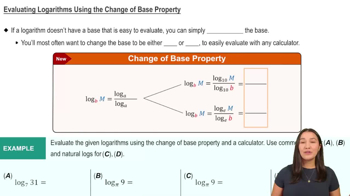
Change of Base Property

Logarithm of One

The natural logarithm of 1, ln(1), is always 0 because e^0 = 1. Recognizing this fact is essential when simplifying logarithmic expressions involving ln(1).
추천 영상:
7:30
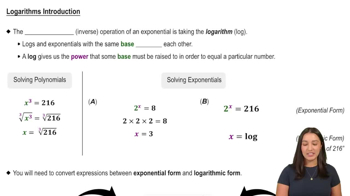
Logarithms Introduction

Equation Verification and Simplification

To determine if an equation involving logarithms is true, simplify both sides using logarithmic properties and evaluate constants. This process helps verify the equality or identify necessary corrections.
추천 영상:
06:00
Categorizing Linear Equations