Ch. 4 - Exponential and Logarithmic Functions
Blitzer - College Algebra 8th Edition
Blitzer8th EditionCollege AlgebraISBN: 9780136970514당신이 사용하는 게 아니라요?교과서 변경
5장, 문제 13

Write each equation in its equivalent logarithmic form. ∛8 = 2

검증된 단계별 안내
1
Identify the given exponential equation: \(\sqrt[3]{8} = 2\). This can be rewritten as \(8^{\frac{1}{3}} = 2\) because the cube root of 8 is the same as raising 8 to the power of \(\frac{1}{3}\).
Recall the relationship between exponential and logarithmic forms: if \(a^x = b\), then the equivalent logarithmic form is \(\log_{a} b = x\).
In the equation \(8^{\frac{1}{3}} = 2\), identify the base \(a = 8\), the exponent \(x = \frac{1}{3}\), and the result \(b = 2\).
Apply the logarithmic form using the identified values: write \(\log_{8} 2 = \frac{1}{3}\).
This expresses the original equation in its equivalent logarithmic form, completing the conversion.

비슷한 문제에 대한 검증된 영상 답변:

이 영상 해법은 위 문제에 도움이 된다고 튜터들이 추천한 것입니다.
영상 길이:
2m
도움이 되었나요?

주요 개념

질문에 올바르게 답하기 위해 반드시 이해해야 하는 핵심 개념들은 다음과 같습니다.

Exponential and Logarithmic Forms

Exponential and logarithmic forms are two ways to express the same relationship. An equation like a^b = c can be rewritten as log_a(c) = b, where the logarithm answers the question: to what power must the base a be raised to get c?
추천 영상:
5:02
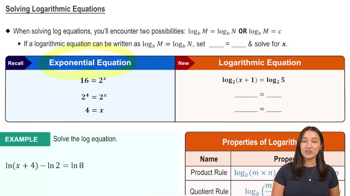
Solving Logarithmic Equations

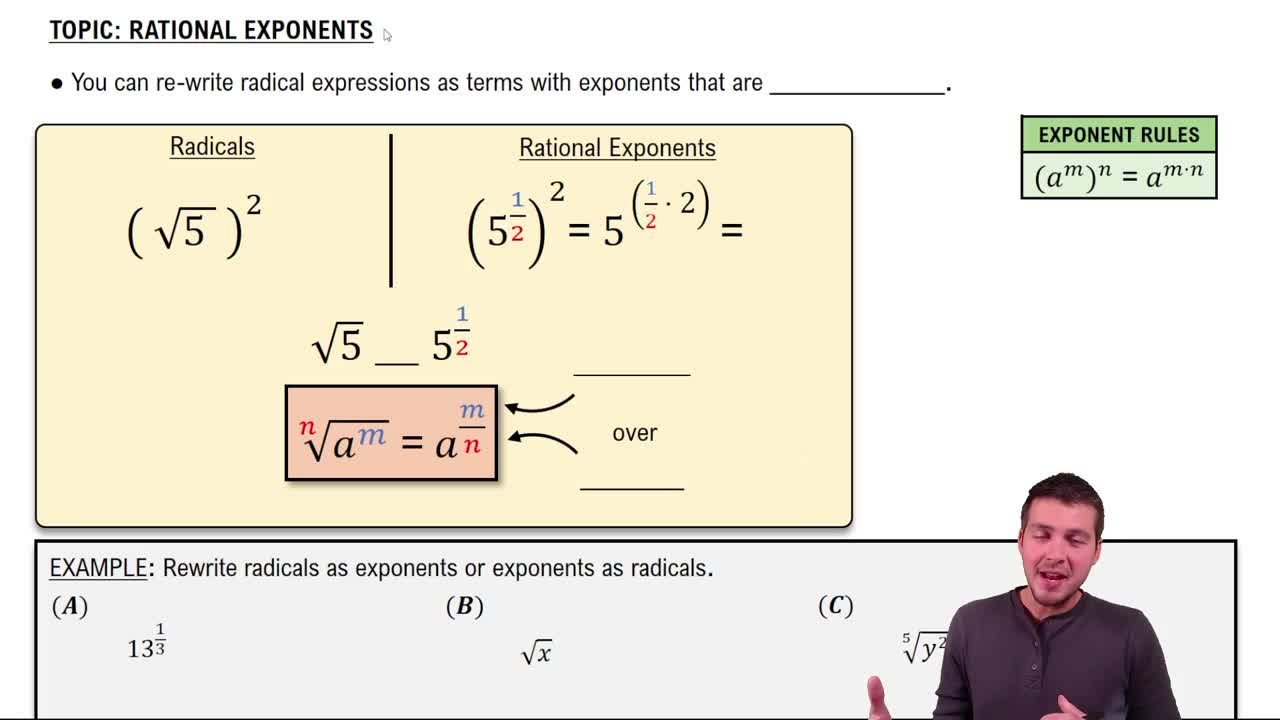
Cube Roots and Rational Exponents

A cube root, such as ∛8, can be expressed as an exponent of 1/3, so ∛8 = 8^(1/3). Understanding this helps convert root expressions into exponential form, which is essential for rewriting equations in logarithmic form.
추천 영상:
가이드 코스
04:06
Rational Exponents

Properties of Logarithms

Logarithms have properties that allow simplification and conversion between forms. Recognizing that log_b(c) = x means b^x = c is key to rewriting equations, especially when dealing with roots and powers.
추천 영상:
5:36
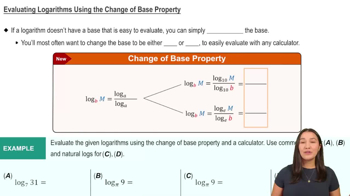
Change of Base Property