Determine whether each equation is true or false. Where possible, show work to support your conclusion. If the statement is false, make the necessary change(s) to produce a true statement.
Ch. 4 - Exponential and Logarithmic Functions

5장, 문제 99
Solve each equation. ln(2x+1)+ln(x−3)−2 ln x=0
검증된 단계별 안내1
Recall the logarithm property that allows combining sums and differences of logarithms: \(\ln a + \ln b = \ln(ab)\) and \(k \ln a = \ln(a^k)\). Use these to combine the terms on the left side of the equation.
Apply the properties to rewrite the equation \(\ln(2x+1) + \ln(x-3) - 2 \ln x = 0\) as a single logarithm: \(\ln\left((2x+1)(x-3)\right) - \ln(x^2) = 0\).
Use the logarithm subtraction property \(\ln A - \ln B = \ln\left(\frac{A}{B}\right)\) to combine the expression into one logarithm: \(\ln\left(\frac{(2x+1)(x-3)}{x^2}\right) = 0\).
Since \(\ln y = 0\) implies \(y = 1\), set the argument of the logarithm equal to 1: \(\frac{(2x+1)(x-3)}{x^2} = 1\).
Multiply both sides by \(x^2\) to clear the denominator and then expand and simplify the resulting quadratic equation. Solve for \(x\), remembering to check that your solutions satisfy the original domain restrictions for the logarithms.

비슷한 문제에 대한 검증된 영상 답변:
이 영상 해법은 위 문제에 도움이 된다고 튜터들이 추천한 것입니다.
영상 길이:
7m도움이 되었나요?
주요 개념
질문에 올바르게 답하기 위해 반드시 이해해야 하는 핵심 개념들은 다음과 같습니다.
Properties of Logarithms
Understanding the properties of logarithms, such as the product, quotient, and power rules, is essential. For example, ln(a) + ln(b) = ln(ab) and k ln(a) = ln(a^k). These allow combining or simplifying logarithmic expressions to solve equations effectively.
추천 영상:
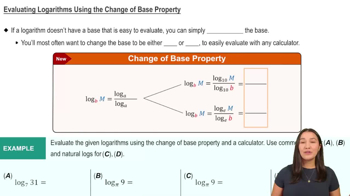
Change of Base Property
Domain of Logarithmic Functions
The domain of a logarithmic function includes only positive arguments. When solving equations involving ln(x), ensure that expressions inside the logarithms are greater than zero to find valid solutions and avoid extraneous roots.
추천 영상:
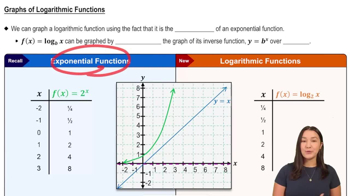
Graphs of Logarithmic Functions
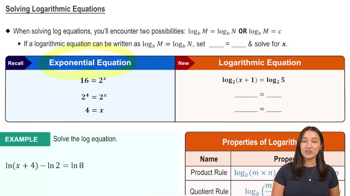
Solving Logarithmic Equations
Solving logarithmic equations often involves rewriting the equation using logarithm properties, then exponentiating both sides to eliminate the logarithm. This transforms the equation into a polynomial or rational form that can be solved using algebraic methods.
추천 영상:
Solving Logarithmic Equations
관련 실천
교과서 질문
907
views
교과서 질문
Solve each equation. ln 3−ln(x+5)−ln x=0
733
views
교과서 질문
Determine whether each equation is true or false. Where possible, show work to support your conclusion. If the statement is false, make the necessary change(s) to produce a true statement. log6 [4(x + 1)] = log6 (4) + log6 (x + 1)
768
views
교과서 질문
Solve each equation.
685
views
교과서 질문
In Exercises 89–102, determine whether each equation is true or false. Where possible, show work to support your conclusion. If the statement is false, make the necessary change(s) to produce a true statement.
761
views
교과서 질문
Evaluate or simplify each expression without using a calculator. 10log √x
833
views