Ch. 4 - Exponential and Logarithmic Functions
Blitzer - College Algebra 8th Edition
Blitzer8th EditionCollege AlgebraISBN: 9780136970514당신이 사용하는 게 아니라요?교과서 변경
5장, 문제 41

Solve each exponential equation in Exercises 23–48. Express the solution set in terms of natural logarithms or common logarithms. Then use a calculator to obtain a decimal approximation, correct to two decimal places, for the solution. 5(2x+3)=3(x−1)

검증된 단계별 안내
1
Start with the given exponential equation: \(5^{(2x+3)} = 3^{(x-1)}\).
Take the natural logarithm (ln) of both sides to bring down the exponents: \(\ln\left(5^{(2x+3)}\right) = \ln\left(3^{(x-1)}\right)\).
Use the logarithm power rule to move the exponents in front: \((2x+3) \ln(5) = (x-1) \ln(3)\).
Distribute the logarithms: \(2x \ln(5) + 3 \ln(5) = x \ln(3) - \ln(3)\).
Collect all terms involving \(x\) on one side and constants on the other: \(2x \ln(5) - x \ln(3) = - \ln(3) - 3 \ln(5)\), then factor out \(x\) and solve for \(x\).

비슷한 문제에 대한 검증된 영상 답변:

이 영상 해법은 위 문제에 도움이 된다고 튜터들이 추천한 것입니다.
영상 길이:
4m
도움이 되었나요?

주요 개념

질문에 올바르게 답하기 위해 반드시 이해해야 하는 핵심 개념들은 다음과 같습니다.

Exponential Equations

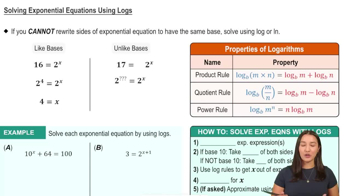
Exponential equations involve variables in the exponent, such as 5^(2x+3) = 3^(x−1). Solving these requires rewriting or applying logarithms to isolate the variable. Understanding how to manipulate and equate exponential expressions is essential for finding solutions.
추천 영상:
5:47
Solving Exponential Equations Using Logs

Logarithms and Their Properties

Logarithms are the inverse operations of exponentials and help solve equations where the variable is an exponent. Using properties like log(a^b) = b·log(a) allows us to bring exponents down and solve for the variable. Both natural (ln) and common (log) logarithms can be used depending on convenience.
추천 영상:
5:36
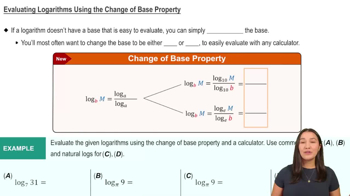
Change of Base Property

Using Calculators for Approximation

After expressing the solution in logarithmic form, calculators are used to find decimal approximations. This step involves evaluating logarithmic expressions and rounding the result to a specified precision, such as two decimal places, to provide a practical numerical answer.
추천 영상:
5:47
Solving Exponential Equations Using Logs
관련 실천
교과서 질문

Use properties of logarithms to condense each logarithmic expression. Write the expression as a single logarithm whose coefficient is 1. Where possible, evaluate logarithmic expressions without using a calculator. log 5 + log 2

1032
views
교과서 질문

Evaluate each expression without using a calculator. 8log8198^{\(\log\)_8 19}

728
views
교과서 질문

Solve each exponential equation in Exercises 23–48. Express the solution set in terms of natural logarithms or common logarithms. Then use a calculator to obtain a decimal approximation, correct to two decimal places, for the solution. e2x−3ex+2=0

933
views
교과서 질문

Use properties of logarithms to condense each logarithmic expression. Write the expression as a single logarithm whose coefficient is 1. Where possible, evaluate logarithmic expressions without using a calculator. ln x + ln 7

758
views
교과서 질문

In Exercises 39–40, graph f and g in the same rectangular coordinate system. Use transformations of the graph of f to obtain the graph of g. Graph and give equations of all asymptotes. Use the graphs to determine each function's domain and range. f(x) = ln x and g(x) = - ln (2x)

1144
views
교과서 질문

The figure shows the graph of f(x) = ex. In Exercises 35-46, use transformations of this graph to graph each function. Be sure to give equations of the asymptotes. Use the graphs to determine graphs. each function's domain and range. If applicable, use a graphing utility to confirm your hand-drawn h(x) = e-x

1039
views