Ch. 4 - Exponential and Logarithmic Functions
Blitzer - College Algebra 8th Edition
Blitzer8th EditionCollege AlgebraISBN: 9780136970514당신이 사용하는 게 아니라요?교과서 변경
5장, 문제 87

Solve each logarithmic equation in Exercises 49–92. Be sure to reject any value of x that is not in the domain of the original logarithmic expressions. Give the exact answer. Then, where necessary, use a calculator to obtain a decimal approximation, correct to two decimal places, for the solution. log x+log(x+3)=log 10

검증된 단계별 안내
1
Recall the logarithmic property that states \( \log a + \log b = \log (a \times b) \). Use this to combine the left side of the equation: \( \log x + \log (x+3) = \log [x(x+3)] \).
Rewrite the equation using the combined logarithm: \( \log [x(x+3)] = \log 10 \).
Since the logarithms are equal and have the same base, set their arguments equal: \( x(x+3) = 10 \).
Expand and rewrite the equation as a quadratic: \( x^2 + 3x = 10 \), then bring all terms to one side to get \( x^2 + 3x - 10 = 0 \).
Solve the quadratic equation using the quadratic formula or factoring, then check each solution to ensure it makes the arguments of the original logarithms positive (i.e., \( x > 0 \) and \( x+3 > 0 \)) to determine valid solutions.

비슷한 문제에 대한 검증된 영상 답변:

이 영상 해법은 위 문제에 도움이 된다고 튜터들이 추천한 것입니다.
영상 길이:
4m
도움이 되었나요?

주요 개념

질문에 올바르게 답하기 위해 반드시 이해해야 하는 핵심 개념들은 다음과 같습니다.

Properties of Logarithms

Understanding the properties of logarithms, especially the product rule, is essential. The product rule states that log(a) + log(b) = log(ab), which allows combining multiple logarithmic terms into a single logarithm, simplifying the equation for easier solving.
추천 영상:
5:36
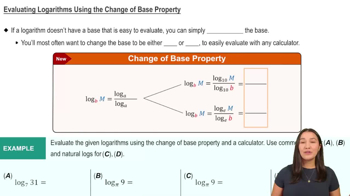
Change of Base Property

Domain of Logarithmic Functions

The domain of a logarithmic function includes only positive real numbers. When solving logarithmic equations, it is crucial to check that the solutions do not make any argument of the logarithm zero or negative, as these values are not valid in the original equation.
추천 영상:
5:26
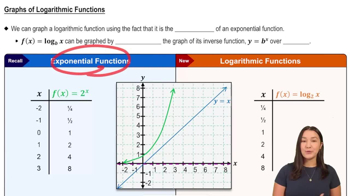
Graphs of Logarithmic Functions

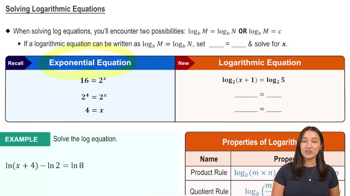
Solving Logarithmic Equations

After applying logarithmic properties, the equation often reduces to an algebraic form. Solving this algebraic equation involves isolating the variable and finding exact solutions, which can then be approximated using a calculator if needed.
추천 영상:
5:02
Solving Logarithmic Equations