Ch. 4 - Exponential and Logarithmic Functions
Blitzer - College Algebra 8th Edition
Blitzer8th EditionCollege AlgebraISBN: 9780136970514당신이 사용하는 게 아니라요?교과서 변경
5장, 문제 89

Solve each logarithmic equation in Exercises 49–92. Be sure to reject any value of x that is not in the domain of the original logarithmic expressions. Give the exact answer. Then, where necessary, use a calculator to obtain a decimal approximation, correct to two decimal places, for the solution. ln(x−4)+ln(x+1)=ln(x−8)

검증된 단계별 안내
1
Recall the logarithmic property that allows us to combine sums of logarithms: \(\ln a + \ln b = \ln(ab)\). Apply this to the left side of the equation to combine the logarithms: \(\ln(x - 4) + \ln(x + 1) = \ln((x - 4)(x + 1))\).
Rewrite the equation using the combined logarithm: \(\ln((x - 4)(x + 1)) = \ln(x - 8)\).
Since the natural logarithm function \(\ln\) is one-to-one, set the arguments equal to each other: \((x - 4)(x + 1) = x - 8\).
Expand the left side: \(x^2 + x - 4x - 4 = x - 8\), which simplifies to \(x^2 - 3x - 4 = x - 8\).
Bring all terms to one side to form a quadratic equation: \(x^2 - 3x - 4 - x + 8 = 0\), which simplifies to \(x^2 - 4x + 4 = 0\). Then solve this quadratic equation for \(x\).

비슷한 문제에 대한 검증된 영상 답변:

이 영상 해법은 위 문제에 도움이 된다고 튜터들이 추천한 것입니다.
영상 길이:
4m
도움이 되었나요?

주요 개념

질문에 올바르게 답하기 위해 반드시 이해해야 하는 핵심 개념들은 다음과 같습니다.

Properties of Logarithms

Understanding the properties of logarithms, such as the product rule ln(a) + ln(b) = ln(ab), is essential for combining or simplifying logarithmic expressions. This allows the equation ln(x−4) + ln(x+1) = ln(x−8) to be rewritten as a single logarithm, facilitating easier solving.
추천 영상:
5:36
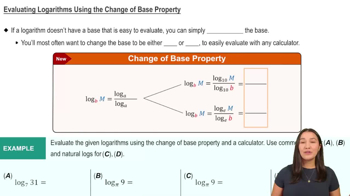
Change of Base Property

Domain of Logarithmic Functions

The domain of a logarithmic function includes only positive arguments because the logarithm of zero or a negative number is undefined. When solving equations like ln(x−4), ensure that x−4 > 0, x+1 > 0, and x−8 > 0 to find valid solutions and reject extraneous roots.
추천 영상:
5:26
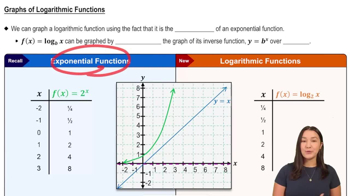
Graphs of Logarithmic Functions

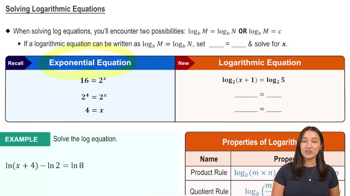
Solving Logarithmic Equations

After applying logarithmic properties, convert the equation from logarithmic form to an algebraic equation to solve for x. For example, if ln(A) = ln(B), then A = B. This step simplifies the problem to solving polynomial or rational equations, which can then be checked against the domain restrictions.
추천 영상:
5:02
Solving Logarithmic Equations