Ch. 4 - Exponential and Logarithmic Functions
Blitzer - College Algebra 8th Edition
Blitzer8th EditionCollege AlgebraISBN: 9780136970514당신이 사용하는 게 아니라요?교과서 변경
5장, 문제 39

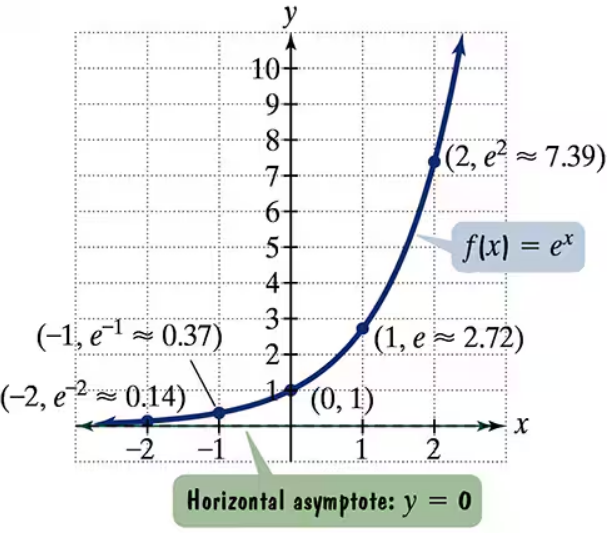
The figure shows the graph of f(x) = ex. In Exercises 35-46, use transformations of this graph to graph each function. Be sure to give equations of the asymptotes. Use the graphs to determine graphs. each function's domain and range. If applicable, use a graphing utility to confirm your hand-drawn h(x) = ex-1+2
Graph of the exponential function f(x) = e^x with key points and horizontal asymptote y = 0 shown.

검증된 단계별 안내
1
Identify the base function and its graph: The base function is \(f(x) = e^{x}\), which is an exponential function with a horizontal asymptote at \(y = 0\), domain \((-\infty, \infty)\), and range \((0, \infty)\).
Analyze the transformation inside the exponent: The function \(h(x) = e^{x-1} + 2\) has \(x-1\) inside the exponent, which represents a horizontal shift. Specifically, replacing \(x\) by \(x - 1\) shifts the graph of \(f(x)\) to the right by 1 unit.
Analyze the transformation outside the exponent: The \(+2\) outside the exponential function shifts the entire graph vertically upward by 2 units. This affects the horizontal asymptote, moving it from \(y = 0\) to \(y = 2\).
Write the equation of the asymptote: Since the graph is shifted up by 2, the horizontal asymptote is \(y = 2\).
Determine the domain and range of \(h(x)\): The domain remains all real numbers \((-\infty, \infty)\) because exponential functions are defined for all real \(x\). The range is shifted up by 2, so it becomes \((2, \infty)\).

비슷한 문제에 대한 검증된 영상 답변:

이 영상 해법은 위 문제에 도움이 된다고 튜터들이 추천한 것입니다.
영상 길이:
10m
도움이 되었나요?

주요 개념

질문에 올바르게 답하기 위해 반드시 이해해야 하는 핵심 개념들은 다음과 같습니다.

Exponential Function and Its Graph

The exponential function f(x) = e^x is a fundamental function where the variable is in the exponent. Its graph passes through (0,1), is always positive, and increases rapidly. Understanding its shape and behavior is essential for applying transformations and analyzing domain and range.
추천 영상:
5:46
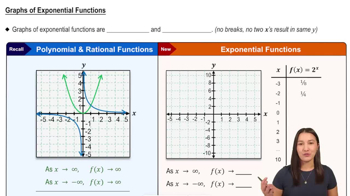
Graphs of Exponential Functions

Transformations of Functions

Transformations include shifts, stretches, and reflections applied to the base graph. For h(x) = e^(x-1) + 2, the graph shifts right by 1 unit and up by 2 units. Recognizing these changes helps in sketching the new graph and identifying changes in asymptotes, domain, and range.
추천 영상:
4:22
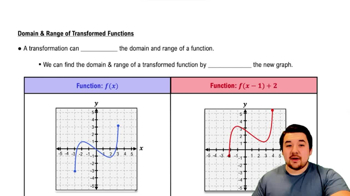
Domain & Range of Transformed Functions

Asymptotes, Domain, and Range of Exponential Functions

Exponential functions have a horizontal asymptote, typically y=0 for e^x. Transformations shift this asymptote accordingly, e.g., y=2 for h(x). The domain of e^x is all real numbers, and the range is positive real numbers; transformations affect the range but not the domain.
추천 영상:
4:22
Domain & Range of Transformed Functions