
교과서 질문
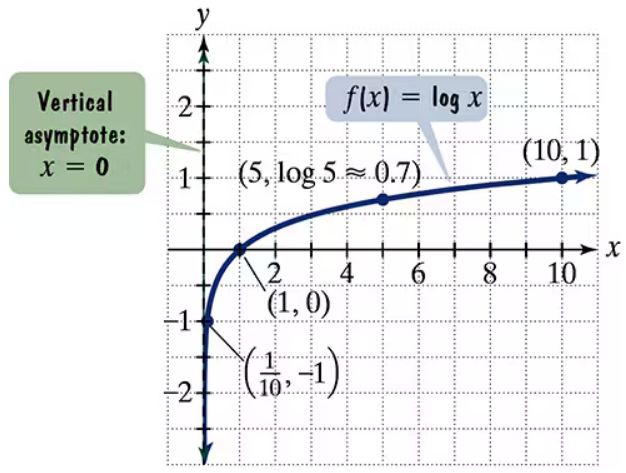
In Exercises 60–63, determine whether each equation is true or false. Where possible, show work to support your conclusion. If the statement is false, make the necessary change(s) to produce a true statement. (log2 x)^4 = 4 log2 x
725
views

 검증된 단계별 안내
 5:26
5:26
 4:22
4:22 4:48
4:48In Exercises 60–63, determine whether each equation is true or false. Where possible, show work to support your conclusion. If the statement is false, make the necessary change(s) to produce a true statement. (log2 x)^4 = 4 log2 x
In Exercises 60–63, determine whether each equation is true or false. Where possible, show work to support your conclusion. If the statement is false, make the necessary change(s) to produce a true statement. (ln x)(ln 1) = 0
Give the equation of each exponential function whose graph is shown.
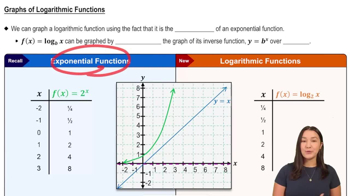
Graph y= 2x and x = 2y in the same rectangular coordinate system.
Use properties of logarithms to condense each logarithmic expression. Write the expression as a single logarithm whose coefficient is 1. Where possible, evaluate logarithmic expressions without using a calculator. 3 ln x + 5 ln y - 6 ln z
Solve each logarithmic equation in Exercises 49–92. Be sure to reject any value of x that is not in the domain of the original logarithmic expressions. Give the exact answer. Then, where necessary, use a calculator to obtain a decimal approximation, correct to two decimal places, for the solution. 5 ln(2x)=20