Ch. 4 - Exponential and Logarithmic Functions
Blitzer - College Algebra 8th Edition
Blitzer8th EditionCollege AlgebraISBN: 9780136970514당신이 사용하는 게 아니라요?교과서 변경
5장, 문제 55

Use the compound interest formulas A = P (1+ r/n)nt and A =Pert to solve exercises 53-56. Round answers to the nearest cent. Suppose that you have \$12,000 to invest. Which investment yields the greater return over 3 years: 0.96% compounded monthly or 0.95% compounded continuously?

검증된 단계별 안내
1
Identify the given values: the principal amount \(P = 12000\), the time period \(t = 3\) years, the interest rates \(r_1 = 0.0096\) (0.96%) for monthly compounding, and \(r_2 = 0.0095\) (0.95%) for continuous compounding.
For the investment compounded monthly, use the formula \(A = P \left(1 + \frac{r}{n}\right)^{nt}\), where \(n = 12\) (months per year). Substitute the values to get \(A_1 = 12000 \left(1 + \frac{0.0096}{12}\right)^{12 \times 3}\).
For the investment compounded continuously, use the formula \(A = Pe^{rt}\). Substitute the values to get \(A_2 = 12000 \times e^{0.0095 \times 3}\).
Calculate the expressions inside the parentheses and exponents separately for both formulas, but do not compute the final numerical values yet.
Compare the two amounts \(A_1\) and \(A_2\) after evaluating the expressions to determine which investment yields the greater return over 3 years.

비슷한 문제에 대한 검증된 영상 답변:

이 영상 해법은 위 문제에 도움이 된다고 튜터들이 추천한 것입니다.
영상 길이:
3m
도움이 되었나요?

주요 개념

질문에 올바르게 답하기 위해 반드시 이해해야 하는 핵심 개념들은 다음과 같습니다.

Compound Interest Formula (Periodic Compounding)

This formula, A = P(1 + r/n)^(nt), calculates the amount of money accumulated after interest is compounded periodically. Here, P is the principal, r is the annual interest rate, n is the number of compounding periods per year, and t is the time in years. It helps determine the future value of an investment with discrete compounding intervals.
추천 영상:
4:47
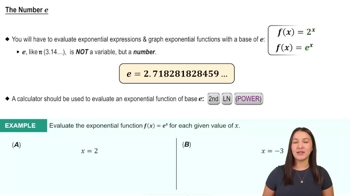
The Number e

Continuous Compounding Formula

The formula A = Pe^(rt) models interest compounded continuously, where e is Euler’s number (~2.718). This represents the limit of compounding frequency increasing indefinitely. It is used to find the future value when interest is added constantly, providing a slightly higher return than periodic compounding at the same rate.
추천 영상:
06:36
Solving Quadratic Equations Using The Quadratic Formula

Comparing Investment Returns

To determine which investment yields a greater return, calculate the final amounts using both compounding methods with the given rates and time. Comparing these results shows which option grows the principal more. Rounding to the nearest cent ensures practical financial interpretation.
추천 영상:
관련 실천
교과서 질문

In Exercises 54–57, use properties of logarithms to condense each logarithmic expression. Write the expression as a single logarithm whose coefficient is 11. log33logx\(\log\)3-3\(\log\) x

1176
views
교과서 질문

Use properties of logarithms to condense each logarithmic expression. Write the expression as a single logarithm whose coefficient is 1. Where possible, evaluate logarithmic expressions without using a calculator. 5 ln x - 2 ln y

1059
views
교과서 질문

Begin by graphing f(x) = log₂ x. Then use transformations of this graph to graph the given function. What is the vertical asymptote? Use the graphs to determine each function's domain and range. h(x) = 2 + log2x

1057
views
교과서 질문

Solve each logarithmic equation in Exercises 49–92. Be sure to reject any value of x that is not in the domain of the original logarithmic expressions. Give the exact answer. Then, where necessary, use a calculator to obtain a decimal approximation, correct to two decimal places, for the solution. log2(x+25)=4

790
views
교과서 질문

Use the compound interest formulas A = P (1+ r/n)nt and A =Pert to solve exercises 53-56. Round answers to the nearest cent. Find the accumulated value of an investment of \$10,000 for 5 years at an interest rate of 1.32% if the money is d. compounded continuously.

2908
views
교과서 질문

Begin by graphing f(x) = log₂ x. Then use transformations of this graph to graph the given function. What is the vertical asymptote? Use the graphs to determine each function's domain and range. h(x)=1+ log₂ x

732
views