Ch. 5 - Systems of Equations and Inequalities
Blitzer - College Algebra 8th Edition
Blitzer8th EditionCollege AlgebraISBN: 9780136970514당신이 사용하는 게 아니라요?교과서 변경
6장, 문제 3

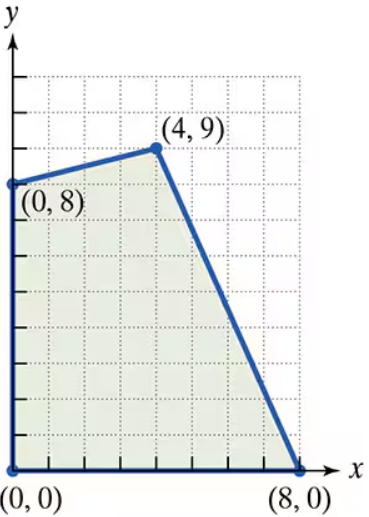
Find the value of the objective function at each corner of the graphed region. What is the maximum value of the objective function? What is the minimum value of the objective function? 1. Objective Function z=40x+50y
Graph showing a shaded polygon with vertices at (0,0), (0,8), (4,9), and (8,0) on an xy-coordinate plane.

검증된 단계별 안내
1
Identify the corner points of the feasible region from the graph. The points are (0, 0), (0, 10), (6, 8), and (10, 0).
Write down the objective function: \(z = 40x + 50y\).
Calculate the value of the objective function at each corner point by substituting the coordinates into the function:
At (0, 0): \(z = 40(0) + 50(0)\)
At (0, 10): \(z = 40(0) + 50(10)\)
At (6, 8): \(z = 40(6) + 50(8)\)
At (10, 0): \(z = 40(10) + 50(0)\)
Compare the calculated values to determine which is the maximum and which is the minimum value of the objective function.

비슷한 문제에 대한 검증된 영상 답변:

이 영상 해법은 위 문제에 도움이 된다고 튜터들이 추천한 것입니다.
영상 길이:
3m

주요 개념

질문에 올바르게 답하기 위해 반드시 이해해야 하는 핵심 개념들은 다음과 같습니다.

Objective Function

An objective function is a mathematical expression that defines the goal of an optimization problem, often to maximize or minimize a value. In this problem, z = 40x + 50y represents the objective function, where x and y are variables, and the goal is to find the maximum and minimum values of z within the feasible region.
추천 영상:
6:37
Permutations of Non-Distinct Objects

Feasible Region and Corner Points

The feasible region is the set of all possible points (x, y) that satisfy the problem's constraints, shown as the shaded area on the graph. The corner points (vertices) of this region are critical because, according to the linear programming theory, the maximum and minimum values of the objective function occur at these points.
추천 영상:
05:46
Point-Slope Form

Evaluating the Objective Function at Corner Points

To find the maximum and minimum values of the objective function, substitute the coordinates of each corner point into the function z = 40x + 50y. Calculate z for each vertex, then compare these values to identify which is the largest (maximum) and which is the smallest (minimum).
추천 영상:
4:26
Evaluating Composed Functions