Ch. 6 - Matrices and Determinants
Blitzer - College Algebra 8th Edition
Blitzer8th EditionCollege AlgebraISBN: 9780136970514당신이 사용하는 게 아니라요?교과서 변경
7장, 문제 40

In Exercises 39–42, find A^(-1) Check that AA^-1 = I and A^(-1)A = I

검증된 단계별 안내
1
Step 1: Recall the definition of the inverse of a matrix. A matrix A has an inverse A^(-1) if and only if A is a square matrix (same number of rows and columns) and its determinant is non-zero. The inverse satisfies the property that AA^(-1) = I and A^(-1)A = I, where I is the identity matrix.
Step 2: Compute the determinant of the matrix A. For a 2x2 matrix A = [[a, b], [c, d]], the determinant is given by det(A) = ad - bc. If the determinant is zero, the matrix does not have an inverse.
Step 3: If the determinant is non-zero, calculate the inverse of the matrix. For a 2x2 matrix A = [[a, b], [c, d]], the inverse is given by A^(-1) = (1/det(A)) * [[d, -b], [-c, a]]. Replace the elements of the matrix and the determinant into this formula to find A^(-1).
Step 4: Verify that AA^(-1) = I by performing matrix multiplication. Multiply the original matrix A by its inverse A^(-1) and confirm that the result is the identity matrix I.
Step 5: Similarly, verify that A^(-1)A = I by performing matrix multiplication in the reverse order. Multiply the inverse A^(-1) by the original matrix A and confirm that the result is the identity matrix I.

비슷한 문제에 대한 검증된 영상 답변:

이 영상 해법은 위 문제에 도움이 된다고 튜터들이 추천한 것입니다.
영상 길이:
7m
도움이 되었나요?

주요 개념

질문에 올바르게 답하기 위해 반드시 이해해야 하는 핵심 개념들은 다음과 같습니다.

Inverse of a Matrix

The inverse of a matrix A, denoted A^(-1), is a matrix that, when multiplied by A, yields the identity matrix I. This means that A * A^(-1) = I and A^(-1) * A = I. Not all matrices have inverses; a matrix must be square and have a non-zero determinant to possess an inverse.
추천 영상:
4:30
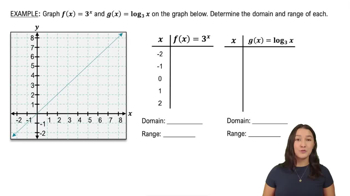
Graphing Logarithmic Functions

Identity Matrix

The identity matrix, denoted I, is a special square matrix that has ones on the diagonal and zeros elsewhere. It acts as the multiplicative identity in matrix multiplication, meaning that for any matrix A, multiplying by I leaves A unchanged (A * I = A). The identity matrix is crucial for verifying the correctness of matrix inverses.
추천 영상:
4:35
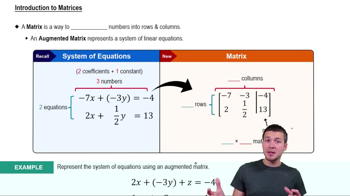
Introduction to Matrices

Matrix Multiplication

Matrix multiplication involves combining two matrices to produce a third matrix. The number of columns in the first matrix must equal the number of rows in the second. The resulting matrix's elements are calculated by taking the dot product of the rows of the first matrix with the columns of the second, which is essential for checking the properties of inverses.
추천 영상:
03:42
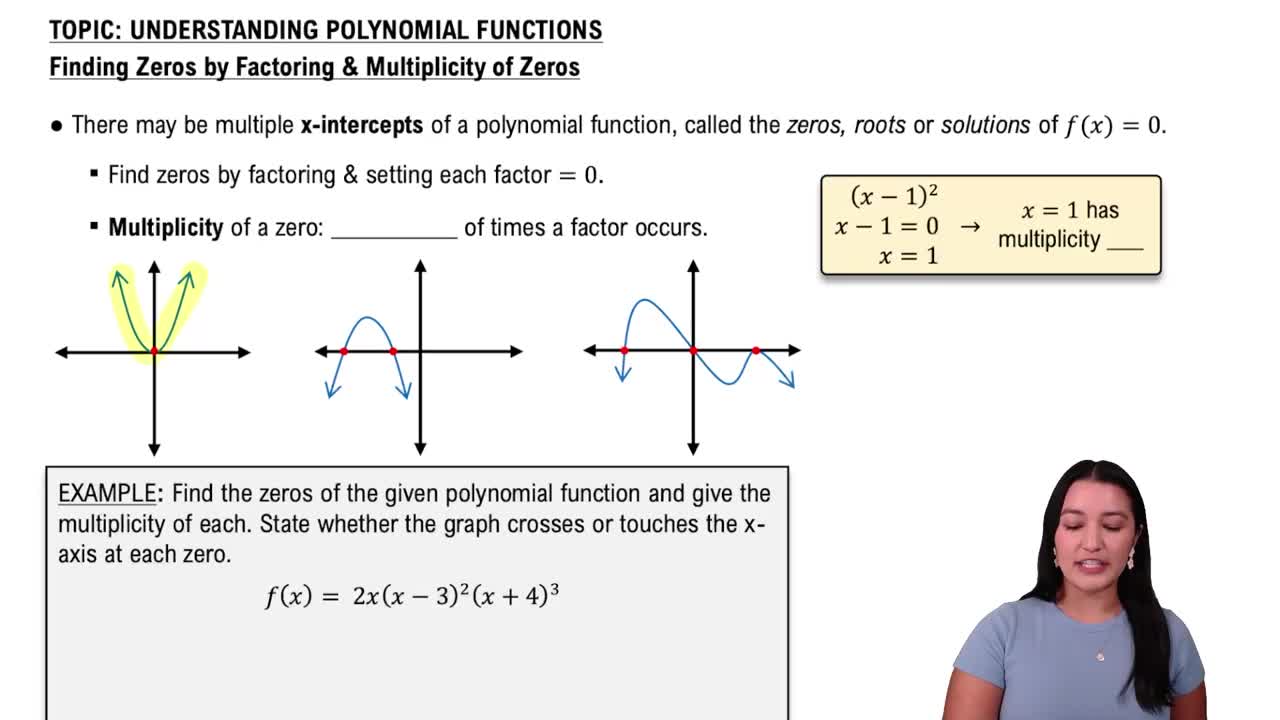
Finding Zeros & Their Multiplicity
관련 실천
교과서 질문

Perform the indicated matrix operations given that A, B and C are defined as follows. If an operation is not defined, state the reason.

A=[403501],B=[5122],C=[1111]A=\(\begin{bmatrix}\)4 & 0\\ -3 & 5\\ 0 & 1\(\end{bmatrix}\),B=\(\begin{bmatrix}\)5 & 1\\ -2 & -2\(\end{bmatrix}\),C=\(\begin{bmatrix}\)1 & -1\\ -1 & 1\(\end{bmatrix}\)

A - C

111
views
교과서 질문

In Exercises 37–44, use Cramer's Rule to solve each system. {4x5y6z=1x2y5z=122xy=7\(\begin{cases}\) 4x - 5y - 6z = -1 \\ x - 2y - 5z = -12 \\ 2x - y = 7 \(\end{cases}\)

939
views
교과서 질문

Perform the indicated matrix operations given that A, B and C are defined as follows. If an operation is not defined, state the reason.

A=[403501],B=[5122],C=[1111]A=\(\begin{bmatrix}\)4 & 0\\ -3 & 5\\ 0 & 1\(\end{bmatrix}\),B=\(\begin{bmatrix}\)5 & 1\\ -2 & -2\(\end{bmatrix}\),C=\(\begin{bmatrix}\)1 & -1\\ -1 & 1\(\end{bmatrix}\)

BC + CB

141
views
교과서 질문

Find the cubic function f(x) = ax³ + bx² + cx + d for which ƒ( − 1) = 0, ƒ(1) = 2, ƒ(2) = 3, and ƒ(3) = 12.

855
views
교과서 질문

Find the quadratic function f(x) = ax² + bx + c for which ƒ( − 2) = −4, ƒ(1) = 2, and f(2) = 0.

874
views
교과서 질문

a. Write each linear system as a matrix equation in the form AX = B. b. Solve the system using the inverse that is given for the coefficient matrix.

{wx+2y=3xy+z=4w+xy+2z=2x+y2z=4The inverse of [1120011111120112] is [0011141312120101]\(\begin{cases}\) w - x + 2y \(\quad\]\quad\) = -3 \\ \(\quad\[\quad\) x - y + z = 4 \\ -w + x - y + 2z = 2 \\ \(\quad\]\quad\) -x + y - 2z = -4 \(\end{cases}\) \\ \(\text{The inverse of }\) \(\begin{bmatrix}\) 1 & -1 & 2 & 0 \\ 0 & 1 & -1 & 1 \\ -1 & 1 & -1 & 2 \\ 0 & -1 & 1 & -2 \(\end{bmatrix}\) \(\text{ is }\) \(\begin{bmatrix}\) 0 & 0 & -1 & -1 \\ 1 & 4 & 1 & 3 \\ 1 & 2 & 1 & 2 \\ 0 & -1 & 0 & -1 \(\end{bmatrix}\)

707
views