Ch. 6 - Matrices and Determinants
Blitzer - College Algebra 8th Edition
Blitzer8th EditionCollege AlgebraISBN: 9780136970514당신이 사용하는 게 아니라요?교과서 변경
7장, 문제 43

Solve the system: (Hint: Let A = ln w, B = ln x, C = ln y, and D = ln z. Solve the system for A, B, C, and D. Then use the logarithmic equations to find w, x, y, and z.)
{2lnw+lnx+3lny2lnz=64lnw+3lnx+lnylnz=2lnw+lnx+lny+lnz=5lnw+lnxlnylnz=5\(\begin{cases}\) 2 \(\ln\) w + \(\ln\) x + 3 \(\ln\) y - 2 \(\ln\) z = -6 \\ 4 \(\ln\) w + 3 \(\ln\) x + \(\ln\) y - \(\ln\) z = -2 \\ \(\ln\) w + \(\ln\) x + \(\ln\) y + \(\ln\) z = -5 \\ \(\ln\) w + \(\ln\) x - \(\ln\) y - \(\ln\) z = 5 \(\end{cases}\)

검증된 단계별 안내
1
Step 1: Introduce the substitutions as given: let \(A = \ln w\), \(B = \ln x\), \(C = \ln y\), and \(D = \ln z\). Rewrite the system of equations in terms of \(A\), \(B\), \(C\), and \(D\).
Step 2: Rewrite each equation by replacing \(\ln w\) with \(A\), \(\ln x\) with \(B\), \(\ln y\) with \(C\), and \(\ln z\) with \(D\). The system becomes: \[\begin{cases}$ 2A + B + 3C - 2D = -6 \\ 4A + 3B + C - D = -2 \\ A + B + C + D = -5 \\ A + B - C - D = 5 $\end{cases}\]
Step 3: Solve this system of linear equations for \(A\), \(B\), \(C\), and \(D\) using methods such as substitution, elimination, or matrix operations (e.g., Gaussian elimination).
Step 4: Once you find the values of \(A\), \(B\), \(C\), and \(D\), recall that these are logarithms of the original variables. Use the inverse logarithm (exponentiation) to find \(w\), \(x\), \(y\), and \(z\): \(w = e^{A}\), \(x = e^{B}\), \(y = e^{C}\), \(z = e^{D}\).
Step 5: Verify your solutions by substituting \(w\), \(x\), \(y\), and \(z\) back into the original system of equations to ensure all equations are satisfied.

비슷한 문제에 대한 검증된 영상 답변:

이 영상 해법은 위 문제에 도움이 된다고 튜터들이 추천한 것입니다.
영상 길이:
19m
도움이 되었나요?

주요 개념

질문에 올바르게 답하기 위해 반드시 이해해야 하는 핵심 개념들은 다음과 같습니다.

Logarithmic Properties and Transformations

Understanding the properties of logarithms, such as the product, quotient, and power rules, is essential. These properties allow the conversion of multiplicative relationships into additive ones, simplifying the system. In this problem, variables are expressed as natural logarithms, enabling linearization of the equations.
추천 영상:
4:37
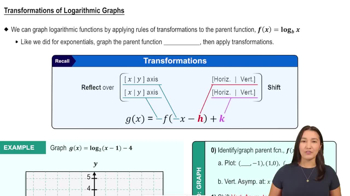
Transformations of Logarithmic Graphs

Solving Systems of Linear Equations

Once the logarithmic variables (A, B, C, D) are defined, the system becomes linear. Techniques such as substitution, elimination, or matrix methods (e.g., Gaussian elimination) can be used to find the values of A, B, C, and D. Mastery of these methods is crucial for efficiently solving the system.
추천 영상:
4:27
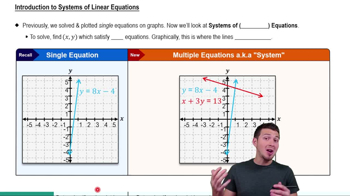
Introduction to Systems of Linear Equations

Exponentiation to Reverse Logarithms

After solving for A = ln w, B = ln x, C = ln y, and D = ln z, exponentiation is used to find the original variables w, x, y, and z. This step involves applying the inverse of the natural logarithm, the exponential function, to convert back from logarithmic form to the original variables.
추천 영상:
7:30
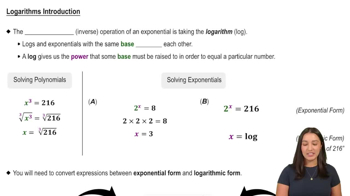
Logarithms Introduction
관련 실천
교과서 질문

Perform the indicated matrix operations given that A, B and C are defined as follows. If an operation is not defined, state the reason.

A=[403501],B=[5122],C=[1111]A=\(\begin{bmatrix}\)4 & 0\\ -3 & 5\\ 0 & 1\(\end{bmatrix}\),B=\(\begin{bmatrix}\)5 & 1\\ -2 & -2\(\end{bmatrix}\),C=\(\begin{bmatrix}\)1 & -1\\ -1 & 1\(\end{bmatrix}\)

A - C

111
views
교과서 질문

In Exercises 37 - 44, perform the indicated matrix operations given that A, B and C are defined as follows. If an operation is not defined, state the reason.

A=[403501],B=[5122],C=[1111]A=\(\begin{bmatrix}\)4 & 0\\ -3 & 5\\ 0 & 1\(\end{bmatrix}\),B=\(\begin{bmatrix}\)5 & 1\\ -2 & -2\(\end{bmatrix}\),C=\(\begin{bmatrix}\)1 & -1\\ -1 & 1\(\end{bmatrix}\)

A(BC)

841
views
교과서 질문

In Exercises 43–44, (a) Write each linear system as a matrix equation in the form AX = B (b) Solve the system using the inverse that is given for the coefficient matrix.

671
views
교과서 질문

In Exercises 37–44, use Cramer's Rule to solve each system. {x+2z=42yz=52x+3y=13\(\begin{cases}\) x + 2z = 4 \\ 2y - z = 5 \\ 2x + 3y = 13 \(\end{cases}\)

875
views
교과서 질문

Find the cubic function f(x) = ax³ + bx² + cx + d for which ƒ( − 1) = 0, ƒ(1) = 2, ƒ(2) = 3, and ƒ(3) = 12.

855
views
교과서 질문

In Exercises 37–44, use Cramer's Rule to solve each system. {x+y+z=4x2y+z=7x+3y+2z=4\(\begin{cases}\) x + y + z = 4 \\ x - 2y + z = 7 \\ x + 3y + 2z = 4 \(\end{cases}\)

864
views