
교과서 질문
Use mathematical induction to prove that each statement is true for every positive integer n. 1/(1 · 2) + 1/(2 · 3) + 1/(3 · 4) + ... + 1/(n(n+1)) = n/(n + 1)
652
views

 검증된 단계별 안내
 5:17
5:17
 8:22 5:17
Use mathematical induction to prove that each statement is true for every positive integer n. 1/(1 · 2) + 1/(2 · 3) + 1/(3 · 4) + ... + 1/(n(n+1)) = n/(n + 1)
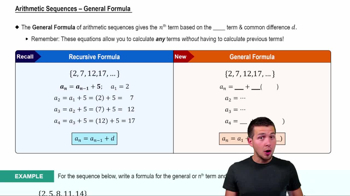
Write a formula for the general term (the nth term) of each arithmetic sequence. Do not use a recursion formula. Then use the formula for an to find a20, the 20th term of the sequence. 1, 5, 9, 13,...
Write a formula for the general term (the nth term) of each geometric sequence. Then use the formula for an to find a7, the seventh term of the sequence. 0.0004, - 0.0004, 0.04, - 0.04, ...
Write a formula for the general term (the nth term) of each arithmetic sequence. Do not use a recursion formula. Then use the formula for an to find a20, the 20th term of the sequence. 7,3,-1,-5,...
Use the formula for the sum of the first n terms of an arithmetic sequence to find the indicated sum.
Evaluate each factorial expression. 18!/16!