Ch. 8 - Sequences, Induction, and Probability
Blitzer - College Algebra 8th Edition
Blitzer8th EditionCollege AlgebraISBN: 9780136970514당신이 사용하는 게 아니라요?교과서 변경
9장, 문제 45

Write out the first three terms and the last term. Then use the formula for the sum of the first n terms of an arithmetic sequence to find the indicated sum.
i=117(5i+3)\(\sum\)_{i=1}^{17} (5i + 3)

검증된 단계별 안내
1
Identify the arithmetic sequence given by the general term \(a_i = 5i + 3\), where \(i\) ranges from 1 to 17.
Find the first three terms by substituting \(i = 1, 2, 3\) into the formula: \(a_1 = 5(1) + 3\), \(a_2 = 5(2) + 3\), \(a_3 = 5(3) + 3\).
Find the last term by substituting \(i = 17\) into the formula: \(a_{17} = 5(17) + 3\).
Recall the formula for the sum of the first \(n\) terms of an arithmetic sequence: \(S_n = \frac{n}{2} (a_1 + a_n)\), where \(n\) is the number of terms, \(a_1\) is the first term, and \(a_n\) is the last term.
Substitute \(n = 17\), the first term \(a_1\), and the last term \(a_{17}\) into the sum formula to express the sum \(S_{17}\) without calculating the final value.

비슷한 문제에 대한 검증된 영상 답변:

이 영상 해법은 위 문제에 도움이 된다고 튜터들이 추천한 것입니다.
영상 길이:
4m
도움이 되었나요?

주요 개념

질문에 올바르게 답하기 위해 반드시 이해해야 하는 핵심 개념들은 다음과 같습니다.

Arithmetic Sequence

An arithmetic sequence is a list of numbers where each term after the first is found by adding a constant difference to the previous term. For example, in the sequence defined by 5i + 3, the difference between consecutive terms is constant (5). Understanding this helps identify the terms and their pattern.
추천 영상:
가이드 코스
5:17
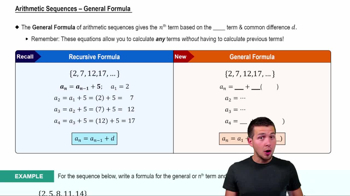
Arithmetic Sequences - General Formula

Sum of the First n Terms of an Arithmetic Sequence

The sum of the first n terms of an arithmetic sequence can be found using the formula S_n = n/2 (a_1 + a_n), where a_1 is the first term and a_n is the nth term. This formula simplifies the process of adding many terms without listing them all.
추천 영상:
가이드 코스
5:17
Arithmetic Sequences - General Formula

Evaluating Summation Notation

Summation notation (Σ) represents the sum of terms defined by a formula over a range of indices. Here, it sums the expression 5i + 3 from i = 1 to 17. Understanding how to interpret and expand this notation is essential for finding specific terms and the total sum.
추천 영상:
05:18
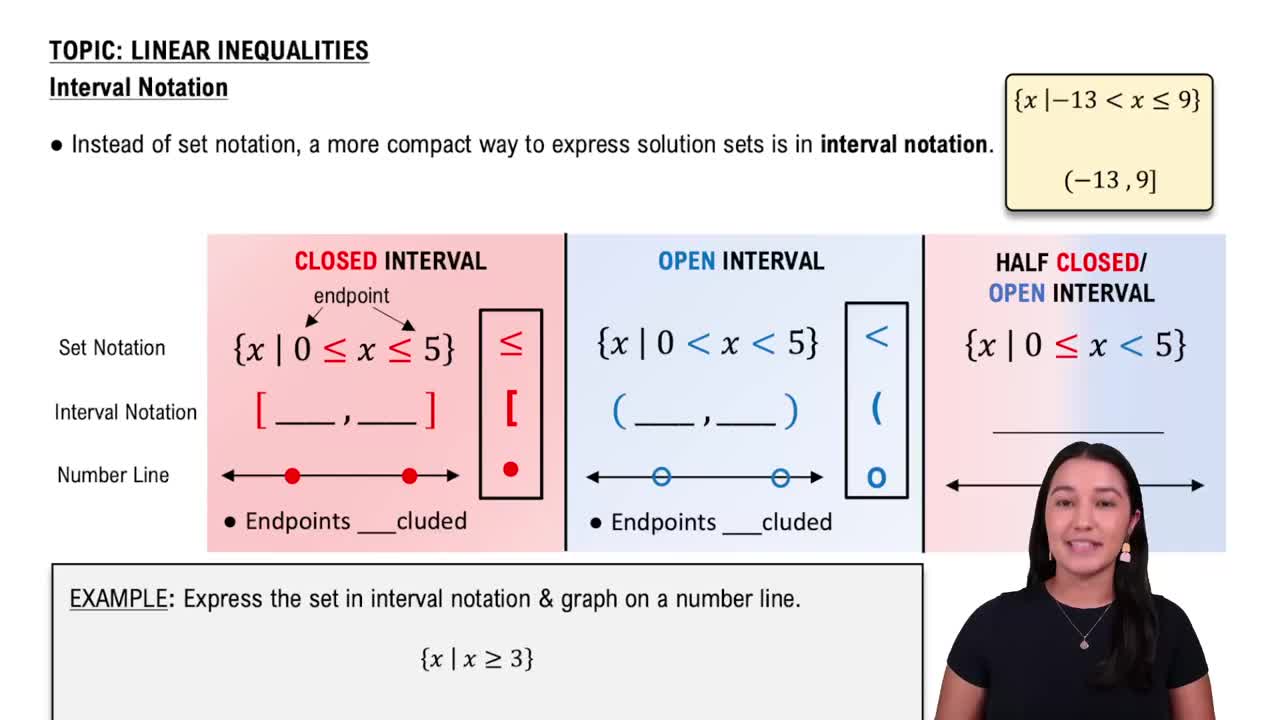
Interval Notation