Ch. 8 - Sequences, Induction, and Probability
Blitzer - College Algebra 8th Edition
Blitzer8th EditionCollege AlgebraISBN: 9780136970514당신이 사용하는 게 아니라요?교과서 변경
9장, 문제 13

In Exercises 11–16, a die is rolled. Find the probability of getting an odd number.

검증된 단계별 안내
1
Identify the total number of possible outcomes when rolling a die. Since a standard die has 6 faces, the total number of outcomes is 6.
Determine the favorable outcomes for the event. The event is getting an odd number, so list the odd numbers on a die: 1, 3, and 5.
Count the number of favorable outcomes. There are 3 odd numbers on the die.
Use the probability formula: \(P(\text{event}) = \frac{\text{number of favorable outcomes}}{\text{total number of outcomes}}\).
Substitute the values into the formula: \(P(\text{odd number}) = \frac{3}{6}\). This fraction can be simplified if needed.

비슷한 문제에 대한 검증된 영상 답변:

이 영상 해법은 위 문제에 도움이 된다고 튜터들이 추천한 것입니다.
영상 길이:
2m
도움이 되었나요?

주요 개념

질문에 올바르게 답하기 위해 반드시 이해해야 하는 핵심 개념들은 다음과 같습니다.

Sample Space

The sample space is the set of all possible outcomes of an experiment. For a single die roll, the sample space consists of the numbers 1 through 6, representing each face of the die.
추천 영상:
5:37
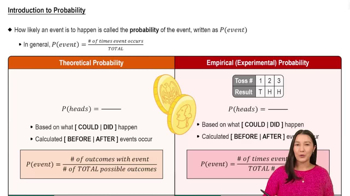
Introduction to Probability

Event

An event is a subset of the sample space that includes outcomes of interest. In this case, the event is rolling an odd number, which includes the outcomes {1, 3, 5}.
추천 영상:
4:23
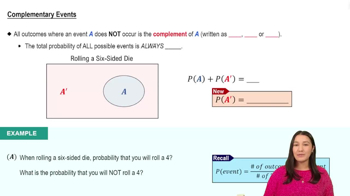
Complementary Events

Probability Calculation

Probability is calculated as the ratio of favorable outcomes to total possible outcomes. For rolling an odd number, it is the number of odd outcomes divided by the total outcomes, i.e., 3/6 or 1/2.
추천 영상:
5:37
Introduction to Probability