Find the indicated term of the arithmetic sequence with first term, and common difference, d. Find a60 when a1 = 35, d = -3.
Ch. 8 - Sequences, Induction, and Probability

9장, 문제 21
Use mathematical induction to prove that each statement is true for every positive integer n. 1 · 2 + 2 · 3 + 3 · 4 + ... + n(n + 1) = n(n + 1)(n + 2)/3
검증된 단계별 안내1
Step 1: Define the statement to prove by induction. Let \( P(n) \) be the statement \( 1 \cdot 2 + 2 \cdot 3 + 3 \cdot 4 + \cdots + n(n + 1) = \frac{n(n + 1)(n + 2)}{3} \). We want to prove \( P(n) \) is true for all positive integers \( n \).
Step 2: Verify the base case \( n = 1 \). Substitute \( n = 1 \) into both sides of the equation and check if the left-hand side equals the right-hand side.
Step 3: Assume the induction hypothesis \( P(k) \) is true for some positive integer \( k \), that is, assume \( 1 \cdot 2 + 2 \cdot 3 + \cdots + k(k + 1) = \frac{k(k + 1)(k + 2)}{3} \).
Step 4: Prove the statement \( P(k + 1) \) is true using the induction hypothesis. Start with the left-hand side of \( P(k + 1) \): \( 1 \cdot 2 + 2 \cdot 3 + \cdots + k(k + 1) + (k + 1)(k + 2) \). Substitute the induction hypothesis for the sum up to \( k(k + 1) \).
Step 5: Simplify the expression obtained in Step 4 and show that it equals the right-hand side of \( P(k + 1) \), which is \( \frac{(k + 1)(k + 2)(k + 3)}{3} \). This completes the induction step and proves the statement for all positive integers \( n \).

비슷한 문제에 대한 검증된 영상 답변:
이 영상 해법은 위 문제에 도움이 된다고 튜터들이 추천한 것입니다.
영상 길이:
7m도움이 되었나요?
주요 개념
질문에 올바르게 답하기 위해 반드시 이해해야 하는 핵심 개념들은 다음과 같습니다.
Mathematical Induction
Mathematical induction is a proof technique used to establish that a statement holds for all positive integers. It involves two steps: proving the base case (usually n=1) is true, and then proving that if the statement holds for an arbitrary integer k, it also holds for k+1. This creates a chain of truth for all n.
추천 영상:
가이드 코스
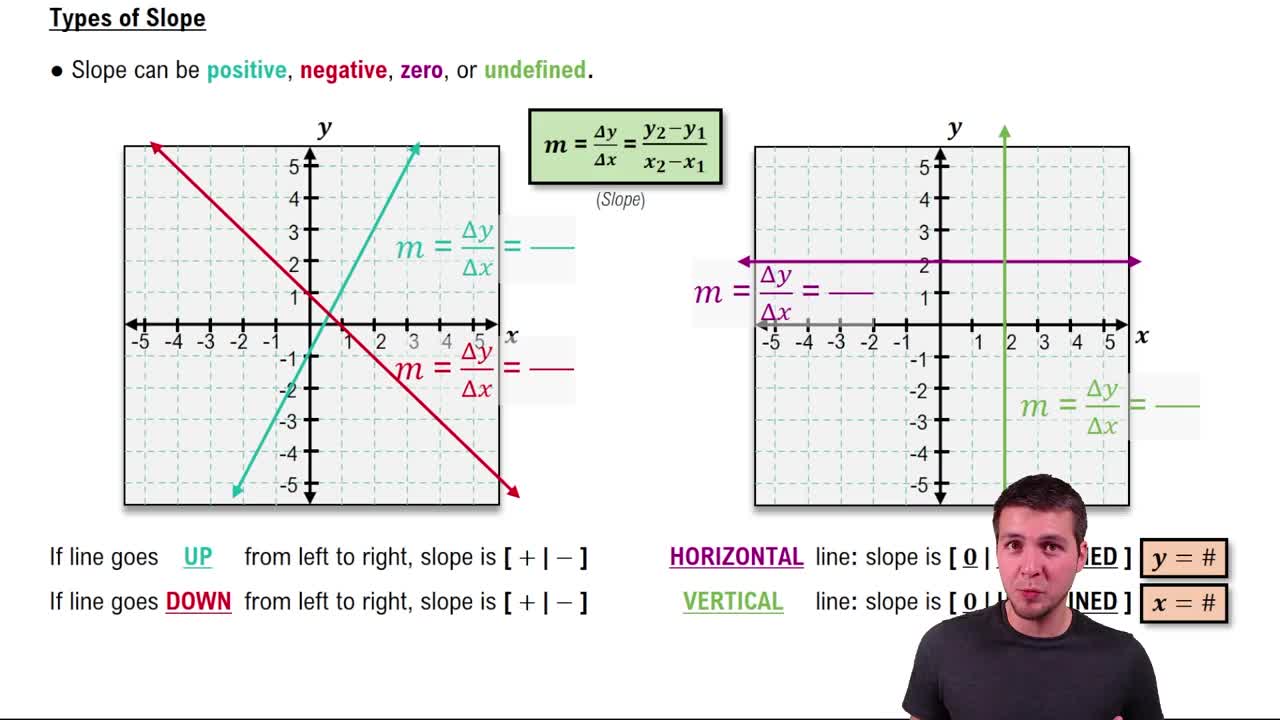
Types of Slope
Summation of Sequences
Summation of sequences involves finding a formula that represents the sum of terms in a sequence. In this problem, the sum is of products of consecutive integers, and the goal is to express this sum in a closed form, which simplifies calculations and helps in proving the formula by induction.
추천 영상:
가이드 코스
Introduction to Sequences
Algebraic Manipulation
Algebraic manipulation refers to the process of simplifying, expanding, or factoring expressions to transform them into a desired form. In induction proofs, it is essential to manipulate expressions correctly to show that the formula for n+1 follows logically from the formula for n.
추천 영상:
가이드 코스
Introduction to Algebraic Expressions
관련 실천
교과서 질문
1213
views
교과서 질문
Use the Binomial Theorem to expand each binomial and express the result in simplified form. (2x3 − 1)4
634
views
교과서 질문
In Exercises 19–22, the general term of a sequence is given and involves a factorial. Write the first four terms of each sequence. a_n=(n+1)!/n^2
529
views
교과서 질문
Write a formula for the general term (the nth term) of each geometric sequence. Then use the formula for an to find a7, the seventh term of the sequence. 1.5, - 3, 6, -12, ...
1098
views
교과서 질문
In Exercises 21–22, a fair coin is tossed two times in succession. The sample space of equally likely outcomes is {HH,HT,TH,TT}. Find the probability of getting two heads.
781
views
교과서 질문
In Exercises 19–22, the general term of a sequence is given and involves a factorial. Write the first four terms of each sequence. an=2(n+1)!
800
views