Ch. 8 - Sequences, Induction, and Probability
Blitzer - College Algebra 8th Edition
Blitzer8th EditionCollege AlgebraISBN: 9780136970514당신이 사용하는 게 아니라요?교과서 변경
9장, 문제 23

Evaluate each factorial expression. 17!/15!

검증된 단계별 안내
1
Recall the definition of factorial: for any positive integer \(n\), \(n! = n \times (n-1) \times (n-2) \times \cdots \times 1\).
Write out the factorial expressions explicitly: \(17! = 17 \times 16 \times 15!\).
Substitute this into the given expression: \(\frac{17!}{15!} = \frac{17 \times 16 \times 15!}{15!}\).
Notice that \$15!$ appears in both numerator and denominator, so they cancel out: \(\frac{17 \times 16 \times \cancel{15!}}{\cancel{15!}} = 17 \times 16\).
The expression simplifies to the product \(17 \times 16\), which you can multiply to find the final value.

비슷한 문제에 대한 검증된 영상 답변:

이 영상 해법은 위 문제에 도움이 된다고 튜터들이 추천한 것입니다.
영상 길이:
2m
도움이 되었나요?

주요 개념

질문에 올바르게 답하기 위해 반드시 이해해야 하는 핵심 개념들은 다음과 같습니다.

Factorial Notation

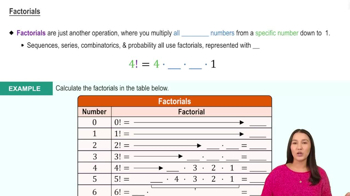
Factorial notation, denoted by n!, represents the product of all positive integers from n down to 1. For example, 5! = 5 × 4 × 3 × 2 × 1 = 120. It is commonly used in permutations, combinations, and other algebraic expressions.
추천 영상:
5:22
Factorials

Simplifying Factorial Expressions

When dividing factorials like 17!/15!, you can cancel common terms. Since 17! = 17 × 16 × 15!, the 15! terms cancel out, leaving 17 × 16. This simplification avoids calculating large factorials directly.
추천 영상:
5:22
Factorials

Properties of Factorials in Division

Factorials have the property that n! = n × (n-1)!. This allows breaking down factorial expressions in division problems to simplify calculations by canceling out common factorial terms, making complex expressions manageable.
추천 영상:
5:22
Factorials