
Ch. 8 - Sequences, Induction, and Probability
Blitzer - College Algebra 8th Edition
Blitzer8th EditionCollege AlgebraISBN: 9780136970514당신이 사용하는 게 아니라요?교과서 변경
9장, 문제 29

Find each indicated sum. i=165i\(\sum\)_{i=1}^{6} 5i

검증된 단계별 안내
1
Identify the summation notation given: \(\sum_{i=1}^{6} 5i\). This means you need to find the sum of the expression \$5i\( as \)i$ goes from 1 to 6.
Rewrite the summation by expanding the terms: \(5(1) + 5(2) + 5(3) + 5(4) + 5(5) + 5(6)\).
Factor out the constant 5 from the summation: \(5 \sum_{i=1}^{6} i\).
Use the formula for the sum of the first \(n\) natural numbers: \(\sum_{i=1}^{n} i = \frac{n(n+1)}{2}\). Here, \(n=6\).
Substitute \(n=6\) into the formula and multiply by 5: \(5 \times \frac{6 \times (6+1)}{2}\). This expression represents the sum you need to calculate.

비슷한 문제에 대한 검증된 영상 답변:

이 영상 해법은 위 문제에 도움이 된다고 튜터들이 추천한 것입니다.
영상 길이:
3m
도움이 되었나요?

주요 개념

질문에 올바르게 답하기 위해 반드시 이해해야 하는 핵심 개념들은 다음과 같습니다.

Summation Notation (Sigma Notation)

Summation notation uses the Greek letter sigma (Σ) to represent the sum of a sequence of terms. It specifies the index of summation, the lower and upper limits, and the expression to be summed. For example, Σ from i=1 to 6 of 5i means adding 5 times each integer from 1 to 6.
추천 영상:
05:18
Interval Notation

Arithmetic Series

An arithmetic series is the sum of terms in an arithmetic sequence, where each term increases by a constant difference. In this problem, 5i forms an arithmetic sequence with a common difference of 5. Understanding this helps in applying formulas to find the sum efficiently.
추천 영상:
가이드 코스
5:17
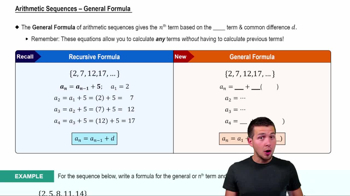
Arithmetic Sequences - General Formula

Formula for the Sum of an Arithmetic Series

The sum of the first n terms of an arithmetic series can be found using the formula S_n = n/2 (first term + last term). This formula simplifies the calculation by avoiding term-by-term addition, making it useful for quickly finding sums like Σ 5i from i=1 to 6.
추천 영상:
가이드 코스
5:17
Arithmetic Sequences - General Formula