Ch. 8 - Sequences, Induction, and Probability
Blitzer - College Algebra 8th Edition
Blitzer8th EditionCollege AlgebraISBN: 9780136970514당신이 사용하는 게 아니라요?교과서 변경
9장, 문제 8

In Exercises 8–9, find each indicated sum. This is a summation, refer to the textbook.

검증된 단계별 안내
1
Step 1: Understand the summation notation. Summation is represented by the Greek letter sigma (∑) and involves adding terms of a sequence. The general form is ∑_(i=a)^(b) f(i), where 'i' is the index of summation, 'a' is the starting value, 'b' is the ending value, and f(i) is the function to be summed.
Step 2: Identify the given summation parameters from the problem. Look for the starting index (a), ending index (b), and the function f(i) that needs to be summed. These details are typically provided in the problem statement or textbook.
Step 3: Substitute the values of the index into the function f(i) for each integer from the starting index (a) to the ending index (b). Write out each term explicitly to ensure clarity.
Step 4: Add the terms together. This involves performing the arithmetic operations to compute the sum of all the terms generated in the previous step.
Step 5: Verify your work by checking each substitution and addition step for accuracy. If the problem involves a formula for summation (e.g., the sum of an arithmetic sequence or geometric sequence), apply the formula as needed to simplify the calculation.

비슷한 문제에 대한 검증된 영상 답변:

이 영상 해법은 위 문제에 도움이 된다고 튜터들이 추천한 것입니다.
영상 길이:
2m
도움이 되었나요?

주요 개념

질문에 올바르게 답하기 위해 반드시 이해해야 하는 핵심 개념들은 다음과 같습니다.

Summation Notation

Summation notation, often represented by the Greek letter sigma (Σ), is a concise way to express the sum of a sequence of terms. It includes an index of summation, a lower limit, an upper limit, and the expression to be summed. Understanding how to interpret and manipulate this notation is essential for calculating sums in algebra.
추천 영상:
05:18
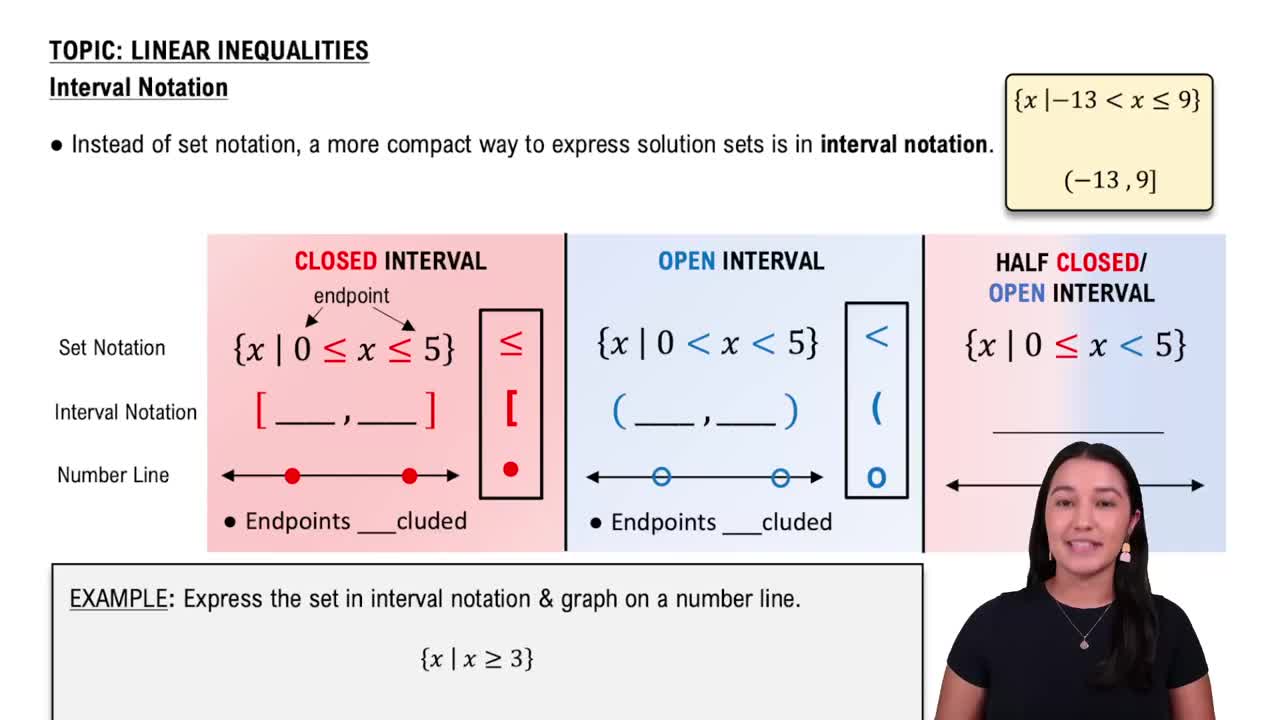
Interval Notation

Arithmetic Series

An arithmetic series is the sum of the terms of an arithmetic sequence, where each term after the first is obtained by adding a constant difference. The formula for the sum of the first n terms of an arithmetic series is S_n = n/2 * (a + l), where a is the first term, l is the last term, and n is the number of terms. Recognizing this structure helps in efficiently calculating sums.
추천 영상:
5:17
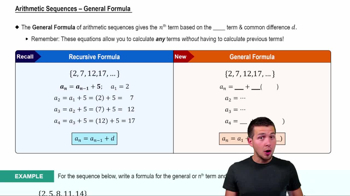
Arithmetic Sequences - General Formula

Geometric Series

A geometric series is the sum of the terms of a geometric sequence, where each term is multiplied by a constant ratio. The sum of the first n terms can be calculated using the formula S_n = a(1 - r^n) / (1 - r) for r ≠ 1, where a is the first term and r is the common ratio. Understanding geometric series is crucial for solving problems involving exponential growth or decay.
추천 영상:
4:18
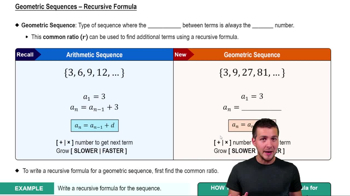
Geometric Sequences - Recursive Formula