In Exercises 49–52, a single die is rolled twice. Find the probability of rolling an even number the first time and a number greater than 2 the second time.
Ch. 8 - Sequences, Induction, and Probability

9장, 문제 51
Use the formula for nCr to solve Exercises 49–56. Of 12 possible books, you plan to take 4 with you on vacation. How many different collections of 4 books can you take?
검증된 단계별 안내1
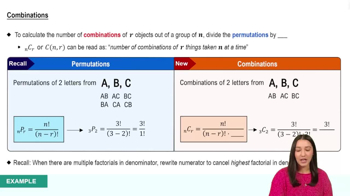
Identify the problem as a combination problem where order does not matter. You want to find the number of ways to choose 4 books out of 12 without regard to order.
Recall the formula for combinations, which is given by \(nCr = \frac{n!}{r!(n-r)!}\), where \(n\) is the total number of items, and \(r\) is the number of items to choose.
Substitute the given values into the formula: \(n = 12\) and \(r = 4\), so the expression becomes \(\frac{12!}{4!(12-4)!}\).
Simplify the factorial expressions in the numerator and denominator to make the calculation easier. For example, expand \$12!\( as \(12 \times 11 \times 10 \times 9 \times 8!\) and cancel the \)8!$ in numerator and denominator.
Calculate the remaining multiplication and division to find the number of different collections of 4 books you can take.

비슷한 문제에 대한 검증된 영상 답변:
이 영상 해법은 위 문제에 도움이 된다고 튜터들이 추천한 것입니다.
영상 길이:
3m도움이 되었나요?
주요 개념
질문에 올바르게 답하기 위해 반드시 이해해야 하는 핵심 개념들은 다음과 같습니다.
Combination Formula (nCr)
The combination formula, denoted as nCr, calculates the number of ways to choose r items from a set of n distinct items without regard to order. It is given by nCr = n! / [r! (n - r)!], where '!' denotes factorial. This formula is essential for counting selections where order does not matter.
추천 영상:
Combinations
Factorials
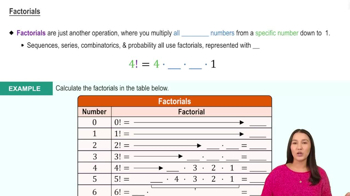
A factorial, represented by n!, is the product of all positive integers from 1 up to n. For example, 5! = 5 × 4 × 3 × 2 × 1 = 120. Factorials are used in permutations and combinations to calculate the total number of arrangements or selections.
추천 영상:
Factorials
Counting Without Replacement
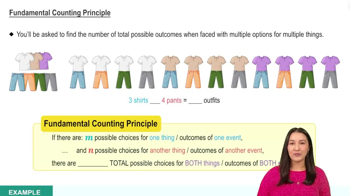
When selecting items from a set without replacement, each chosen item is not returned to the set, reducing the total number available for subsequent choices. Combinations apply here because the order of selection does not matter, only the group chosen.
추천 영상:
Fundamental Counting Principle
관련 실천
교과서 질문
673
views
교과서 질문
The general term of a sequence is given. Determine whether the sequence is arithmetic, geometric, or neither. If the sequence is arithmetic, find the common difference; if it is geometric, find the common ratio. an = n + 5
964
views
교과서 질문
Use the Binomial Theorem to expand each expression and write the result in simplified form. (x1/3 +x-1/3)3
635
views
교과서 질문
Use the graphs of the arithmetic sequences {a} and {b} to solve Exercises 51-58.
Find a14+b12.
1232
views
교과서 질문
Express each sum using summation notation. Use as the lower limit of summation and for the index of summation.
924
views
교과서 질문
Express each repeating decimal as a fraction in lowest terms. 0.6 (repeating 6)
1055
views