Ch. 8 - Sequences, Induction, and Probability
Blitzer - College Algebra 8th Edition
Blitzer8th EditionCollege AlgebraISBN: 9780136970514당신이 사용하는 게 아니라요?교과서 변경
9장, 문제 55

Use the formula for nCr to solve Exercises 49–56. To win at LOTTO in the state of Florida, one must correctly select 6 numbers from a collection of 53 numbers (1 through 53). The order in which the selection is made does not matter. How many different selections are possible?

검증된 단계별 안내
1
Identify the problem as a combination problem because the order of selection does not matter. We need to find the number of ways to choose 6 numbers from 53 without regard to order.
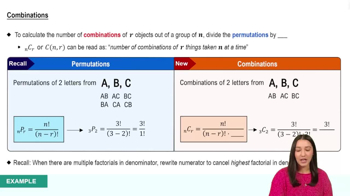
Recall the formula for combinations (nCr), which is given by: \[ \text{nCr} = \frac{n!}{r!(n-r)!} \] where \(n\) is the total number of items to choose from, and \(r\) is the number of items to choose.
Substitute the given values into the formula: Here, \(n = 53\) and \(r = 6\), so the expression becomes \[ \text{53C6} = \frac{53!}{6!(53-6)!} = \frac{53!}{6! \times 47!} \]
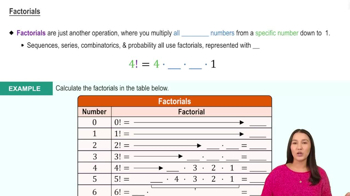
Understand that the factorial notation (\(n!\)) means the product of all positive integers from 1 up to \(n\). For example, \(6! = 6 \times 5 \times 4 \times 3 \times 2 \times 1\).
To simplify the calculation, expand the numerator \$53!$ only down to $(53-6+1) = 48$, so it becomes \(53 \times 52 \times 51 \times 50 \times 49 \times 48!\), which allows the \$48!$ in numerator and denominator to cancel out, leaving: \[ \frac{53 \times 52 \times 51 \times 50 \times 49 \times 48!}{6! \times 47!} = \frac{53 \times 52 \times 51 \times 50 \times 49 \times 48!}{6! \times 47!} \] Then cancel \$48!$ with part of \$47!$ accordingly to simplify further before calculating.

비슷한 문제에 대한 검증된 영상 답변:

이 영상 해법은 위 문제에 도움이 된다고 튜터들이 추천한 것입니다.
영상 길이:
2m
도움이 되었나요?

주요 개념

질문에 올바르게 답하기 위해 반드시 이해해야 하는 핵심 개념들은 다음과 같습니다.

Combination Formula (nCr)

The combination formula, denoted as nCr, calculates the number of ways to choose r items from a set of n items without regard to order. It is given by nCr = n! / [r! (n - r)!], where '!' denotes factorial. This formula is essential for problems where order does not matter, such as selecting lottery numbers.
추천 영상:
5:22
Combinations

Factorials

A factorial, represented by n!, is the product of all positive integers from 1 up to n. For example, 5! = 5 × 4 × 3 × 2 × 1 = 120. Factorials are used in the combination formula to count permutations and combinations by accounting for the number of ways to arrange or select items.
추천 영상:
5:22
Factorials

Order Irrelevance in Combinations

In combinations, the order of selection does not matter, meaning that selecting numbers {1, 2, 3} is the same as {3, 2, 1}. This contrasts with permutations, where order matters. Understanding this distinction helps determine when to use combinations versus permutations in counting problems.
추천 영상:
5:22
Combinations