Ch. P - Fundamental Concepts of Algebra
Blitzer - College Algebra 8th Edition
Blitzer8th EditionCollege AlgebraISBN: 9780136970514당신이 사용하는 게 아니라요?교과서 변경
1장, 문제 65

Evaluate each expression 1251/3.

검증된 단계별 안내
1
Recognize that the expression involves a negative fractional exponent: \(125^{\left(-\frac{1}{3}\right)}\).
Recall the rule for negative exponents: \(a^{-n} = \frac{1}{a^n}\). Apply this to rewrite the expression as \(\frac{1}{125^{\frac{1}{3}}}\).
Understand that the fractional exponent \(\frac{1}{3}\) represents the cube root, so rewrite the denominator as \(\sqrt[3]{125}\).
Evaluate the cube root of 125 by finding the number which, when cubed, equals 125.
Write the final expression as \(\frac{1}{\sqrt[3]{125}}\) and simplify further if possible.

비슷한 문제에 대한 검증된 영상 답변:

이 영상 해법은 위 문제에 도움이 된다고 튜터들이 추천한 것입니다.
영상 길이:
1m
도움이 되었나요?

주요 개념

질문에 올바르게 답하기 위해 반드시 이해해야 하는 핵심 개념들은 다음과 같습니다.

Negative Exponents

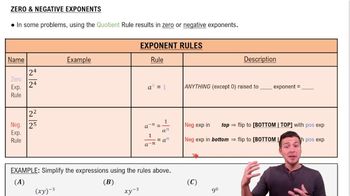
A negative exponent indicates the reciprocal of the base raised to the corresponding positive exponent. For example, a^(-n) equals 1 divided by a^n. This concept allows us to rewrite expressions with negative powers into fractions.
추천 영상:
6:37
Zero and Negative Rules

Fractional Exponents

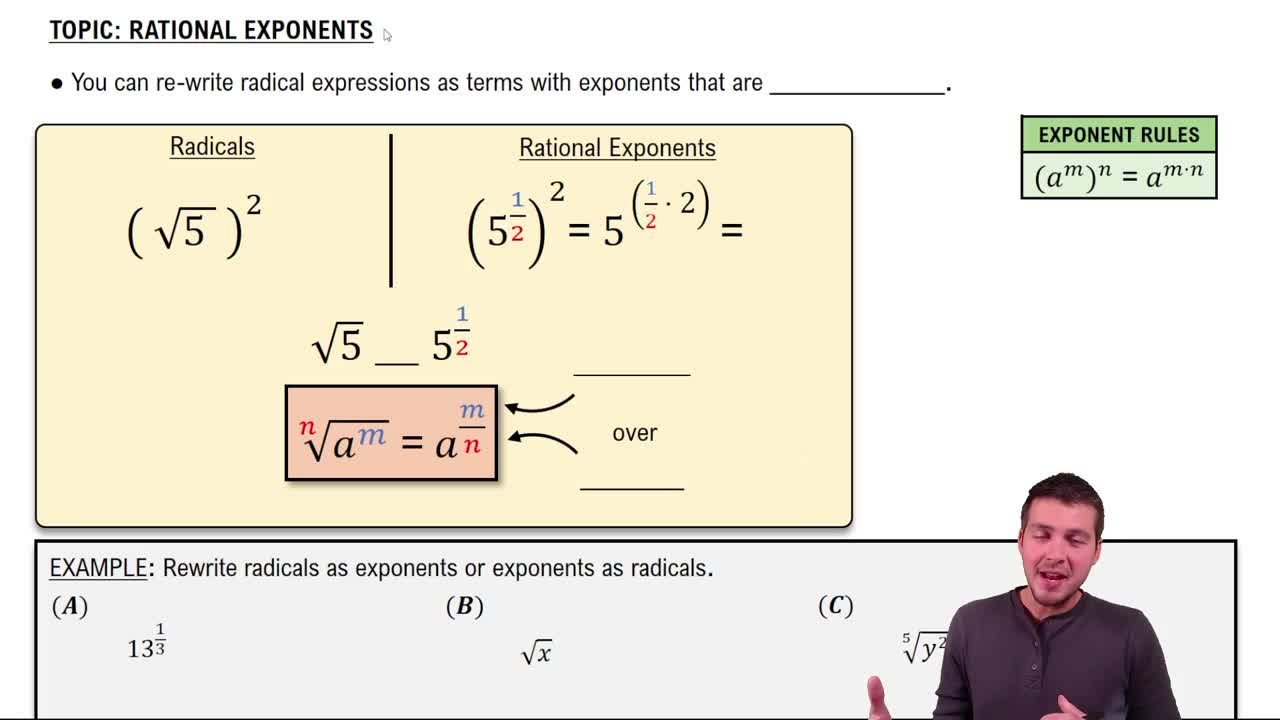
Fractional exponents represent roots and powers simultaneously. Specifically, a^(m/n) means the n-th root of a raised to the m-th power, or equivalently, (a^(1/n))^m. This helps in simplifying expressions involving roots and powers.
추천 영상:
04:06
Rational Exponents

Evaluating Cube Roots

The cube root of a number is a value that, when multiplied by itself three times, gives the original number. For example, the cube root of 125 is 5 because 5^3 = 125. Understanding cube roots is essential for simplifying expressions with fractional exponents like 1/3.
추천 영상:
02:20
Imaginary Roots with the Square Root Property