In Exercises 121–128, write each English phrase as an algebraic expression. Then simplify the expression. Let x represent the number. The difference between the product of six and a number and negative two times the number
Ch. P - Fundamental Concepts of Algebra

1장, 문제 123
In Exercises 121–128, write each English phrase as an algebraic expression. Then simplify the expression. Let x represent the number. Six times the product of negative five and a number
검증된 단계별 안내1
Step 1: Start by identifying the key components of the English phrase. The phrase mentions 'six times' and 'the product of negative five and a number'. Let the variable x represent the unknown number.
Step 2: Translate 'the product of negative five and a number' into an algebraic expression. The product of -5 and x is written as -5x.
Step 3: Now, incorporate the 'six times' part. To represent six times the product, multiply -5x by 6. This gives the expression 6(-5x).
Step 4: Simplify the expression by performing the multiplication. Multiply 6 by -5 to get -30, so the expression becomes -30x.
Step 5: The simplified algebraic expression for the given phrase is -30x.

비슷한 문제에 대한 검증된 영상 답변:
이 영상 해법은 위 문제에 도움이 된다고 튜터들이 추천한 것입니다.
영상 길이:
1m도움이 되었나요?
주요 개념
질문에 올바르게 답하기 위해 반드시 이해해야 하는 핵심 개념들은 다음과 같습니다.
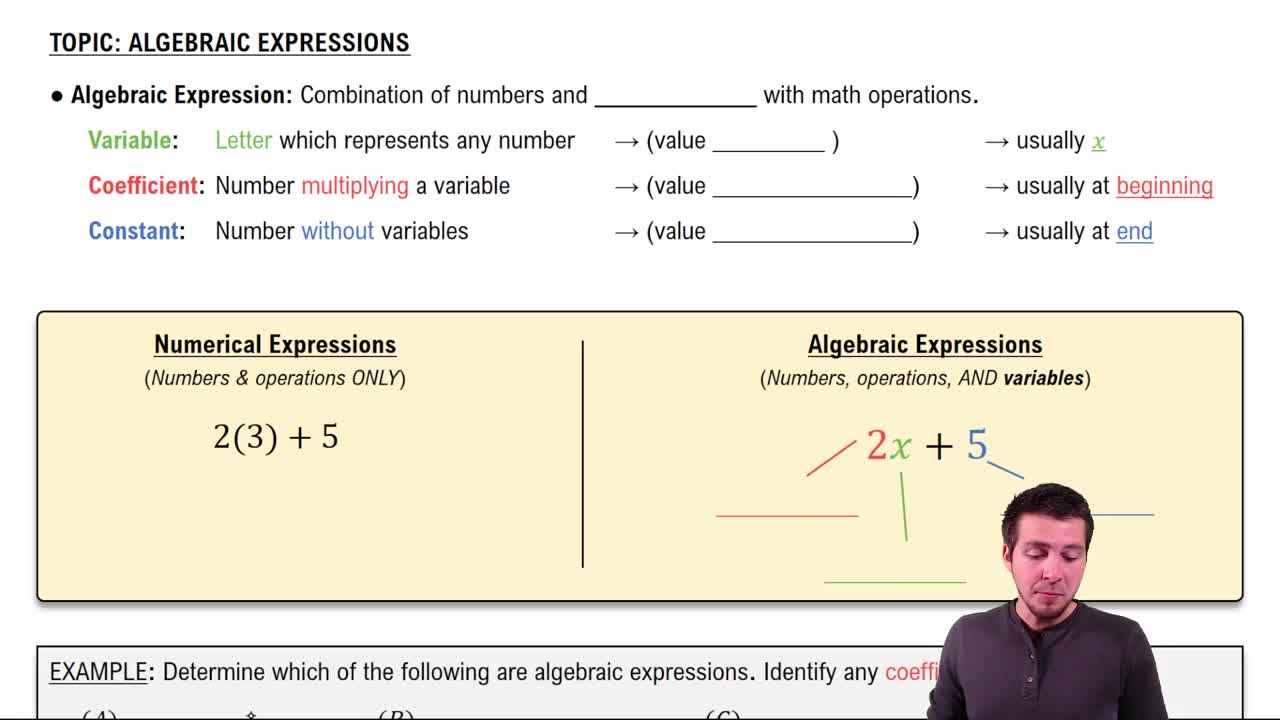
Algebraic Expressions
An algebraic expression is a mathematical phrase that can include numbers, variables, and operation symbols. It represents a value and can be simplified or manipulated according to algebraic rules. Understanding how to translate verbal phrases into algebraic expressions is crucial for solving problems in algebra.
추천 영상:
Introduction to Algebraic Expressions
Variables and Constants
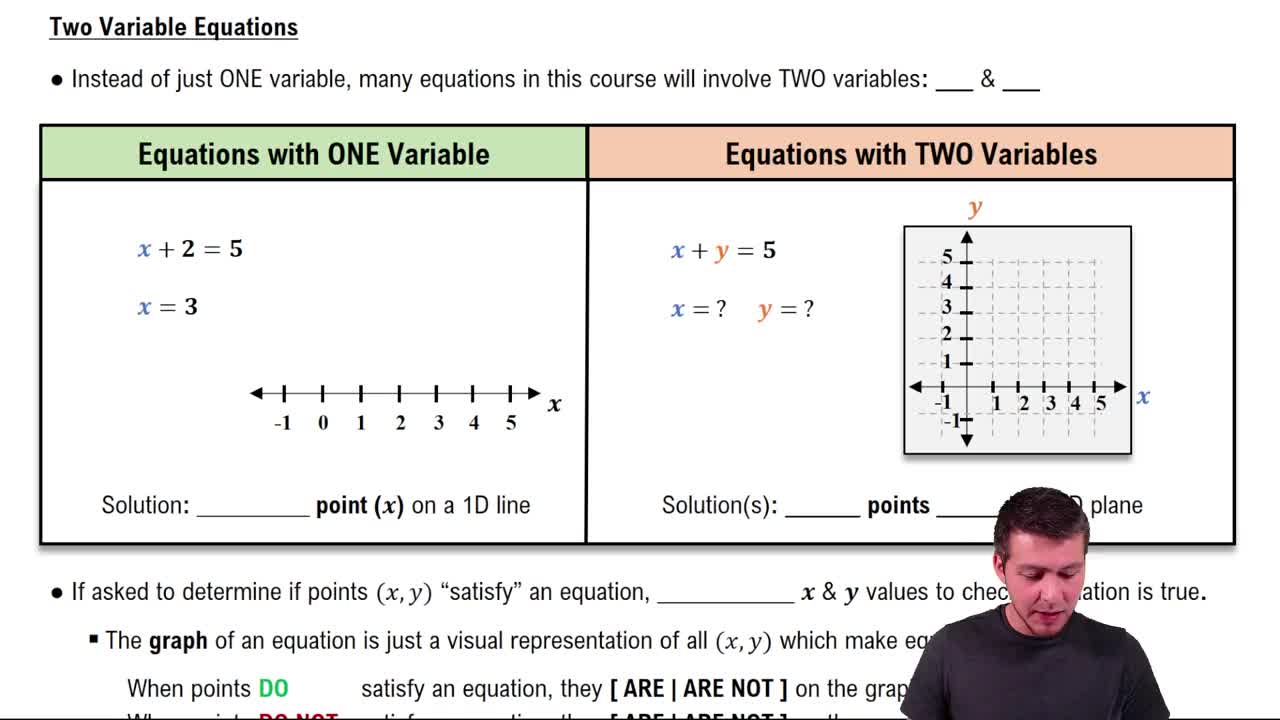
In algebra, a variable is a symbol, often represented by letters like x, that stands for an unknown value. Constants are fixed values that do not change. In the given question, 'x' represents the number, while '-5' is a constant. Recognizing the role of variables and constants is essential for forming and simplifying expressions.
추천 영상:
Equations with Two Variables
Order of Operations
The order of operations is a set of rules that dictates the sequence in which mathematical operations should be performed to ensure consistent results. The common acronym PEMDAS (Parentheses, Exponents, Multiplication and Division, Addition and Subtraction) helps remember this order. Applying these rules correctly is vital when simplifying algebraic expressions.
추천 영상:
Performing Row Operations on Matrices
관련 실천
교과서 질문
1122
views
교과서 질문
In Exercises 121–128, write each English phrase as an algebraic expression. Then simplify the expression. Let x represent the number. A number decreased by the sum of the number and four
1505
views
1
comments
교과서 질문
Simplify each complex rational expression. (1/x-1/2)/(1/3-x/6)
189
views
교과서 질문
In Exercises 121–128, write each English phrase as an algebraic expression. Then simplify the expression. Let x represent the number. Eight decreased by three times the sum of a number and six
1176
views
교과서 질문
Simplify each complex rational expression. [3-1/(x+3)]/[3+1/(x+3)]
168
views
교과서 질문
Exercises 159–161 will help you prepare for the material covered in the next section. If 6.2 is multiplied by 10^3, what does this multiplication do to the decimal point in 6.2?
980
views