Ch. P - Fundamental Concepts of Algebra
Blitzer - College Algebra 8th Edition
Blitzer8th EditionCollege AlgebraISBN: 9780136970514당신이 사용하는 게 아니라요?교과서 변경
1장, 문제 74

Write each number in decimal notation without the use of exponents. 3.14×10³-3.14\(\times\)10^{-3}

검증된 단계별 안내
1
Identify the given number in scientific notation: \(-3.14 \times 10^{-3}\).
Recall that \(10^{-3}\) means \(\frac{1}{10^3}\) or moving the decimal point 3 places to the left.
Start with the number 3.14 and move the decimal point 3 places to the left to convert from scientific notation to decimal notation.
Since the number is negative, keep the negative sign in front of the decimal number after moving the decimal point.
Write the final number in decimal form without exponents, ensuring the decimal point is correctly placed after moving it 3 places to the left.

비슷한 문제에 대한 검증된 영상 답변:

이 영상 해법은 위 문제에 도움이 된다고 튜터들이 추천한 것입니다.
영상 길이:
1m

주요 개념

질문에 올바르게 답하기 위해 반드시 이해해야 하는 핵심 개념들은 다음과 같습니다.

Scientific Notation

Scientific notation expresses numbers as a product of a decimal number and a power of ten, making very large or small numbers easier to read and work with. For example, 3.14×10^−3 means 3.14 multiplied by 10 raised to the power of -3.
추천 영상:
05:18
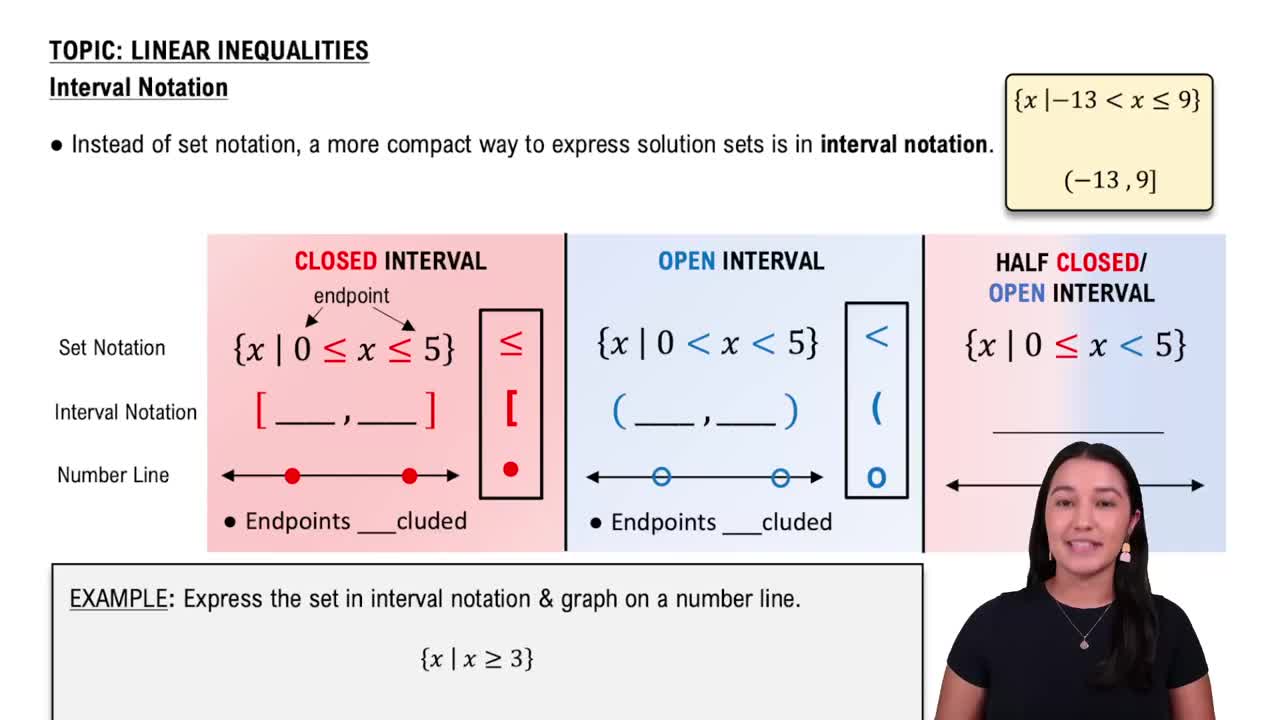
Interval Notation

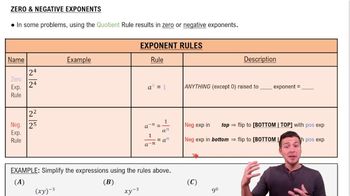
Negative Exponents

A negative exponent indicates the reciprocal of the base raised to the positive exponent. For instance, 10^−3 equals 1 divided by 10^3, or 1/1000, which helps convert numbers from scientific notation to decimal form.
추천 영상:
6:37
Zero and Negative Rules

Converting Scientific Notation to Decimal Notation

To convert a number from scientific notation to decimal notation, multiply the decimal part by 10 raised to the given exponent. For negative exponents, move the decimal point to the left accordingly, turning 3.14×10^−3 into 0.00314.
추천 영상:
05:18
Interval Notation