Ch. P - Fundamental Concepts of Algebra
Blitzer - College Algebra 8th Edition
Blitzer8th EditionCollege AlgebraISBN: 9780136970514당신이 사용하는 게 아니라요?교과서 변경
1장, 문제 45

Rationalize the denominator.
17\(\frac{1}{\sqrt7}\)

검증된 단계별 안내
1
Identify the expression to rationalize: \(\frac{1}{\sqrt7}\), where the denominator contains a square root.
To rationalize the denominator, multiply both the numerator and the denominator by \(\sqrt7\) to eliminate the square root in the denominator.
Write the multiplication as: \(\frac{1}{\sqrt7} \times \frac{\sqrt7}{\sqrt7}\).
Multiply the numerators together and the denominators together: numerator becomes \(1 \times \sqrt7 = \sqrt7\), denominator becomes \(\sqrt7 \times \sqrt7 = 7\).
Rewrite the expression with the rationalized denominator as \(\frac{\sqrt7}{7}\).

비슷한 문제에 대한 검증된 영상 답변:

이 영상 해법은 위 문제에 도움이 된다고 튜터들이 추천한 것입니다.
영상 길이:
2m
도움이 되었나요?

주요 개념

질문에 올바르게 답하기 위해 반드시 이해해야 하는 핵심 개념들은 다음과 같습니다.

Rationalizing the Denominator

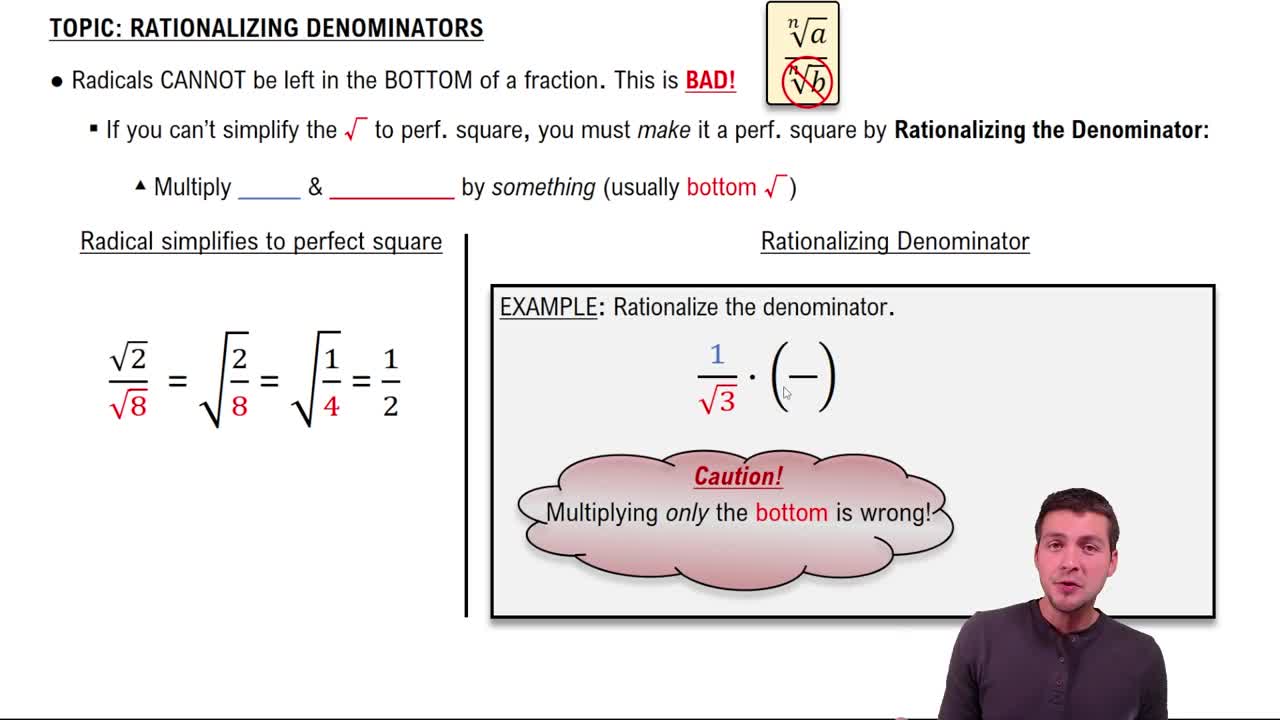
Rationalizing the denominator involves eliminating any irrational numbers, such as square roots, from the denominator of a fraction. This is done by multiplying the numerator and denominator by a suitable expression that removes the radical, making the expression easier to interpret and use in further calculations.
추천 영상:
02:58
Rationalizing Denominators

Properties of Square Roots

Square roots represent a number which, when multiplied by itself, gives the original number. Understanding that √a × √a = a is essential for rationalizing denominators, as multiplying by the square root in the denominator can simplify the expression by removing the radical.
추천 영상:
02:20
Imaginary Roots with the Square Root Property

Multiplying Fractions by 1

Multiplying a fraction by a form of 1, such as √7/√7, does not change its value but can change its form. This technique is used to rationalize denominators by creating an equivalent fraction with a rational denominator, facilitating easier manipulation and simplification.
추천 영상:
04:15
Multiply Polynomials Using the Distributive Property