Ch. 1 - Equations and Inequalities
Lial - College Algebra 13th Edition
Lial13th EditionCollege AlgebraISBN: 9780136881063당신이 사용하는 게 아니라요?교과서 변경
2장, 문제 43

Solve each equation or inequality. |4x + 3| - 2 = -1

검증된 단계별 안내
1
Start by isolating the absolute value expression on one side of the equation. Add 2 to both sides to get: \(|4x + 3| = -1 + 2\).
Simplify the right side of the equation to find the value that the absolute value expression equals.
Recall that the absolute value of any real number is always greater than or equal to zero. Therefore, check if the equation \(|4x + 3| = \text{(value from step 2)}\) is possible given the properties of absolute value.
If the value from step 2 is negative, conclude that there is no solution because an absolute value cannot be negative.
If the value from step 2 is zero or positive, set up two separate equations to solve for \(x\): \(4x + 3 = \text{value}\) and \(4x + 3 = -\text{value}\), then solve each for \(x\).

비슷한 문제에 대한 검증된 영상 답변:

이 영상 해법은 위 문제에 도움이 된다고 튜터들이 추천한 것입니다.
영상 길이:
3m
도움이 되었나요?

주요 개념

질문에 올바르게 답하기 위해 반드시 이해해야 하는 핵심 개념들은 다음과 같습니다.

Absolute Value Definition

The absolute value of a number represents its distance from zero on the number line, always yielding a non-negative result. For an expression |A| = B, B must be non-negative, and the equation splits into two cases: A = B or A = -B.
추천 영상:
08:07
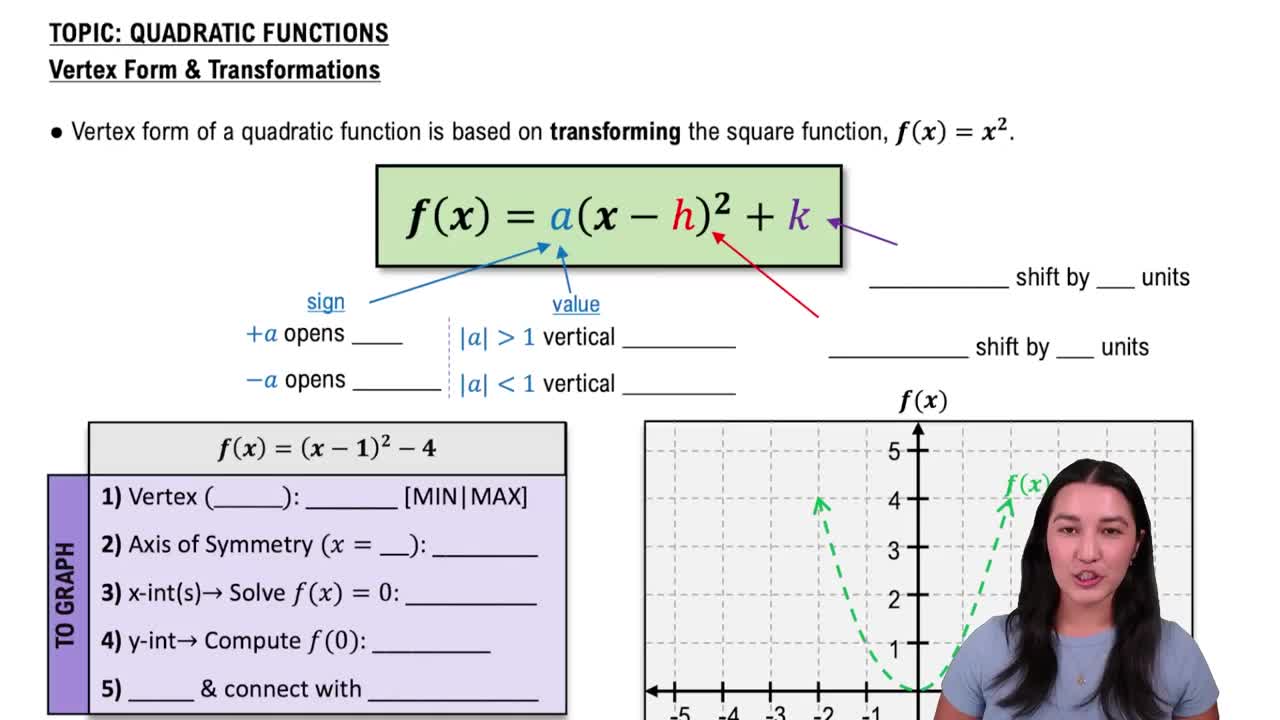
Vertex Form

Solving Absolute Value Equations

To solve equations involving absolute values, isolate the absolute value expression first. Then, set up two separate equations based on the definition: one where the inside equals the positive value, and one where it equals the negative value, solving each for the variable.
추천 영상:
5:02
Solving Logarithmic Equations

Checking for Extraneous Solutions

After solving, substitute solutions back into the original equation to verify validity. Some solutions may not satisfy the original equation, especially when dealing with absolute values and negative results, so this step ensures only true solutions are accepted.
추천 영상:
05:21
Restrictions on Rational Equations
관련 실천
교과서 질문

Solve each problem. See Examples 5 and 6. Formaldehyde is an indoor air pollutant formerly found in plywood, foam insulation, and carpeting. When concentrations in the air reach 33 micrograms per cubic foot (μg/ft3), eye irritation can occur. One square foot of new plywood could emit 140 μg per hr. (Data from A. Hines, Indoor Air Quality & Control.) A room has 100 ft2 of new plywood flooring. Find a linear equation F that computes the amount of formaldehyde, in micrograms, emitted in x hours.

636
views
교과서 질문

Solve each problem. See Examples 5 and 6. Formaldehyde is an indoor air pollutant formerly found in plywood, foam insulation, and carpeting. When concentrations in the air reach 33 micrograms per cubic foot (μg/ft^3), eye irritation can occur. One square foot of new plywood could emit 140 μg per hr. (Data from A. Hines, Indoor Air Quality & Control.) The room contains 800 ft^3 of air and has no ventilation. Determine how long it would take for concentrations to reach 33 μg/ft^3. (Round to the nearest tenth.)

630
views
교과서 질문

Solve each quadratic inequality. Give the solution set in interval notation. 2x2-9x≤18

597
views
교과서 질문

Height of a Projectile A projectile is launched from ground level with an initial velocity of v0 feet per second. Neglecting air resistance, its height in feet t seconds after launch is given by s=-16t2+v0t. In each exercise, find the time(s) that the projectile will (a) reach a height of 80 ft and (b) return to the ground for the given value of v0. Round answers to the nearest hundredth if necessary. v0=96

1070
views
교과서 질문

Write each number in standard form a+bi. 10+ √-200 / 5

841
views
교과서 질문

Solve each equation. (2x+1)(x-4) = x

917
views