Solve each formula for the specified variable. Assume that the denominator is not 0 if variables appear in the denominator. F = GMm/r², for m (force of gravity)
Ch. 1 - Equations and Inequalities

2장, 문제 43a
Solve each problem. See Examples 5 and 6. Formaldehyde is an indoor air pollutant formerly found in plywood, foam insulation, and carpeting. When concentrations in the air reach 33 micrograms per cubic foot (μg/ft3), eye irritation can occur. One square foot of new plywood could emit 140 μg per hr. (Data from A. Hines, Indoor Air Quality & Control.) A room has 100 ft2 of new plywood flooring. Find a linear equation F that computes the amount of formaldehyde, in micrograms, emitted in x hours.
검증된 단계별 안내1
Identify the given information: each square foot of plywood emits 140 micrograms of formaldehyde per hour, and the room has 100 square feet of plywood.
Calculate the total emission rate per hour by multiplying the emission rate per square foot by the total square footage: \(140 \times 100\) micrograms per hour.
Define the variable \(x\) as the number of hours.
Write the linear equation \(F(x)\) to represent the total amount of formaldehyde emitted after \(x\) hours by multiplying the total emission rate per hour by \(x\): \(F(x) = (140 \times 100) \times x\).
Simplify the equation if desired to express \(F(x)\) in terms of \(x\).

비슷한 문제에 대한 검증된 영상 답변:
이 영상 해법은 위 문제에 도움이 된다고 튜터들이 추천한 것입니다.
영상 길이:
2m도움이 되었나요?
주요 개념
질문에 올바르게 답하기 위해 반드시 이해해야 하는 핵심 개념들은 다음과 같습니다.
Linear Equations
A linear equation represents a relationship between two variables with a constant rate of change, typically in the form y = mx + b. In this problem, the amount of formaldehyde emitted changes linearly over time, so the equation will model total emission as a function of hours.
추천 영상:
Categorizing Linear Equations
Rate of Change (Slope)
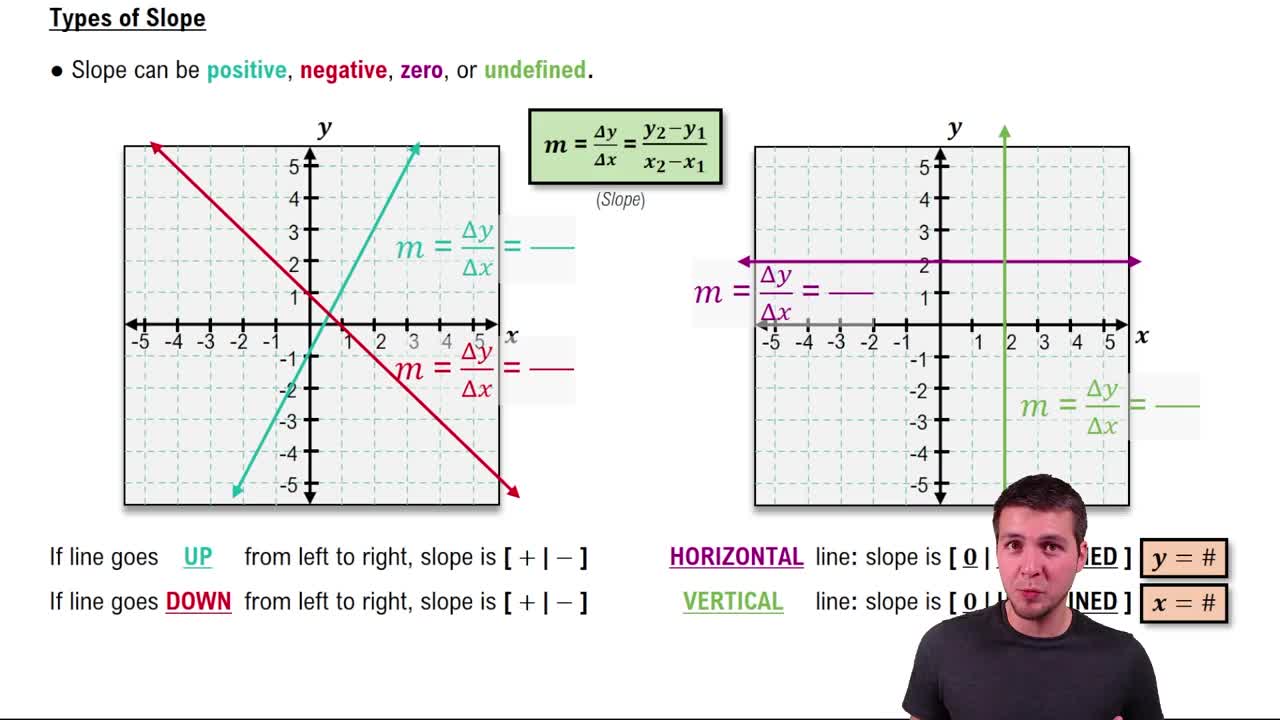
The rate of change indicates how one quantity changes relative to another. Here, the emission rate per square foot per hour (140 μg/hr) is the slope, which must be multiplied by the total area and time to find total emissions.
추천 영상:
가이드 코스
Types of Slope
Units and Dimensional Analysis
Understanding and correctly using units ensures the equation makes sense physically. Emission rate is given in micrograms per hour per square foot, so multiplying by area (square feet) and time (hours) yields total micrograms emitted.
추천 영상:
Square Roots of Negative Numbers
관련 실천
교과서 질문
988
views
교과서 질문
Solve each problem. See Examples 5 and 6. Formaldehyde is an indoor air pollutant formerly found in plywood, foam insulation, and carpeting. When concentrations in the air reach 33 micrograms per cubic foot (μg/ft^3), eye irritation can occur. One square foot of new plywood could emit 140 μg per hr. (Data from A. Hines, Indoor Air Quality & Control.) The room contains 800 ft^3 of air and has no ventilation. Determine how long it would take for concentrations to reach 33 μg/ft^3. (Round to the nearest tenth.)
630
views
교과서 질문
Solve each quadratic inequality. Give the solution set in interval notation. 2x2-9x≤18
597
views
교과서 질문
Solve each equation or inequality. |4x + 3| - 2 = -1
726
views
교과서 질문
Write each number in standard form a+bi. 10+ √-200 / 5
841
views
교과서 질문
Solve each equation. (2x+1)(x-4) = x
917
views