Ch. 2 - Graphs and Functions
Lial - College Algebra 13th Edition
Lial13th EditionCollege AlgebraISBN: 9780136881063당신이 사용하는 게 아니라요?교과서 변경
3장, 문제 23d

For the pair of functions defined, find (f/g)(x).Give the domain of each. See Example 2.
ƒ(x)=√(4x-1), g(x)=1/x

검증된 단계별 안내
1
First, find the expression for the quotient of the two functions, which is given by \(\left(\frac{f}{g}\right)(x) = \frac{f(x)}{g(x)}\). Substitute the given functions to get \(\left(\frac{f}{g}\right)(x) = \frac{\sqrt{4x - 1}}{\frac{1}{x}}\).
Simplify the expression by dividing by a fraction, which is equivalent to multiplying by its reciprocal. So, \(\left(\frac{f}{g}\right)(x) = \sqrt{4x - 1} \times x\).
Next, determine the domain of \(f(x) = \sqrt{4x - 1}\). Since the expression inside the square root must be non-negative, set up the inequality \(4x - 1 \geq 0\) and solve for \(x\).
Determine the domain of \(g(x) = \frac{1}{x}\). Since division by zero is undefined, exclude \(x = 0\) from the domain.
Finally, find the domain of \(\left(\frac{f}{g}\right)(x)\) by combining the restrictions from both \(f(x)\) and \(g(x)\). This means the domain includes all \(x\) values that satisfy \(4x - 1 \geq 0\) and \(x \neq 0\).

비슷한 문제에 대한 검증된 영상 답변:

이 영상 해법은 위 문제에 도움이 된다고 튜터들이 추천한 것입니다.
영상 길이:
3m
도움이 되었나요?

주요 개념

질문에 올바르게 답하기 위해 반드시 이해해야 하는 핵심 개념들은 다음과 같습니다.

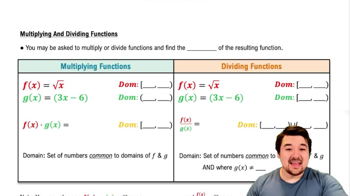
Function Division (f/g)(x)

Dividing two functions f and g means creating a new function (f/g)(x) = f(x) / g(x). This requires evaluating both functions at the same input x and then dividing the results, provided g(x) ≠ 0 to avoid division by zero.
추천 영상:
7:24
Multiplying & Dividing Functions

Domain of a Function

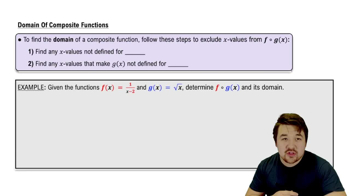
The domain of a function is the set of all input values x for which the function is defined. For composite functions like (f/g)(x), the domain is the intersection of the domains of f and g, excluding values that make the denominator zero or cause undefined expressions.
추천 영상:
3:51
Domain Restrictions of Composed Functions

Square Root Function Domain Restrictions

For a function involving a square root, such as f(x) = √(4x - 1), the expression inside the root must be non-negative (≥ 0) to produce real outputs. This restriction limits the domain to values of x satisfying 4x - 1 ≥ 0.
추천 영상:
3:51
Domain Restrictions of Composed Functions