Ch. 2 - Graphs and Functions
Lial - College Algebra 13th Edition
Lial13th EditionCollege AlgebraISBN: 9780136881063당신이 사용하는 게 아니라요?교과서 변경
3장, 문제 23b

For the pair of functions defined, find (ƒ-g)(x).Give the domain of each. See Example 2.
ƒ(x)=√(4x-1), g(x)=1/x

검증된 단계별 안내
1
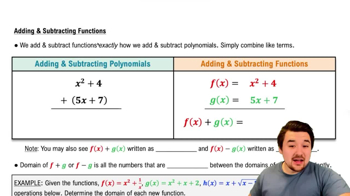
First, understand that (ƒ - g)(x) means you subtract the function g(x) from ƒ(x). So, write the expression as (ƒ - g)(x) = ƒ(x) - g(x).
Substitute the given functions into the expression: (ƒ - g)(x) = \(\sqrt{4x - 1}\) - \(\frac{1}{x}\).
Next, find the domain of each function separately. For ƒ(x) = \(\sqrt{4x - 1}\), the expression inside the square root must be greater than or equal to zero, so set up the inequality 4x - 1 \(\geq\) 0 and solve for x.
For g(x) = \(\frac{1}{x}\), the denominator cannot be zero, so x \(\neq\) 0. This restriction must be considered when determining the domain of (ƒ - g)(x).
Finally, combine the domain restrictions from both functions to find the domain of (ƒ - g)(x). This means taking the intersection of the domain of ƒ(x) and the domain of g(x), excluding any values that make either function undefined.

비슷한 문제에 대한 검증된 영상 답변:

이 영상 해법은 위 문제에 도움이 된다고 튜터들이 추천한 것입니다.
영상 길이:
4m
도움이 되었나요?

주요 개념

질문에 올바르게 답하기 위해 반드시 이해해야 하는 핵심 개념들은 다음과 같습니다.

Function Operations (Addition and Subtraction)

Function operations involve combining two functions using addition, subtraction, multiplication, or division. For (ƒ - g)(x), subtract the output of g(x) from ƒ(x) for each x in the domain. This creates a new function whose value depends on both original functions.
추천 영상:
5:56
Adding & Subtracting Functions

Domain of a Function

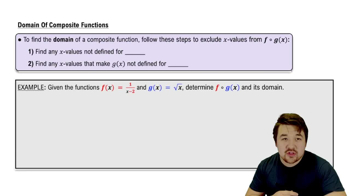
The domain is the set of all input values (x) for which a function is defined. When combining functions, the domain of the resulting function is the intersection of the individual domains, considering restrictions like square roots requiring non-negative radicands and denominators not equal to zero.
추천 영상:
3:51
Domain Restrictions of Composed Functions

Square Root and Rational Function Restrictions

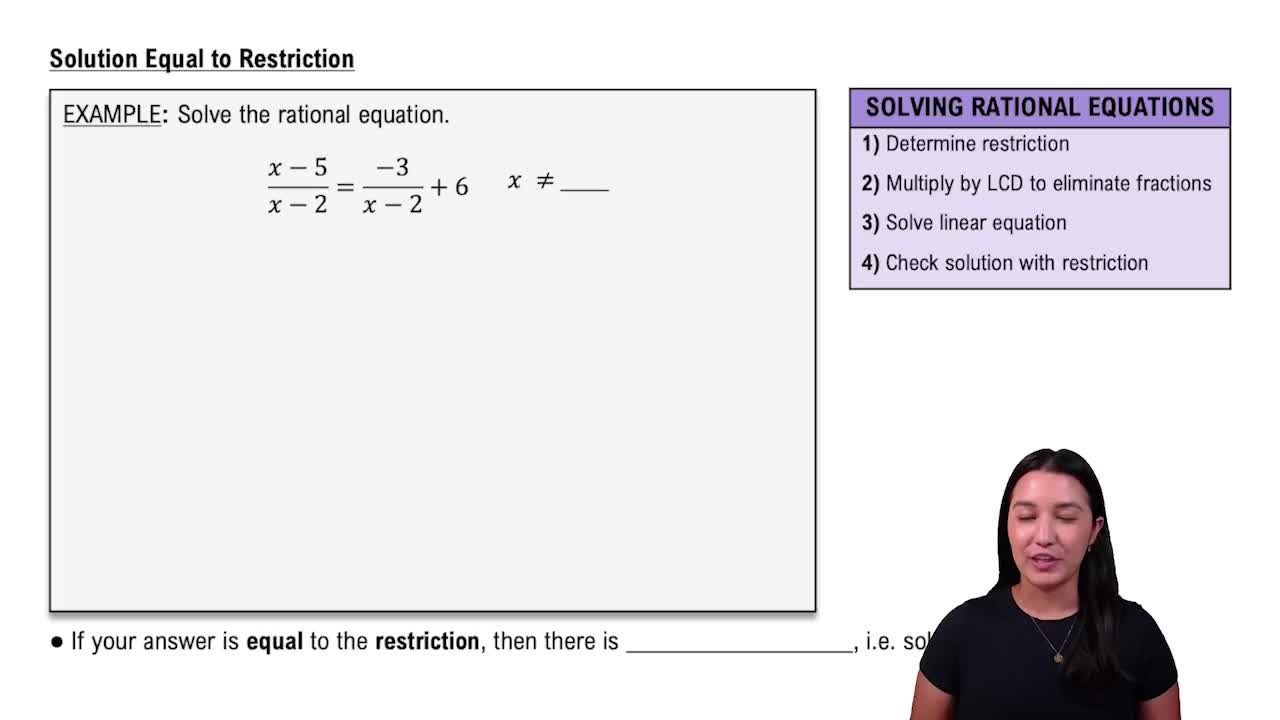
For ƒ(x) = √(4x - 1), the expression inside the square root must be ≥ 0, so 4x - 1 ≥ 0. For g(x) = 1/x, x cannot be zero because division by zero is undefined. These restrictions determine the valid input values for each function.
추천 영상:
05:21
Restrictions on Rational Equations