Ch. 2 - Graphs and Functions
Lial - College Algebra 13th Edition
Lial13th EditionCollege AlgebraISBN: 9780136881063당신이 사용하는 게 아니라요?교과서 변경
3장, 문제 34b

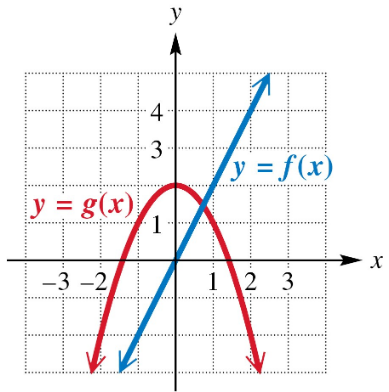
Use the graph to evaluate each expression. See Example 3(a).
(ƒ-g)(-1)

검증된 단계별 안내
1
Understand that (ƒ - g)(-1) means you need to find the value of ƒ(-1) and g(-1) from the graph, then subtract g(-1) from ƒ(-1).
Locate the point where x = -1 on the x-axis and find the corresponding y-value on the red curve (ƒ(x)) to determine ƒ(-1).
Next, locate the point where x = -1 on the x-axis and find the corresponding y-value on the blue line (g(x)) to determine g(-1).
Write the expression for the difference: (ƒ - g)(-1) = ƒ(-1) - g(-1).
Substitute the values you found for ƒ(-1) and g(-1) into the expression and simplify to find the result.

비슷한 문제에 대한 검증된 영상 답변:

이 영상 해법은 위 문제에 도움이 된다고 튜터들이 추천한 것입니다.
영상 길이:
3m
도움이 되었나요?

주요 개념

질문에 올바르게 답하기 위해 반드시 이해해야 하는 핵심 개념들은 다음과 같습니다.

Function Notation and Evaluation

Function notation, such as f(x) and g(x), represents the output of a function for a given input x. To evaluate a function at a specific value, substitute the input into the function and find the corresponding output on the graph or from the equation.
추천 영상:
4:26
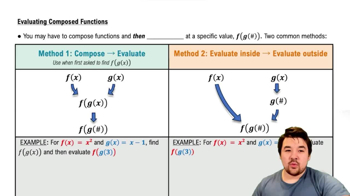
Evaluating Composed Functions

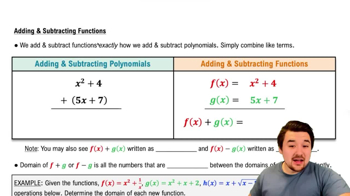
Operations on Functions (Addition and Subtraction)

Operations like (f - g)(x) involve subtracting the output of g(x) from f(x) for the same input x. This means evaluating both functions at x and then subtracting their values to find the result.
추천 영상:
5:56
Adding & Subtracting Functions

Reading Values from a Graph

To evaluate functions from a graph, locate the input value on the x-axis, then find the corresponding y-values for each function by tracing vertically to the graph lines. These y-values represent the function outputs needed for calculations.
추천 영상:
가이드 코스
05:10
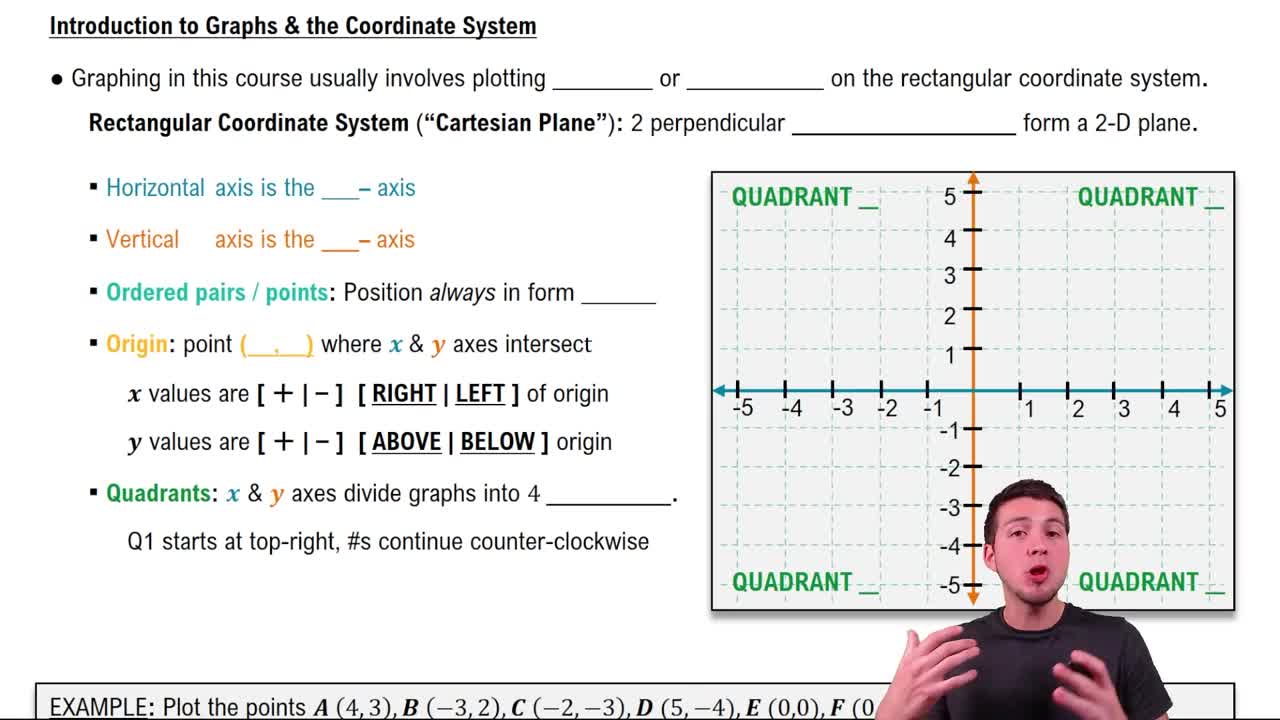
Graphs & the Rectangular Coordinate System