Use a graphing calculator to find the coordinates of the turning points of the graph of each polynomial function in the given domain interval. Give answers to the nearest hundredth. ƒ(x)=x4-7x3+13x2+6x-28; [-1, 0]
Ch. 3 - Polynomial and Rational Functions

4장, 문제 87
Determine the different possibilities for the numbers of positive, negative, and nonreal complex zeros of each function.
검증된 단계별 안내1
Identify the degree of the polynomial function. Here, the degree is 5, so there are 5 zeros in total (counting multiplicities and including complex zeros).
Use Descartes' Rule of Signs to determine the possible number of positive real zeros by counting the sign changes in ƒ(x) = x^5 + 3x^4 - x^3 + 2x + 3. Each sign change indicates a possible positive zero or fewer by an even number.
Apply Descartes' Rule of Signs to ƒ(-x) to find the possible number of negative real zeros. Substitute -x into the polynomial and count the sign changes in the resulting expression.
Determine the possible number of nonreal complex zeros by subtracting the possible number of positive and negative real zeros from the total degree (5). Remember that complex zeros come in conjugate pairs, so the number of nonreal zeros must be even.
List all combinations of positive, negative, and nonreal zeros that satisfy the above conditions, ensuring the total number of zeros sums to 5.

비슷한 문제에 대한 검증된 영상 답변:
이 영상 해법은 위 문제에 도움이 된다고 튜터들이 추천한 것입니다.
영상 길이:
6m도움이 되었나요?
주요 개념
질문에 올바르게 답하기 위해 반드시 이해해야 하는 핵심 개념들은 다음과 같습니다.
Fundamental Theorem of Algebra
This theorem states that a polynomial of degree n has exactly n roots in the complex number system, counting multiplicities. For the given fifth-degree polynomial, there are five zeros total, which can be real or nonreal complex numbers.
추천 영상:
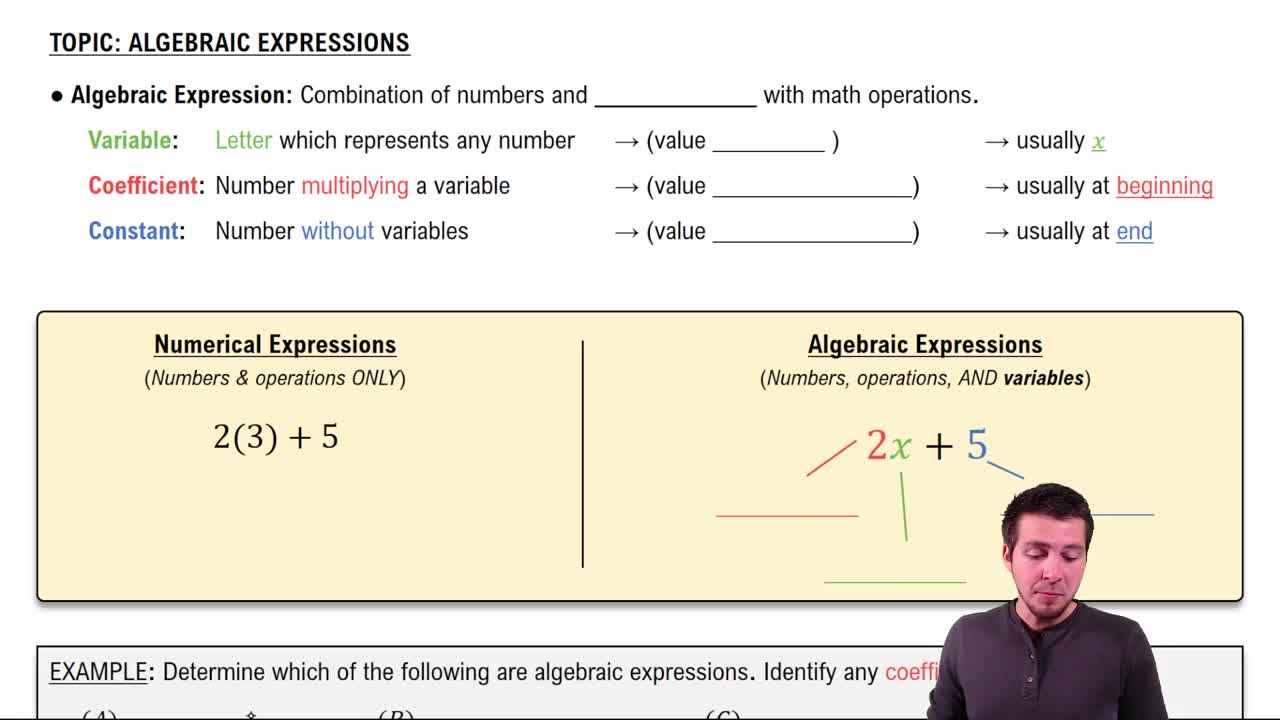
Introduction to Algebraic Expressions
Descartes' Rule of Signs
Descartes' Rule of Signs helps determine the possible number of positive and negative real zeros of a polynomial by counting sign changes in f(x) and f(-x). It provides the maximum number of positive and negative roots and their possible variations.
추천 영상:
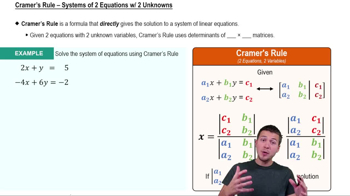
Cramer's Rule - 2 Equations with 2 Unknowns
Complex Conjugate Root Theorem
This theorem states that nonreal complex roots of polynomials with real coefficients occur in conjugate pairs. Therefore, the number of nonreal zeros must be even, which restricts the possible counts of nonreal roots for the polynomial.
추천 영상:
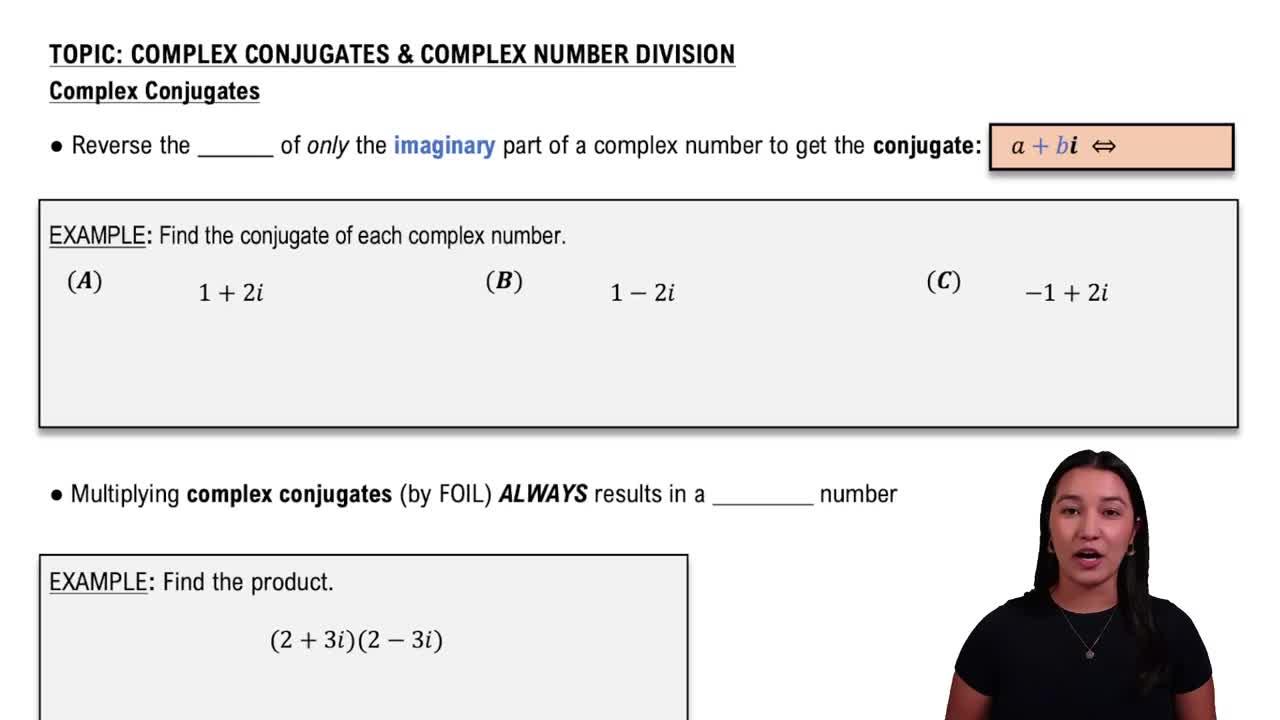
Complex Conjugates
관련 실천
교과서 질문
1884
views
교과서 질문
Graph each rational function. ƒ(x)=(18+6x-4x2)/(4+6x+2x2)
427
views
교과서 질문
Determine the different possibilities for the numbers of positive, negative, and nonreal complex zeros of each function.
521
views
교과서 질문
Determine the different possibilities for the numbers of positive, negative, and nonreal complex zeros of each function.
457
views
교과서 질문
A quadratic equation ƒ(x) = 0 has a solution x = 2. Its graph has vertex (5, 3). What is the other solution of the equation?
888
views
교과서 질문
Use a graphing calculator to find the coordinates of the turning points of the graph of each polynomial function in the given domain interval. Give answers to the nearest hundredth. ƒ(x)=x3+4x2-8x-8; [-3.8, -3]
1572
views