Ch. 3 - Polynomial and Rational Functions
Lial - College Algebra 13th Edition
Lial13th EditionCollege AlgebraISBN: 9780136881063당신이 사용하는 게 아니라요?교과서 변경
4장, 문제 53

Find a polynomial function ƒ(x) of degree 3 with real coefficients that satisfies the given conditions. Zeros of -3, 1, and 4; ƒ(2)=30

검증된 단계별 안내
1
Identify the general form of a cubic polynomial with the given zeros. Since the zeros are -3, 1, and 4, the polynomial can be written as \(f(x) = a(x + 3)(x - 1)(x - 4)\), where \(a\) is a real number coefficient to be determined.
Expand the factors partially or fully if needed to understand the polynomial structure, but keep the factorized form for now to make substitution easier.
Use the given condition \(f(2) = 30\) to find the value of \(a\). Substitute \(x = 2\) into the polynomial: \(f(2) = a(2 + 3)(2 - 1)(2 - 4)\).
Calculate the product inside the parentheses: \((2 + 3) = 5\), \((2 - 1) = 1\), and \((2 - 4) = -2\). So, \(f(2) = a imes 5 imes 1 imes (-2) = -10a\).
Set the expression equal to 30 and solve for \(a\): \(-10a = 30\). Once \(a\) is found, write the final polynomial function \(f(x) = a(x + 3)(x - 1)(x - 4)\).

비슷한 문제에 대한 검증된 영상 답변:

이 영상 해법은 위 문제에 도움이 된다고 튜터들이 추천한 것입니다.
영상 길이:
8m
도움이 되었나요?

주요 개념

질문에 올바르게 답하기 위해 반드시 이해해야 하는 핵심 개념들은 다음과 같습니다.

Polynomial Functions and Degree

A polynomial function is an expression involving variables raised to whole-number exponents with real coefficients. The degree of the polynomial is the highest exponent of the variable, which determines the general shape and number of roots. For a degree 3 polynomial, the function will have up to three roots and can be written in the form ƒ(x) = a(x - r1)(x - r2)(x - r3).
추천 영상:
06:04
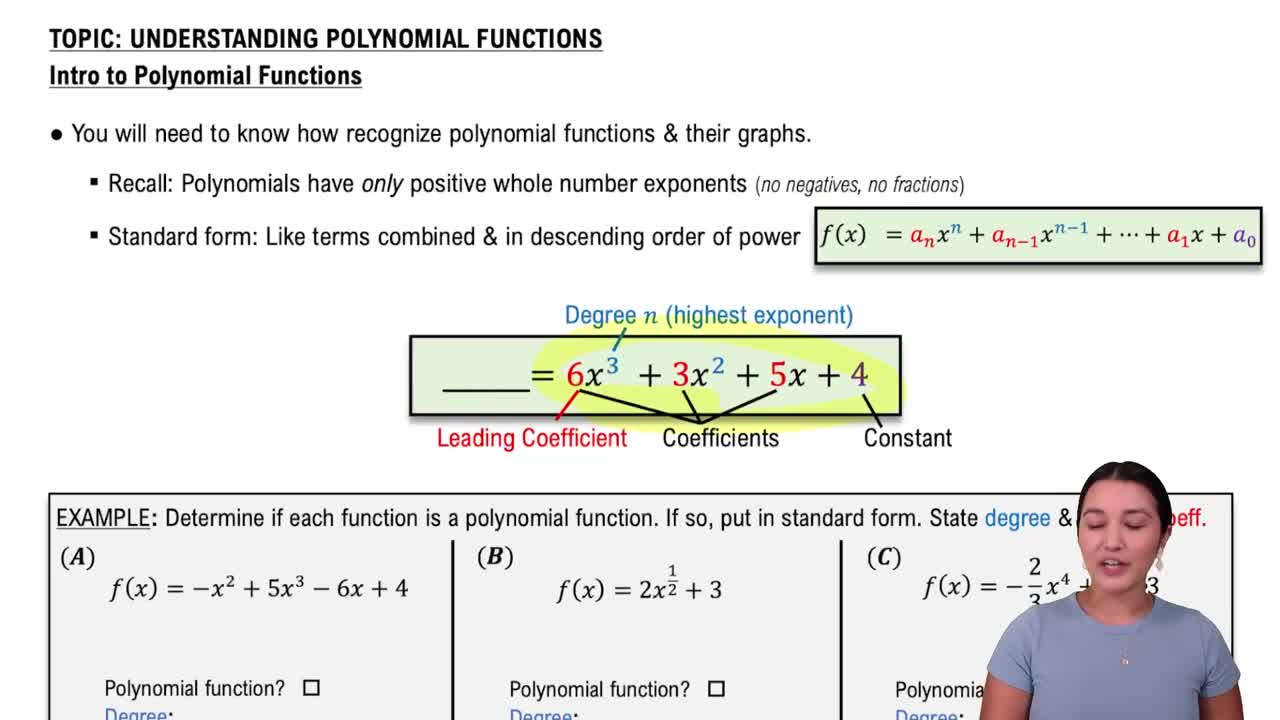
Introduction to Polynomial Functions

Zeros (Roots) of a Polynomial

Zeros of a polynomial are the values of x for which the function equals zero. They correspond to the x-intercepts of the graph. Given zeros allow us to express the polynomial as a product of factors (x - zero). For example, zeros at -3, 1, and 4 imply factors (x + 3), (x - 1), and (x - 4).
추천 영상:
02:20
Imaginary Roots with the Square Root Property

Using a Point to Find the Leading Coefficient

When the zeros are known, the polynomial can be written up to a constant multiplier a. To find a, substitute a given point (x, ƒ(x)) into the polynomial and solve for a. This ensures the polynomial passes through the specified point, such as ƒ(2) = 30, which helps determine the exact function.
추천 영상:
가이드 코스
04:27
Finding Equations of Lines Given Two Points