Ch. 3 - Polynomial and Rational Functions
Lial - College Algebra 13th Edition
Lial13th EditionCollege AlgebraISBN: 9780136881063당신이 사용하는 게 아니라요?교과서 변경
4장, 문제 53

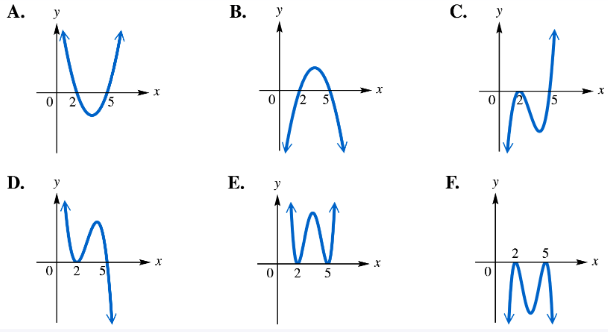
For each polynomial function, identify its graph from choices A–F. ƒ(x)=(x-2)2(x-5)
Six graphs labeled A to F show different polynomial curves with x-intercepts at 2 and 5, illustrating various shapes and turning points.

검증된 단계별 안내
1
Start by identifying the degree of the polynomial function ƒ(x) = (x-2)^2(x-5). Since (x-2)^2 is squared, it contributes degree 2, and (x-5) contributes degree 1, so the total degree is 2 + 1 = 3.
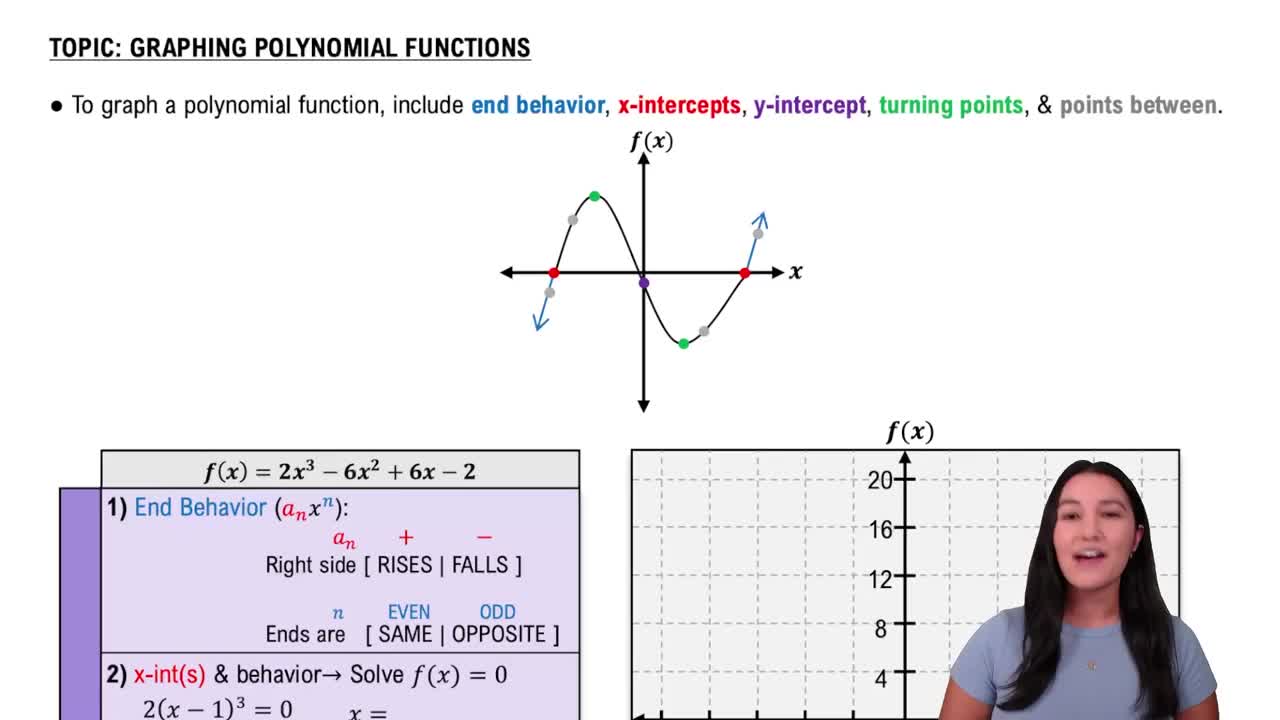
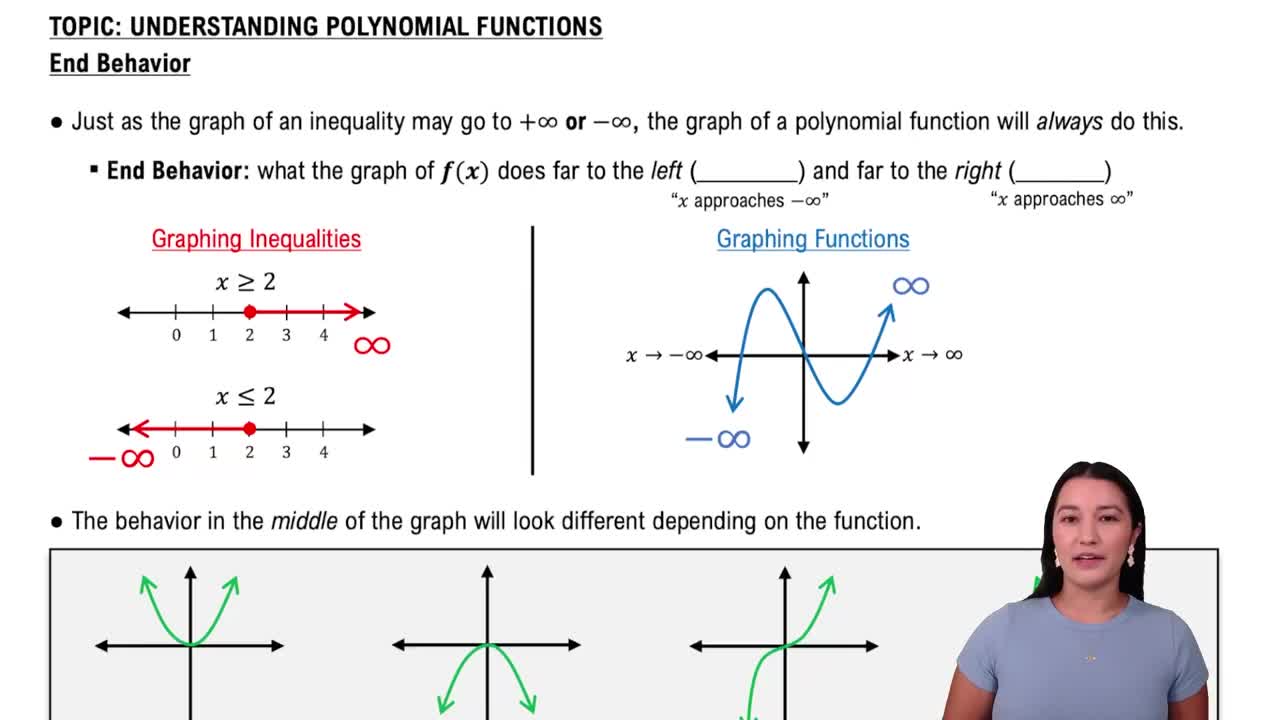
Determine the leading term by multiplying the highest degree terms from each factor: (x)^2 * (x) = x^3. This tells us the polynomial is cubic with a positive leading coefficient, so the end behavior will be: as x → ∞, ƒ(x) → ∞ and as x → -∞, ƒ(x) → -∞.
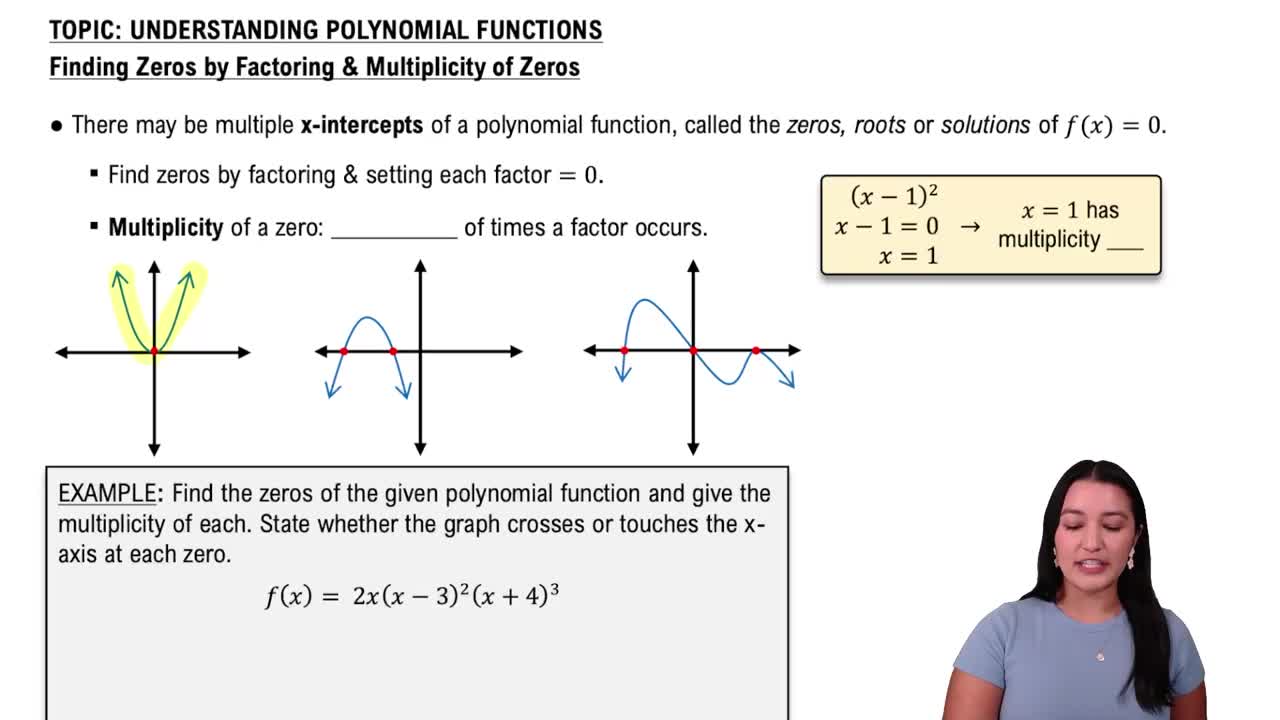
Identify the zeros of the function from the factors: x = 2 (with multiplicity 2) and x = 5 (with multiplicity 1). The multiplicity affects the graph's behavior at these points.
Analyze the behavior at each zero: at x = 2, since the multiplicity is even (2), the graph will touch the x-axis and turn around (bounce off) at this point; at x = 5, with multiplicity 1 (odd), the graph will cross the x-axis.
Use this information to match the graph: look for a cubic graph that crosses the x-axis at 5, touches and bounces at 2, and has the end behavior of going down to the left and up to the right.

비슷한 문제에 대한 검증된 영상 답변:

이 영상 해법은 위 문제에 도움이 된다고 튜터들이 추천한 것입니다.
영상 길이:
8m
도움이 되었나요?

주요 개념

질문에 올바르게 답하기 위해 반드시 이해해야 하는 핵심 개념들은 다음과 같습니다.

Polynomial Functions and Their Graphs

A polynomial function is an expression involving variables raised to whole-number exponents combined using addition, subtraction, and multiplication. Its graph is a smooth curve with no breaks, and the degree of the polynomial determines the general shape and number of turning points.
추천 영상:
05:25
Graphing Polynomial Functions

Zeros and Their Multiplicities

The zeros of a polynomial are the values of x that make the function equal to zero. The multiplicity of a zero indicates how many times that root is repeated, affecting the graph's behavior at that point: even multiplicities cause the graph to touch and turn around, while odd multiplicities cause it to cross the x-axis.
추천 영상:
03:42
Finding Zeros & Their Multiplicity

End Behavior of Polynomial Functions

End behavior describes how the graph behaves as x approaches positive or negative infinity. It depends on the leading term's degree and coefficient: for example, an odd-degree polynomial with a positive leading coefficient falls to the left and rises to the right, guiding the overall shape of the graph.
추천 영상:
06:08
End Behavior of Polynomial Functions