Ch. 3 - Polynomial and Rational Functions
Lial - College Algebra 13th Edition
Lial13th EditionCollege AlgebraISBN: 9780136881063당신이 사용하는 게 아니라요?교과서 변경
4장, 문제 50

For each polynomial function, find all zeros and their multiplicities. ƒ(x)=5x2(x2-16)(x+5)

검증된 단계별 안내
1
Start by writing the given polynomial function clearly: \(f(x) = 5x^2 (x^2 - 16)(x + 5)\).
Recognize that the polynomial is factored into three parts: \$5x^2\(, \)(x^2 - 16)\(, and \)(x + 5)$. Each factor can give zeros when set equal to zero.
Find the zeros from each factor: For \$5x^2\(, set \)x^2 = 0\( which gives \)x = 0\(. For \)(x^2 - 16)\(, recognize it as a difference of squares and factor it further into \)(x - 4)(x + 4)\(, giving zeros \)x = 4\( and \)x = -4\(. For \)(x + 5)\(, set \)x + 5 = 0\( which gives \)x = -5$.
Determine the multiplicity of each zero by looking at the exponents of the factors: \(x = 0\) comes from \(x^2\) so its multiplicity is 2; \(x = 4\) and \(x = -4\) come from linear factors each with multiplicity 1; \(x = -5\) also comes from a linear factor with multiplicity 1.
Summarize the zeros and their multiplicities: \(x = 0\) (multiplicity 2), \(x = 4\) (multiplicity 1), \(x = -4\) (multiplicity 1), and \(x = -5\) (multiplicity 1).

비슷한 문제에 대한 검증된 영상 답변:

이 영상 해법은 위 문제에 도움이 된다고 튜터들이 추천한 것입니다.
영상 길이:
4m
도움이 되었나요?

주요 개념

질문에 올바르게 답하기 위해 반드시 이해해야 하는 핵심 개념들은 다음과 같습니다.

Polynomial Zeros

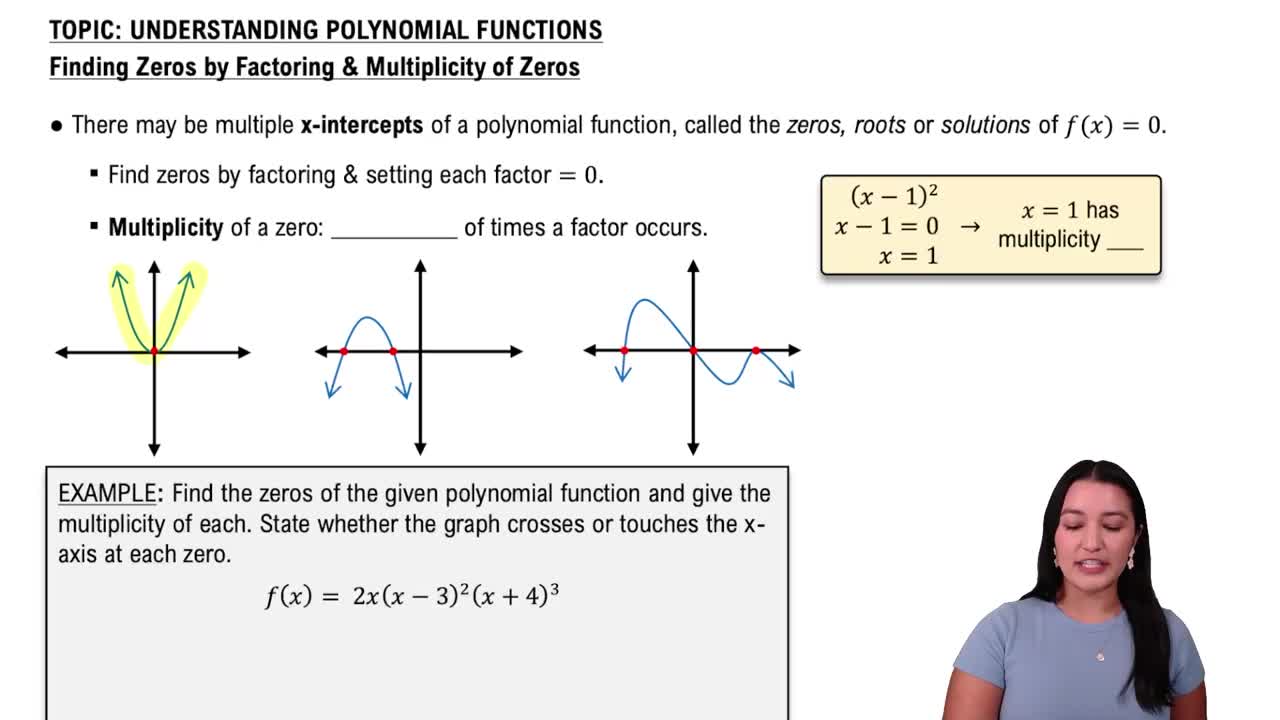
Zeros of a polynomial are the values of x that make the function equal to zero. Finding zeros involves setting the polynomial equal to zero and solving for x. These values correspond to the x-intercepts of the graph.
추천 영상:
03:42
Finding Zeros & Their Multiplicity

Factoring Polynomials

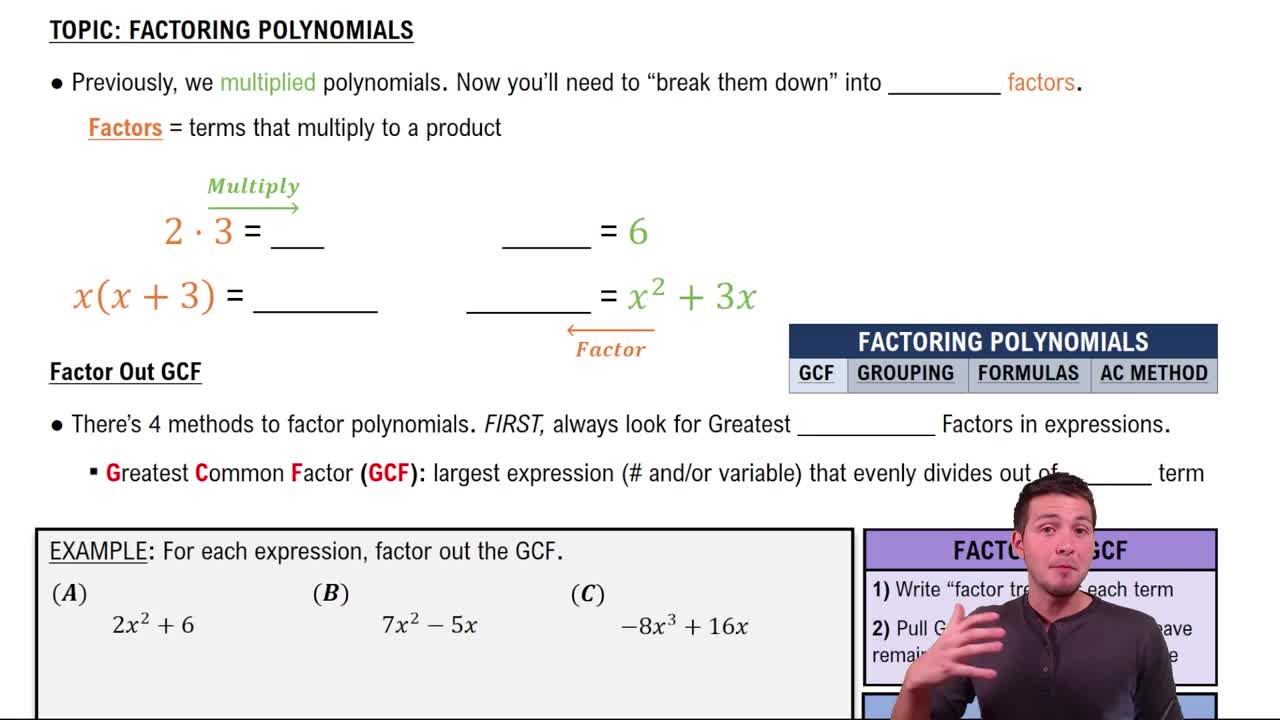
Factoring breaks down a polynomial into simpler expressions multiplied together. This process helps identify zeros by setting each factor equal to zero. Recognizing special products like difference of squares is useful in factoring.
추천 영상:
07:30
Introduction to Factoring Polynomials

Multiplicity of Zeros

Multiplicity refers to how many times a particular zero appears as a root of the polynomial. It is determined by the exponent of the factor associated with that zero. Multiplicity affects the graph's behavior at the zero, such as touching or crossing the x-axis.
추천 영상:
03:42
Finding Zeros & Their Multiplicity
관련 실천
교과서 질문

For each polynomial function, find all zeros and their multiplicities. ƒ(x)=3x(x2)(x+3)(x21)ƒ(x)=3x(x-2)(x+3)(x^2-1)

519
views
교과서 질문

Work each problem. Choices A–D below show the four ways in which the graph of a rational function can approach the vertical line x=2 as an asymptote. Identify the graph of each rational function defined in parts (a) – (d). ƒ(x)=1/(x-2)^2

556
views
교과서 질문

Nuclear Bomb Detonation Suppose the effects of detonating a nuclear bomb will be felt over a distance from the point of detonation that is directly proportional to the cube root of the yield of the bomb. Suppose a 100-kiloton bomb has certain effects to a radius of 3 km from the point of detonation. Find, to the nearest tenth, the distance over which the effects would be felt for a 1500-kiloton bomb.

543
views
교과서 질문

Several graphs of the quadratic function ƒ(x) = ax2 + bx + c are shown below. For the given restrictions on a, b, and c, select the corresponding graph from choices A–F. (Hint: Use the discriminant.) A > 0; b2 - 4ac > 0

2616
views
교과서 질문

Use synthetic division to determine whether the given number k is a zero of the polynomial function. If it is not, give the value of ƒ(k). ƒ(x) = x3 - 3x2 + 4x -4; k=2

682
views
교과서 질문

Work each problem. Choices A–D below show the four ways in which the graph of a rational function can approach the vertical line x=2 as an asymptote. Identify the graph of each rational function defined in parts (a) – (d). ƒ(x)=1/(x2)ƒ(x)=1/(x-2)

563
views